










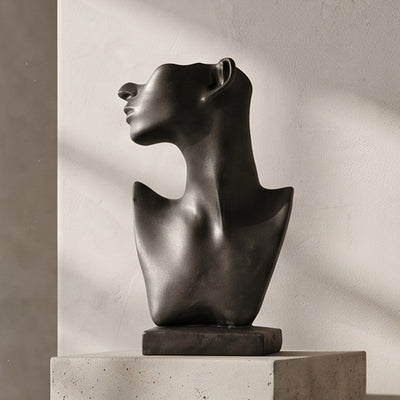

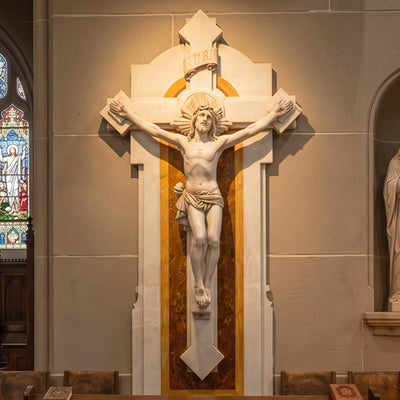
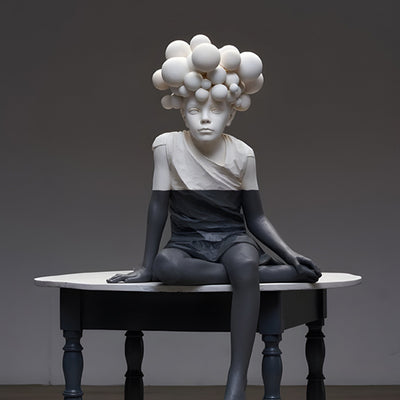

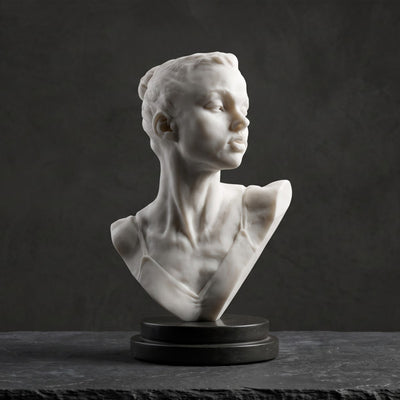






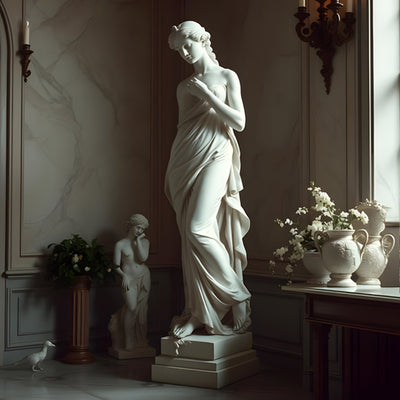



































Search for marble garden statues for sale and you will find three very different materials sold under one word, often at prices that sit uncomfortably close together. Only one of them was cut from a quarry block. The other two can look identical in a listing photo and very different after their third winter in a Hudson Valley garden.
Looking for the full range in this category? Browse our Marble Headstones collection for every available finish, size, and configuration.
We see the fallout every season, and the story is usually the same. A buyer sends us photos of a "Carrara" figure bought from a marketplace seller. The freight label shows well under 100 pounds for a statue close to five feet tall, and after one summer in full sun the face has taken on a faint yellow cast. They ask us to carve a replacement in real stone. Our first question is always why the original listing never stated a weight.

At a Glance
Carved marble is quarried stone shaped from a single block. It is heavy and cold to the touch, and its veining runs unevenly through the piece.
Cast marble is crushed marble bound with resin or cement and poured into a mold.
Resin with marble dust is mostly polymer with a stone-colored skin.
Weight per foot of height is the fastest honest test.
Ask about fixing points and delivery terms before you pay, not after the truck arrives.
Carved, Cast or Resin: Three Products Under One Word
Carved marble starts as a block, usually a white Carrara or the purer, more uniform Statuario, and a carver removes everything that is not the figure. The calcite crystals let light pass a short way into the surface before scattering back, which is why real marble looks warm rather than flat.
Carved figures waiting for their crates in our workshop. Unlike many marble garden statues for sale online, each one ships with a stated crated weight.
Cast marble (sometimes called bonded or cultured marble) is marble powder mixed with a binder and poured into a mold. Solid casts can be heavy and perfectly decent indoors. Outdoors, quality varies widely, and cement-bound casts can spall once water gets into the binder. Resin pieces are lighter still: a hollow shell, often backfilled with sand or foam, with marble dust in the outer coat to give it sparkle. Search filters for marble garden statues for sale lump all three together, so the burden of sorting them falls on you.

The Weight Test That Gives a Listing Away
Stone is dense and physics does not negotiate. ASTM C503, the US standard for marble dimension stone, sets a minimum density of about 162 pounds per cubic foot (2,595 kg/m³) for calcite marble. Even a slender carved figure, with air between the limbs, will weigh a couple of hundred pounds or more by the time it reaches 3 to 4 feet (90 to 120 cm).
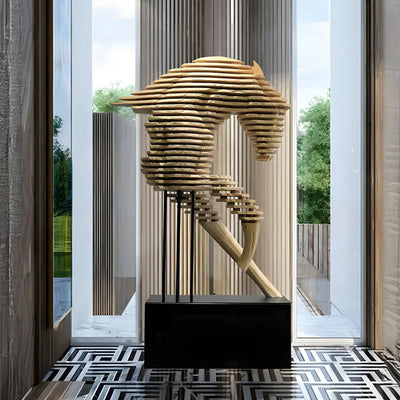
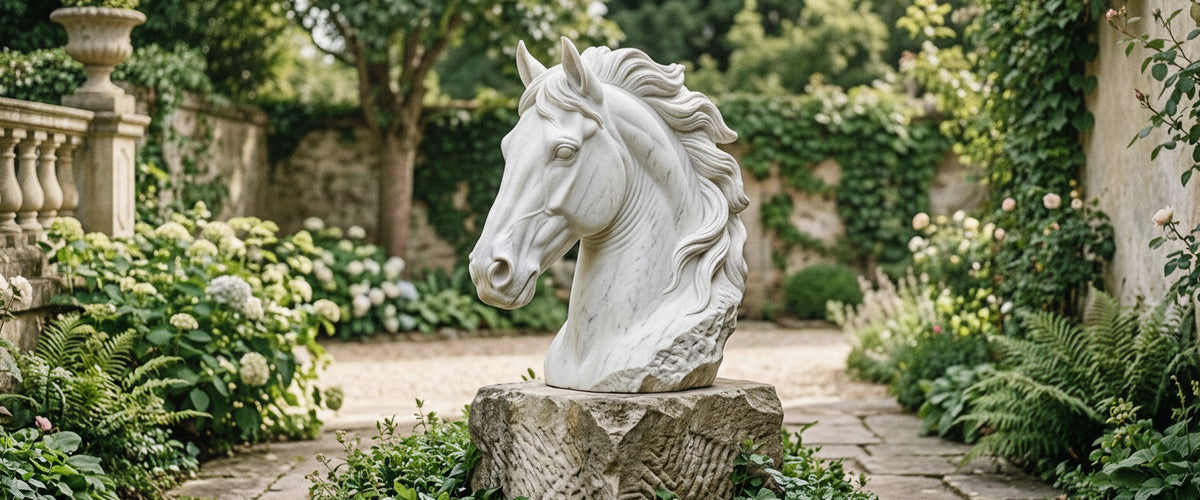
So when you compare marble garden statues for sale, read the spec sheet for weight first. If a listing for a 4-foot figure omits weight, or quotes a number you could carry up the porch steps alone, it is almost certainly resin. Solid cast marble sits in between. Even a terrace-scale accent is not a one-person job: a carved head-and-neck piece such as the Graceful Horse Head in white marble, at 60 cm (about 24 inches), still needs a planned lift, and an honest seller should quote crated weight before you ask.
Tool Marks, Mold Seams and Painted Veining
Good photos will tell you most of what you need. Ask for an unedited daylight shot of the underside of the base, and look for these tells:
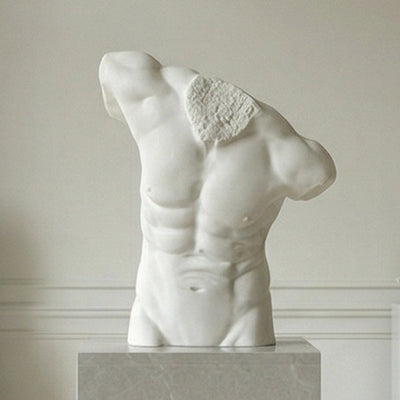
Tool marks. Carvers leave claw chisel and rasp texture under the plinth and deep inside folds where polishing tools cannot reach. Our carvers often leave a patch on purpose; it is the stone's signature.
Mold seams. A faint ridge running over the shoulders, down the sides of the head, or under the arms marks where two mold halves met.
Pinholes. Tiny round voids in recesses are trapped air from a pour. Stone has natural pits, but they are irregular.
Veining that behaves. Real veins pass through edges and continue across undercuts. Painted or printed veining sits on the surface, follows the contours too neatly, and repeats identically on "matching" pairs.
Left: the mold seam on a cast figure's shoulder. Right: claw chisel texture under a carved base.

Why the Price Gap Is Smaller Than It Should Be, and Larger
Smaller, because many resin and cast pieces are priced on the word marble rather than on their cost to make. That leaves the gap between a convincing fake and a carved original narrower than the materials justify.
Larger, because carved stone carries costs you never see in a photo: block selection and waste, many hours of carving and finishing, a timber crate built to the piece, and freight priced by weight. Over a decade, though, the math shifts in stone's favor. A resin figure that yellows and chalks may need replacing long before a carved piece needs anything beyond routine cleaning. Marble does need sensible care outdoors; the National Park Service's Preservation Briefs cover cleaning and weathering of historic masonry, including acid-sensitive stones like marble.
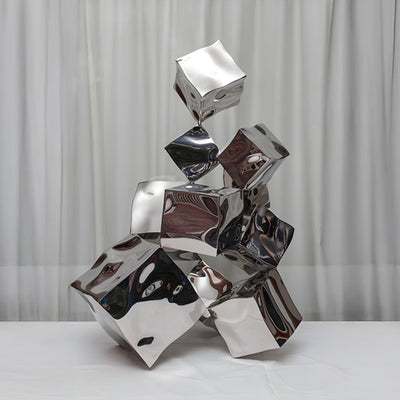
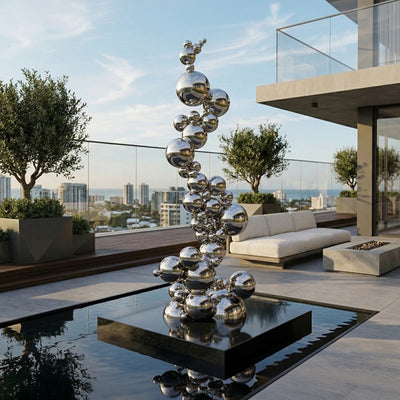
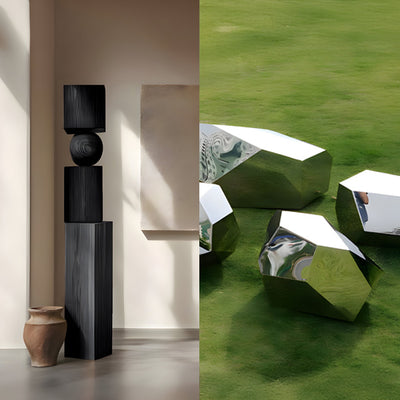
If carved stone will not fit the budget, we would rather steer you to a different honest material than a persuasive imitation. Where the garden can take a contemporary form rather than classical weight, a pebble shape rendered in polished stainless steel, such as Monoform Stone II, is closer to the right answer: it shrugs off weather and makes no pretense about what it is.
What to Ask Before You Buy Marble Garden Statues for Sale
Most disappointments with marble garden statues for sale trace back to questions nobody asked. Put these to any seller, including us:
Is it carved from a single block, cast, or resin? Get the answer written on the invoice.
What are the net weight and the crated weight?
Where are the fixing points? Carved pieces should have a drilled socket for a stainless steel pin into the plinth; resin often relies on sand fill or adhesive.
How is it crated: custom timber, foam-lined, strapped to a pallet?
Is delivery curbside or placed? Curbside means a liftgate at the end of your drive. Placed means a crew sets it on the plinth. On a long gravel drive in the Hamptons or a sloped lot in the Texas Hill Country, that difference decides your weekend.
What foundation does the seller recommend, and has the stone been sealed?

When a Carved-Stone Commission Beats the Catalog Price
A commission starts to make sense when no catalog of marble garden statues for sale can give you the size, pose or pairing you need. Matched pairs flanking an entry are a common example; two cast pieces from the same mold look identical in a way stone never does, and the eye notices. Large statues are another: once cast pieces reach a substantial scale, their price can approach a carving quote while delivering far less.
Climate matters too. For a garden in Aspen or upstate New York, our studio selects denser blocks and rejects any with visible fault lines, which no catalog listing can promise for your specific site. Some effects are simply better in carved stone. Drapery is the clearest case: the fabric falling over the face of a black marble veiled figure bust depends on thin, crisp folds cut directly into the stone, while casts tend to thicken and soften those edges so they survive the mold.
Budget for any carved piece depends on material, scale, complexity, engineering, installation and finishing, so the useful step is a tailored quote from Giant Sculptures rather than a guess. Browse our marble busts and torsos or large garden statues for scale and subject ideas, then bring us your site photos and measurements. We will tell you plainly whether carved marble is the right answer.
For wider placement ideas, Large Marble Garden Statues: What a Decade of Weather Reveals is useful companion reading before finalising the setting and sightlines.