





































































































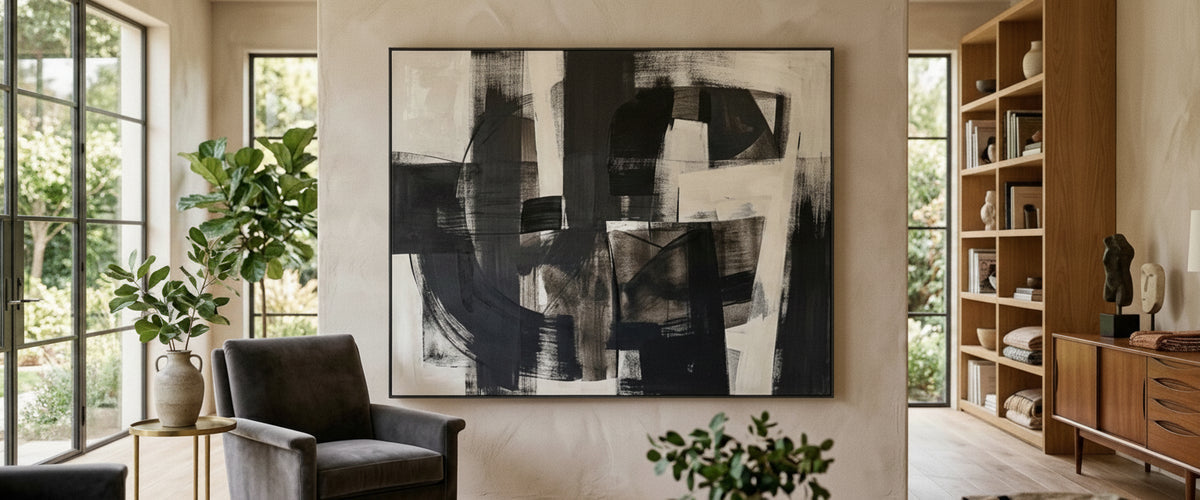

A blank 20-foot wall is not a mystery to solve; it is a proportion problem waiting to happen. Most people underbuy. They order a canvas that looked huge on a laptop screen, hang it, and watch the room swallow it whole. Large canvas wall art only works when the piece, the wall, and the sightline agree with each other, and getting that agreement right is a craft decision long before it is a shopping decision.
Looking for the full range in this category? Browse our Wall Art and Wall Decor collection for every available finish, size, and configuration.
We spend most of our days on bronze, stainless steel, and stone at architectural scale, so when a client asks us about a large canvas wall commission, we treat it the same way we treat a monumental piece: measure first, romanticize later.

Key Takeaways for Large Canvas Wall Art
- Scale to the wall, not the sofa. A single large canvas wall piece usually reads best filling roughly two-thirds of the open wall width.
- Viewing distance changes everything. A composition that sings at 10 feet can fall apart at 30, and vice versa.
- Finish and edge treatment drive perceived quality more than most buyers expect.
- Bespoke means a maquette or sample first. You should never commit to a large format sight unseen.
- Budget depends on size, material, framing, and install, so ask for a tailored quote rather than trusting a flat price.

What We Think About Before Taking On a Large Canvas Wall Commission
The first question is never the image. It is the wall. How wide, how tall, how far back does the viewer stand, and what light hits it across the day. A canvas facing a west-facing window deals with hours of raking afternoon light; the same piece in a windowless hallway lives entirely under artificial lighting. Those two rooms want different finishes, different contrast levels, and sometimes different subjects entirely.
We also look at the architecture around the wall. A double-height stairwell reads very differently from a long, low living room wall. Vertical space wants a composition with vertical energy; a wide horizontal wall usually punishes a square canvas. Large canvas wall art is a spatial decision as much as a visual one, and the buyers who get this right tend to send us a photo of the room with a tape measure in shot before they say a word about color.

Large Canvas Wall Art for a Living Room: Sizing and Placement
For wider placement ideas, Large 3d Wall Art: How Scale, Light, and Placement Decide Its Impact is useful companion reading before finalising the setting and sightlines.
Living rooms are where most people go wrong, because they anchor the art to the furniture instead of the wall. A large canvas wall art piece for a living room should relate to the whole plane, not just the sofa beneath it. As a working rule, aim for the canvas to span about two-thirds of the available wall width and to leave breathing room above the furniture, roughly 6 to 10 inches (15 to 25 cm) between the top of the sofa and the bottom of the frame.
Height matters just as much. Center the visual weight of the piece around 57 to 60 inches (145 to 152 cm) from the floor when the room is used standing, but drop that center a little when the primary view is from a seated position, which is most living rooms. If you are working with a set rather than a single canvas, a three-panel arrangement such as the Fantoria 3-Set Animal Fantasy Oil Canvas Wall Art lets you dial the total footprint to the wall by adjusting the gaps between panels, which is far more forgiving than committing to one enormous stretched canvas.
If you want continuity across a whole room, it helps to browse a focused range rather than scrolling endlessly. Our Canvas Art collection is a sensible starting point for tone and subject before you talk scale with us.

Craft Decisions That Change the Result (and the Price)
Two large canvas wall pieces at the same dimensions can feel worlds apart, and the difference is almost always in the details buyers do not ask about. Stretcher-bar depth is the first. A shallow 3/4-inch bar makes even a big canvas feel like a poster; a gallery-depth bar of 1.5 inches (about 4 cm) or more gives the piece physical presence and lets you leave it unframed with a clean wrapped edge.
Canvas weight and priming come next. Heavier cotton or linen holds tension across a wide span without rippling, and a properly gessoed surface stops the image looking thin under strong light. Then there is the edge: gallery-wrapped, mirror-wrapped, floated in a shadow-gap frame, or bordered. Each choice reads differently from across a room and each affects cost. A hand-finished varnish or a textured overpaint on a printed base sits at the higher end of the range, and it shows.
None of these choices have a fixed price. What they cost depends on the size, the material, the framing, and how the piece is installed, which is exactly why we quote each commission individually rather than publishing a flat figure.
Why Some Pieces Read Right at 10 Feet and Wrong at 30
Scale is not just size; it is resolution of intent at distance. A dense, detailed composition rewards close viewing but flattens into noise from across a large open-plan room. A bold, high-contrast abstract does the opposite: it commands a 30-foot sightline and looks slightly crude up close. Neither is wrong. They are answers to different rooms.
This is where our sculpture background earns its keep. We think constantly about how a monumental form resolves at distance, the same instinct behind a piece like the Monumental Classical Galloping Horse and Swallow Bronze Sculpture - 500cm at 500cm, which is built to be read from far back. We bring that same distance-first thinking to canvas. If your primary view is from a landing 25 feet away, we push contrast and simplify detail. If the piece lives in a reading nook, we can afford texture and nuance. Where the wall calls for something that holds up across a wider range of distances than a busy figurative scene, an abstract such as the Skull&Stone I Abstract Canvas Wall Art is closer to the right design language.
Our Studio Process: Maquette, Sample, Fabrication, Install
For anything bespoke, we work in stages so nothing is a surprise. First, a scaled maquette or a to-scale mockup laid over a photo of your actual wall, so you can judge proportion before we produce anything. Second, a physical sample: a swatch of the canvas, the primer, the edge treatment, and where relevant a small painted or printed test so you can see the finish in your own light.
Only then do we move to fabrication. Large formats are built on cross-braced stretchers to hold tension over time, because a wide canvas with no bracing will bow and ripple within a season. The Canadian Conservation Institute notes that fluctuating humidity is one of the main stresses on canvas support and paint layers, which is why we build for movement rather than pretending a room stays at constant humidity all year (Canadian Conservation Institute). Finally, install. For anything genuinely large or heavy, we specify the fixings and, where needed, arrange professional hanging so the piece sits flat, level, and secure.
Honest Red Flags to Ask About Before You Commit
Ask the supplier these questions, and be wary if the answers are vague.
- What is the stretcher depth and bracing? No cross-bracing on a wide canvas is a warning sign.
- Can I see a sample in my own light? A studio that refuses is hoping you will not notice the finish.
- How is the edge treated? "We'll figure it out" usually means an afterthought.
- What is the fixing and weight? Big canvas can be surprisingly light, but the hanging system still needs to match your wall type.
- What happens if it ripples or the print shifts? A real maker stands behind tension and color over time.
How to Hang Large Canvas Wall Art Without Regret
Two people, a laser level, and painters' tape beat guesswork every time. Cut a paper or tape template to the exact footprint and stick it to the wall first; live with it for a day before you drill. For a heavy piece, hang from studs or use anchors rated well above the actual weight, and use a French cleat for anything large so the load spreads across the wall rather than hanging off two small hooks. On a stairway side wall, forget centering to the floor; center the piece to the diagonal sightline as you climb, and step back onto the landing to check it reads level against the raking angle of the stairs.
Where Canvas Fits Alongside Metal and Sculpture
Canvas is the fast, flexible way to fill a large wall, but it is not the only route to presence. If you want a wall piece with more physical depth and permanence, a bronze relief such as the Traditional Horse Head Bronze Relief - 80cm brings shadow and cast texture that a printed surface cannot match, and reads with real weight even from across a room. Buyers weighing options often compare our Metal Wall Art range against canvas for exactly this reason. The right answer depends on the room, the budget, and how permanent you want the statement to feel.
Whether you commission a single large canvas wall piece or a mixed wall of canvas and relief, Giant Sculptures approaches it the same way we approach a monumental bronze: proportion first, finish second, and nothing produced until you have seen it to scale. Send us the wall dimensions and a photo, and we will start with a mockup rather than a sales pitch.