





































































































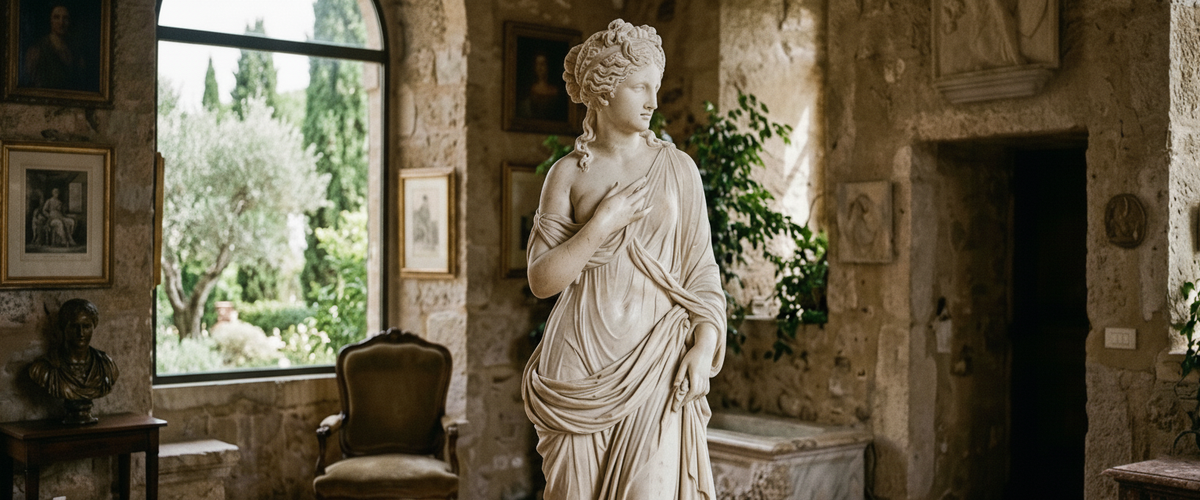

Search for an Aphrodite Greek finish statue and you will find hundreds of listings showing the same pale, softly lit goddess at prices that make no sense for carved stone. They make no sense because most of them are not stone. “Marble finish” describes a surface, and on a goddess listing it almost always means a cast. That is fine if you know it. It becomes a problem when a resin figure meets a Napa terrace in August or a Connecticut garden through a freeze-thaw winter.
At a glance
“Marble finish” describes appearance, not material. With any Aphrodite Greek finish statue, always ask what the body is made of.
Three common recipes sit behind the phrase: cast marble, stone-dust resin and painted resin.
Weight, sound and the underside reveal the material in under a minute.
Drapery, fingertips and hair are where casts lose detail first.
For permanent outdoor placement, carved marble or bronze outlasts any resin-based cast.

Why “Marble Finish” on an Aphrodite Greek Finish Statue Rarely Means Stone
The wording is a retail habit. A listing titled “aphrodite greek goddess of love marble finish statue” is telling you about color and sheen, and very little about what sits beneath. Carved marble is cut from a quarried block, then roughed out, refined and polished by hand over a long stretch of studio time. A cast is poured into a mold taken from a master sculpture, so one master can produce many identical copies.
Neither route is dishonest. The vagueness is. If a seller cannot tell you the core material of their Aphrodite Greek finish statue, assume it is not stone.
Cast Marble, Stone-Dust Resin and Painted Resin: Three Recipes, One Photo
Under studio lights these three can look identical, and any of them may be sold as an Aphrodite Greek finish statue. In a garden, five years on, they look nothing alike.
Cast Marble
Crushed marble aggregate bound with polyester resin, usually at a high stone ratio. This is the heaviest recipe behind Aphrodite Greek finish statues. It is cool to the touch and takes a decent polish. The binder is still a plastic, though, and sunlight works on it over time.
Stone-Dust Resin
Less stone, more resin, often finished with a tinted gel coat. Lighter and cheaper to ship, with a surface that reads slightly waxy up close. Fine detail is usually softer.
Painted Resin
A resin or fiberglass shell, painted white and sometimes hand-veined. The paint is the finish, so a chip shows a gray or off-white core immediately. For indoor themed venues and short-term displays, the pieces in our resin sculptures collection make sense; just do not mistake them for heirloom stone.

Weight, Tap and Underside: The Thirty-Second Test
Lift a corner. Marble is roughly 2.7 times the density of water. A solid carved bust should feel planted; if one person can swing it about easily, it is hollow or resin-rich.
Tap with a knuckle. Solid stone gives a short, dense click. Hollow casts answer with a drum-like knock.
Check the underside. Tip the Aphrodite Greek finish statue back, or ask for a photo. Carved stone shows a sawn face or tool marks in the same crystalline material as the surface. Casts show a seam line, a fill hole or a core in a different shade.
Follow the veining. Real veins run through edges and continue around corners. Painted veins stop at an edge, or repeat in the same pattern on every copy.
Touch it in the shade. Stone draws heat from your hand quickly, so it feels noticeably cooler than resin sitting in the same spot.
A seam and fill hole on the base give a cast away in seconds.
Where an Aphrodite Gives the Game Away First
Drapery is the first giveaway on a cast Aphrodite Greek finish statue. Classical carvers cut deep undercuts into folds so shadows pool in them. A mold cannot release from a deep undercut, so cast drapery is shallower, or bridged where two folds should separate. Compare any cast with the carved folds around the hips of the Venus de Milo at the Louvre and the difference in shadow depth is obvious.
Deep undercuts hold shadow; molded folds cannot.
Fingertips come next. On casts, fingers are thickened so they survive demolding and shipping. Our carvers leave the hands until late in the process because a slip there costs the whole hand, and the slender, slightly tapered fingers that result are hard to fake.
Hair finishes the story. Ancient sculptors used the drill to cut channels between curls, throwing dark lines across the head. A cast smooths those channels into gentle ripples. That difference is easiest to judge at bust scale: a carved head such as the Aphrodite Marble Bust Sculpture, 65cm (about 26 inches) is read from arm's length, so the drilled hairline and the turn of the neck have nowhere to hide.

A Wet British Winter Versus a Hot American Summer
Climate decides how fast a cast Aphrodite Greek finish statue fails. In a wet British winter, water creeps into hairline cracks and seams, freezes, expands and splits them; algae colonizes the softer resin surfaces. The same applies to gardens in Aspen or upstate New York.
A hot American summer attacks from the other side. UV breaks down resin binders, so surfaces chalk, yellow and craze, and painted veining fades first. Beside a pool in Scottsdale or Palm Springs, a painted-resin Aphrodite Greek finish statue can start peeling at the shoulders within a couple of summers.
Carved marble is not immune either. Calcite reacts slowly with acidic rain, which is why old marble can turn sugary and lose crisp edges, as the USGS documents on monuments in Washington, DC. The difference is time: stone weathers over decades, resin over a few seasons. Where a Hamptons driveway or Texas courtyard needs year-round presence at full outdoor scale, a solid carved piece on its own plinth, such as the Winged Lion on a Greek Key Plinth Marble Statue, 220cm (about 7 feet 3 inches), will hold up to the weather in a way no resin cast can.
When Carved Marble Greek Goddess Statues Are Worth the Wait
Carved marble Greek goddess statues take longer and cost more, and they are not right for every space. Here are the criteria we use with clients:
Permanence. If the piece will stay outdoors year-round, carved stone or bronze is the only sensible choice.
Viewing distance. Anything seen from under 10 feet (3 m) will reveal the cast detail on an Aphrodite Greek finish statue. Distant focal points are more forgiving.
Ownership horizon. Buying for a decade or more, or for resale value, points toward carved marble.
Site access. Solid stone needs a footing, lifting gear and an installation plan. Check access before you commit.
Budget logic. Cost depends on material, scale, complexity, engineering, installation and finishing. Request a tailored quote rather than comparing against cast listings.
If a full figure is more than the space needs, a polished fragment can carry the same classical mood at a smaller footprint. Set elsewhere in a garden, a piece like the Classical Male Torso Fragment Sculpture (Polished Finish) - 80cm makes a quieter counterpoint to a goddess rather than competing with her.

Questions to Ask Before You Buy
Before you pay for any Aphrodite Greek finish statue, put these questions to the seller:
What is the core material, not just the surface?
Is the piece carved, cast or a hollow shell?
Is it rated for outdoor use in my climate?
How is it fixed to its base or plinth?
Can I see photographs of the underside?
At Giant Sculptures we carve, cast and commission at scale, and we will tell you plainly which material suits your site. Browse our Greek and Roman statues, or skip the guesswork of a Greek finish statue of Aphrodite and ask us about a bespoke Aphrodite carved to your proportions and setting.
For wider placement ideas, Aphrodite Marble Sculpture: Which Goddess Are You Actually Buying? is useful companion reading before finalizing the setting and sightlines.