





































































































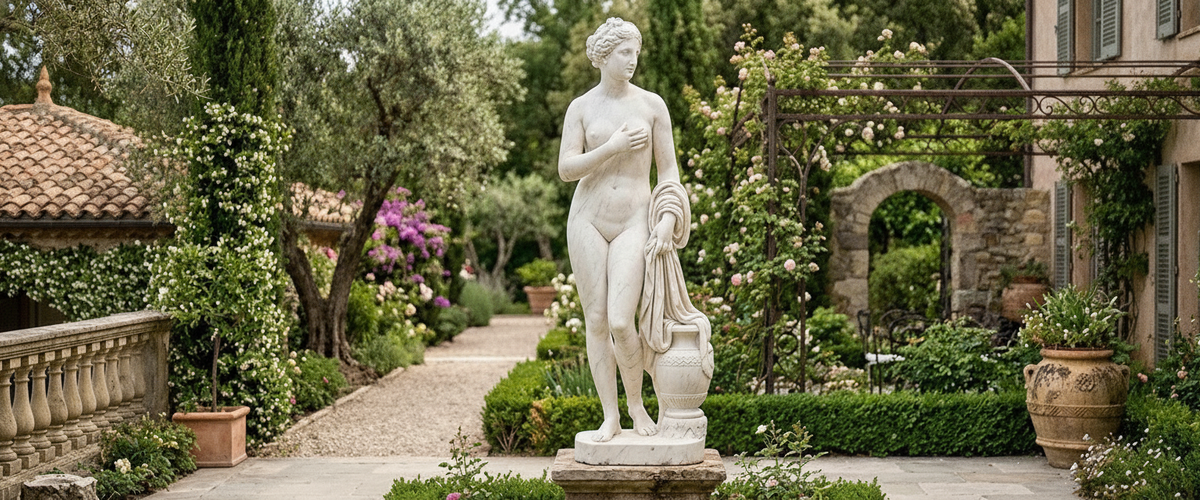

Most buyers who ask us for an Aphrodite marble sculpture already have a pose in mind, and it is often the wrong pose for their space. The goddess comes in at least four standard types. Each is carved from a differently shaped block, and each was designed to be seen from a particular angle. Choose the type before you choose the size, and every later decision gets easier.

At a Glance
Knidian: standing nude, one hand shielding, drapery falling onto a water jar. It needs a side support and reads best from the front three-quarter view.
Capitoline and Medici: both arms drawn across the body and a slimmer silhouette. They are strong in niches and at the end of a garden axis.
Crouching: compact and low, rewarding from every side. This is the natural choice for walk-around placement.
Stone: Statuario for a luminous, nearly unmarked skin; standard Carrara for a softer, gray-veined surface.
From Herodotus's Urania to Praxiteles' Nude
Herodotus is the earliest useful witness to how the Greeks first pictured the goddess behind every Aphrodite marble sculpture. Writing in the fifth century BCE, he calls her Aphrodite Ourania, the heavenly Aphrodite, and names the sanctuary at Ascalon on the Levantine coast as the oldest of her temples. Cult images of that era showed a clothed, formal goddess: a civic power more than a body. That changed around the middle of the fourth century BCE, when Praxiteles carved her nude. Pliny the Elder tells the story. The people of Kos chose the draped version, Knidos took the nude, and visitors sailed to Knidos just to see it.
Every Aphrodite marble sculpture made since sits somewhere between those two ideas: veiled authority or private bather. Decide which mood you want before you open a catalog. It will narrow the field faster than any measurement.
Why Nearly Every Roman Marble Sculpture of Aphrodite Answers a Lost Greek Original
The Praxiteles statue is gone. What survives are Roman versions carved for villas, bathhouses and gardens, often centuries later and in uneven quality. The Metropolitan Museum's essay on Roman copies of Greek statues explains how workshops reproduced Greek models from casts while adjusting proportion, finish and supports to Roman taste. So a Roman marble Aphrodite is really a Roman reading of a Greek idea. For a modern commission, this means you are choosing which copy tradition to follow, and our carvers will ask you that question early.
The Knidian Type: Contrapposto, the Water Jar and the Support
The Knidian Aphrodite stands in contrapposto. Her weight is on one leg and the other knee eases forward. One hand screens her body while the other lets drapery fall onto a tall water jar. That jar does structural work. Marble is weak in tension, and a life-size figure balanced on slender ankles needs a strut, so the cloth and vessel carry load as much as they tell the story.
The Knidian pose: the water jar and drapery double as a structural strut.
Roman copyists often misjudged the support, and it is still the detail that makes or breaks an Aphrodite marble sculpture. If the jar is too small, it looks like an afterthought. If it is too tall, it competes with the hip and flattens the silhouette. In our studio we set the support out in clay at full scale before the block is cut, because a few inches of height change the whole profile. For outdoor figures above life size we also discuss a concealed stainless steel pin through the ankles into the plinth.

Capitoline, Medici and Crouching: Block and Base
The Capitoline type draws both arms across the body, with drapery over a vessel at her side. It needs a tall, narrow block and a deep plinth so the figure does not look perched. The Medici type, best known from the Medici Venus in the Uffizi, is slighter. Her head turns sharply to one side, and a dolphin ridden by small cupids replaces the jar as the support. That turn of the head sets the primary viewing angle, so position the plinth to suit it.
The Crouching Aphrodite, traditionally linked to the sculptor Doidalsas, works almost the other way round. The block is close to a cube and the center of gravity sits low, so she needs very little added support. The vulnerable point is the extended arm. Her base can be wide and shallow, which suits courtyards with low walls and terraces where a tall figure would block a view.
The Crouching type's low, compact block holds its shape from every side.
Niche, Garden Axis or Full Walk-Around
Match the type to how people will actually see it. A niche suits the Medici or Capitoline, since both were composed for a dominant front view. At the end of a long garden axis, such as a cypress allée in Napa or a lawn walk in the Hamptons, the Knidian reads clearly at distance as long as you scale up. A figure that looks generous in the workshop can shrink to a doll at 100 feet (30 m).
Full walk-around placement is where buyers trip up. One client planning a round courtyard in Austin asked for a Knidian at the center. From behind, that support reads as a stump. We steered them to a Crouching Aphrodite, which holds its shape from every side.
For interiors, the bust is often the better answer. On a pedestal at eye level in a library or on a stair landing, a carved head and shoulders such as the Aphrodite Marble Bust Sculpture - 65cm gives the face and the turn of the neck the close viewing a full figure rarely gets indoors. Where a terrace calls for a facing pair, a standing male figure in the same classical language, such as the Apollo Marble Sculpture - 180cm, gives her a partner of real presence. Scale her to match so neither figure reads as the lesser of the two.
Statuario Versus Carrara: What the Skin Tells You
Statuario is a premium grade from the Carrara quarry district. It is very white and fine-grained, with a slight translucency that lets light enter the surface before it bounces back. On a nude Aphrodite marble sculpture, that reads as skin. Large clean blocks are scarce, which affects both lead time and budget.
Standard Bianco Carrara has a gray-white ground and fine veining. It carves beautifully and weathers honestly, but a vein running across a cheek can read like a bruise. The risk is greatest at close range. On a bust viewed at arm's length, such as a Classical Female Marble Bust Sculpture - 75cm, the eye meets the stone before it meets the carving, so block selection matters as much as the modeling. Good carvers orient the block so veining runs along the limbs, away from the face. Ask for photos of the raw block before carving. Finish matters too. A high polish suits interiors. A honed or satin finish is wiser outdoors, where rain will soften a polish anyway and calcite slowly dissolves in acidic weather.

Buying Checklist for an Aphrodite Marble Sculpture
Viewing angle: front-only, axis, or full walk-around. This decides the type.
Distance: measure where people will stand and scale the figure to that distance, not to the plinth.
Support design: approve the jar, dolphin or drapery strut in clay or drawings first.
Stone grade: Statuario or Carrara, with block photos showing veining near the face.
Finish: polished indoors, honed or satin outdoors.
Climate: freeze-thaw sites such as Aspen need drainage at the base and periodic sealing.
Access: confirm crane or gantry routes before delivery; standing marble figures are very heavy.
Budget for an Aphrodite marble sculpture depends on material grade, scale, pose complexity, engineering, installation and finishing, so request a tailored quote once the type and size are settled. Giant Sculptures carves and ships bespoke marble figures worldwide, from draped busts to full-length goddesses. Continue with our Greek and Roman statues, compare stone and scale across the wider marble sculptures collection, or bring us a pose and a site plan and we will tell you which Aphrodite belongs there.
For wider placement ideas, How to Judge a Cupid and Psyche Marble Statue Before You Buy is useful companion reading before finalising the setting and sightlines.