





































































































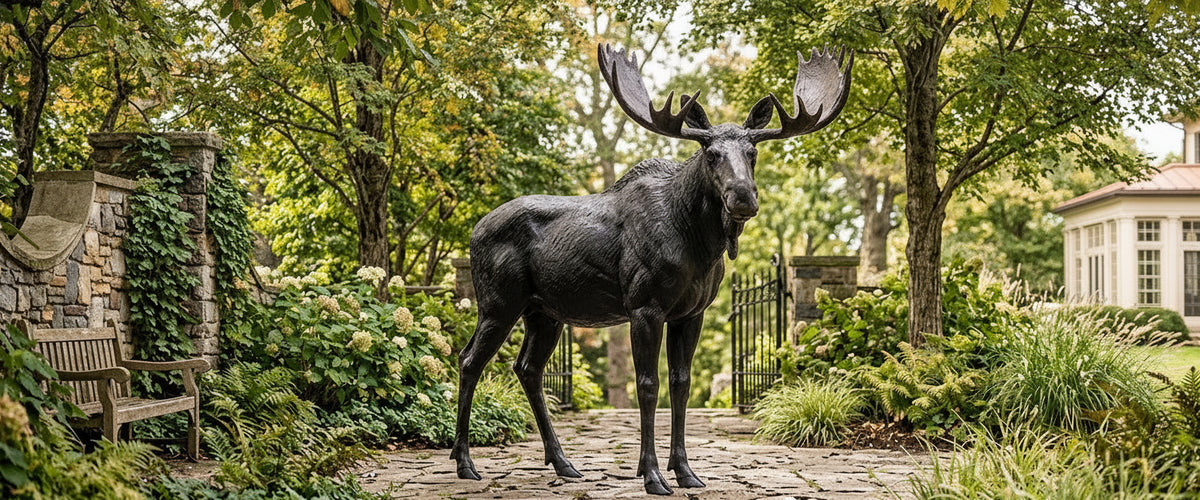

A bull moose reads at distance. The antlers spread wide, the shoulder hump sits high, the legs run long and ungainly, and the whole animal carries a top-heavy geometry that no other large mammal has. That is exactly why a bronze moose sculpture holds ground where a deer or a hound would simply vanish: it anchors a meadow, a driveway curve or a lodge forecourt from two hundred feet away. It is also unforgiving. Undersize the piece, or drop it in front of a busy backdrop, and you have paid for a silhouette that nobody sees.

At a Glance: What Matters Most
Scale first. Life-size bull moose bronzes commonly stand around 230 to 290 cm (roughly 7.5 to 9.5 feet) at the antler tip. Monumental versions go taller.
Patina is a design decision. Warm black-brown reads traditional and wildlife-accurate; matte black reads graphic and modern.
Sky is your best backdrop. Antlers only work when there is empty space behind them.
Wall-mounted moose bronzes need engineering, not picture hooks. Weight goes into structure, never plasterboard.
Budget depends on scale, casting complexity, patina, base engineering, crating and install, so ask for a tailored quote rather than a list price.
What a Bronze Moose Sculpture Means, and Who Actually Buys One
Cast bronze moose fall into three broad categories: life-size wildlife studies, monumental statement pieces scaled beyond the real animal, and wall-mounted heads or reliefs. Buyers tend to be predictable in the best way. Mountain-property owners in Colorado and Wyoming. Ranch and lake-house clients in Montana and Maine. Lodge, resort and clubhouse operators who need one object at the arrival point that guests photograph. We have also shipped moose bronzes to buyers who simply wanted a piece with more character than another lion or eagle.
The appeal is partly biological. Bull moose antlers are palmate rather than branched, and mature Alaskan bulls can carry a spread of more than 6 feet (1.8 m), according to the Alaska Department of Fish and Game. That horizontal mass at head height gives a sculptor something to work with that few animals offer. It also gives a foundry a headache, which is why quality varies so much across the market.
Bronze, Patina and Casting Quality
Silicon bronze is the workhorse alloy for outdoor animal casting: it pours cleanly, welds predictably, and holds up to freeze-thaw cycles and coastal air far better than most metals. For a moose in particular, casting method matters more than usual. The antlers, legs and body are cast separately in a lost-wax process, then chased, welded and blended. On a poor casting you can find the weld lines with your fingers along the antler palms. On a good one you cannot. Ask any bronze moose sculpture supplier for close-up photography of the antler joins and the hoof-to-base connection before you commit.
A life-size bull in warm black-brown patina, set where the antler palms break the horizon rather than the treeline.
Patina then sets the mood. A traditional black-brown patina keeps the piece in wildlife territory, warm in low sun and softly variegated across the shoulder, which is why a piece such as the Life-Size Traditional Bull Moose Bronze Sculpture (Black-Brown Patina) - 260cm tends to sit so comfortably against timber and stone. Where the architecture is glass and gray board-formed concrete, the identical form finished in Life-Size Traditional Bull Moose Bronze Sculpture (Matte Black Patina) - 260cm is closer to the right design language: the animal turns graphic, almost cut-out, against a pale wall.
Patina is a controlled chemical surface, not paint, and it keeps developing outdoors. The Tate definition is a useful reminder that the film on aged bronze is part of the work rather than a defect. What you want to avoid is uncontrolled streaking, which happens when a piece is left unwaxed under a drip line or a leaking gutter. Two wax applications a year with a quality microcrystalline wax, plus a rinse with clean water, keep a moose bronze looking intentional for decades.
Getting Scale Right Before You Commit
The single most common mistake we see is buying to a photograph rather than to a sightline. A moose at true life-size is already large; a walking bull at 8.5 feet (260 cm) can still look modest at the far end of a five-acre pasture. Distance eats mass quickly.
A rough working rule from our installs: if the primary viewing point is more than 100 feet (30 m) away, go up a size. If people will walk within 15 feet of the piece, life-size is plenty, and the detail in the muzzle, dewlap and coat becomes the reason to own it. For a pure arrival statement where the piece has to compete with a building facade, a rearing bull close to 10 feet such as the Monumental Rearing Bull Moose Bronze Sculpture - 300cm buys vertical drama that no standing pose can match.
A rearing pose at 300cm needs sky behind it; drop the same form against dense planting and the drama disappears.
Pose changes the math too. A reclining moose reads long and low, which suits a lawn edge, a pool terrace or a spot where you cannot afford to block a view. Standing and walking poses need breathing room on all four sides. Rearing poses need sky.
The Moose Bronze Wall Sculpture Option
When floor space is the constraint, a moose bronze wall sculpture solves the problem. Wall-mounted bulls, whether a full head study or a shallow relief, project from the surface and throw a shadow that changes across the day, so they are more sculptural than any flat panel. Practical points buyers underestimate: cast bronze is heavy, so the mount has to reach structural timber, steel or masonry with a concealed backplate and through-bolts. We size the bracket to the piece, not the other way around. Double-height entry halls, chimney breasts and covered outdoor loggias all take these well, and a bespoke wall version can be developed from any of our free-standing moose forms.

Where to Place a Bronze Moose Sculpture
For wider placement ideas, Bronze Framed Wall Art: How to Buy a Piece That Earns Its Wall is useful companion reading before finalising the setting and sightlines.
Antlers need negative space. That is the whole game. Set a bull against a dense conifer hedge and the palms disappear into the foliage; set it where the head breaks the horizon line and the silhouette does the work for you.
Sites that consistently perform:
The inside curve of a gravel drive, so the piece rotates through the windshield as guests approach.
Meadow edge, roughly a third into the open ground, never dead center. Off-axis placement looks found rather than staged.
Water margins. Moose are wetland animals; a lake or pond edge is narratively right and gives you reflection at low sun.
Lodge, hotel and clubhouse forecourts, where a single monumental animal beats three smaller pieces every time.
One lesson from a Colorado install: the client wanted the bull facing the house. We argued for a three-quarter turn away, so the antler spread showed its full width from the terrace instead of foreshortening into a narrow head-on view. They agreed on site, and it is the angle every photograph now uses. Orientation is worth an hour of your time with stakes and string before the crane arrives.
The Elk Tradition, from Russia to the Rockies
North American moose and European elk are the same species, Alces alces, which explains why searches for a russia bronze moose sculpture and an American moose bronze often land on similar forms. Northern Europe and Russia have a long civic tradition of monumental cast elk, most famously the bronze elk that has stood in Vyborg since the 1920s, and roadside elk monuments scattered across Russian regions. Those pieces are typically stylized, heavier in the shoulder and blockier in the leg than the anatomically precise wildlife bronzes favored in the United States.
It is worth knowing the difference before you brief a commission. If you want the Nordic civic feel, the sculptor works with simplified planes and a more upright stance. If you want a Rocky Mountain wildlife study, the reference material shifts to field photography, coat texture and correct antler development for the animal's age. Both are legitimate. They are not interchangeable.
Budget, Commissioning and Delivery
Cost is driven by scale, alloy volume, casting complexity, antler engineering, patina work, base and armature design, crating and installation access. A monumental rearing pose with a complex weight distribution takes far more internal steel than a standing bull of similar height. Because those variables move independently, we quote each project rather than publishing bands.
Timeline questions to settle early:
Foundation or plinth design, including frost depth for cold-climate sites
Wind and snow loading on antlers, which we detail into the internal armature
Crane or telehandler access, gate widths and ground protection
Crating, freight route and customs paperwork for international delivery
Anchor bolt pattern supplied to your contractor ahead of the pour
Buyer Checklist Before You Order
Photograph the site from every main viewpoint and mark the sightline distances.
Confirm what sits behind the piece. Sky and open ground beat hedging.
Choose patina against your actual building materials, not against a screen.
Request close-up images of antler welds, hooves and the base connection.
Check the internal armature specification and the anchoring method.
Agree access logistics and lifting equipment before the shipping date.
Plan for two waxings a year and note gutter or drip lines that could stain the surface.
Working With a Bronze Moose Sculpture Supplier on a Bespoke Piece
Most of our moose commissions start with a catalog form and a change: taller antlers, a different head angle, a custom patina to match an architect's palette, or a wall-mounted adaptation of a standing bull. Giant Sculptures works from client reference images and site photography through clay maquette and scaled model, then into lost-wax casting, chasing, patination and crated delivery. Browse the wider bronze animal sculptures range to see how pose and finish shift the character, or the life-size bronze statues collection if you are still testing scale against your site. For garden-scale context alongside planting, the bronze garden statues collection is the better starting point.
Buy a bronze moose sculpture properly and it outlives the house it was bought for. That is the standard we work to.