
























































































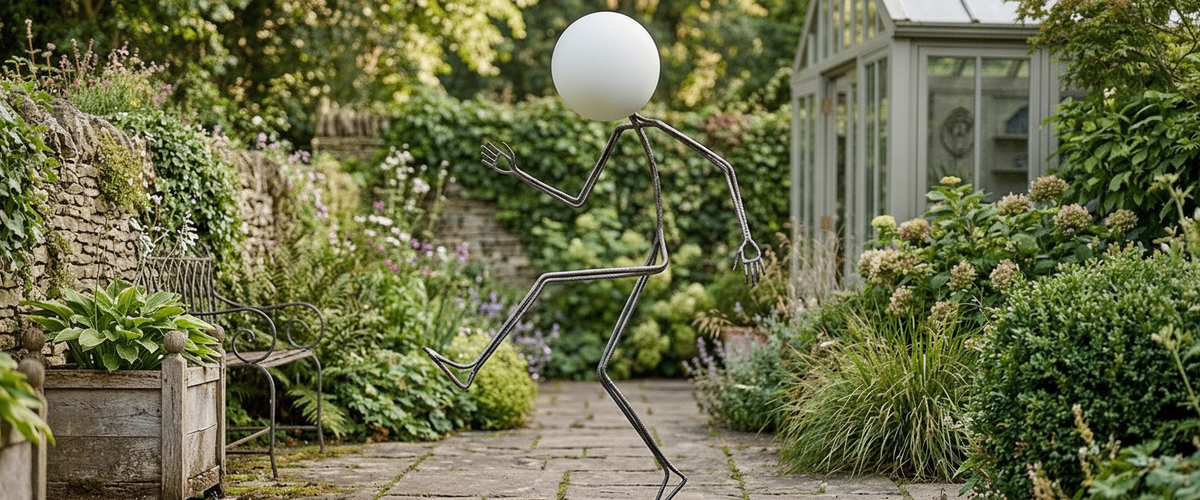

A stick figure astronaut sculpture either reads instantly from sixty feet away or it looks like a coat rack wearing a fishbowl. There is very little middle ground. Strip a spacesuit down to line and sphere and you remove every forgiving detail: no folds, no texture, no patina doing quiet work in the background. What is left is proportion, weld quality and posture. Get those right and the piece carries a double-height lobby on its own. Get them slightly wrong and every visitor senses it without being able to say why.

Quick Answer: What Makes a Stick Figure Astronaut Sculpture Work
Silhouette first. The helmet sphere plus the suit stance is the whole idea. If the outline fails at distance, detail will not rescue it.
Limb-to-helmet ratio decides the tone. Thin rod and a modest sphere reads sculptural. Thin rod and an oversized sphere reads cartoon.
Welded stainless or bronze rod outlasts cast resin in any space with real sun, heat swing or footfall.
One-foot poses need engineered ballast, not a thicker plinth. The base plate should disappear into the floor build-up.
Finish is a maintenance decision. Chrome shows fingerprints, matte white shows scuffs, powder coat hides both but needs the right spec.
Budget follows material, scale, engineering and install, so a tailored quote beats any published figure.
Fewer Lines, Faster Read: Why the Stripped-Back Suit Wins in a Wide Atrium
Large interiors punish busy sculpture. Across a 60 ft (18 m) atrium, the eye resolves shape long before it resolves surface, which is exactly why the spacesuit silhouette works so hard. It is one of the few outlines in modern visual culture that almost everyone decodes at a glance, a point that comes through in the Smithsonian National Air and Space Museum writing on how suit design entered popular imagery. A stick figure astronaut sculpture leans on that recognition and then subtracts everything else.
Across a wide atrium the outline does the work: helmet sphere, shoulder line, stance.
The practical gain is sightline flexibility. A heavily modeled figure wants a front. A line-drawn figure reads from three or four approach angles because the rod work stays legible in profile. In a lobby with escalators on two sides and a mezzanine above, that matters more than any surface treatment you could specify.

Limb Thickness and Helmet Diameter: The Ratio That Tips into Cartoon
This is where most off-the-shelf stick figure astronaut sculptures fall apart. Helmet diameter sets the character; limb gauge sets the credibility. As a rule of thumb from our own maquette reviews, once the helmet sphere pushes past about a quarter of total figure height, the piece stops reading as a figure and starts reading as a mascot. Some buyers want that. Retail and hospitality clients often do. Corporate collectors almost never do.
Limb thickness works in the opposite direction. Rod that is too fine looks fragile at close range and vanishes at distance, particularly against glazing. Rod that is too heavy turns the astronaut into plumbing. We usually test the ratio at maquette scale first, then walk it back to the real viewing distance, because a proportion that looks elegant on a studio bench can lose its legs entirely once it is 12 ft (3.7 m) tall and seen from 40 ft (12 m) away.
Welded Rod or Cast Resin: Which One Still Stands Straight After Five Summers
Cast resin and fiberglass versions are common because they are quick to mold and light to move. They are also the ones we get asked to replace. Resin creeps under sustained load, and a long unsupported limb is sustained load by definition. Add a west-facing window wall in Phoenix or Dallas and heat softening becomes a genuine planning issue, not a theoretical one.
A welded stainless steel stick figure astronaut sculpture is the honest answer for most commissions. Steel rod holds line, takes a mirror polish or a brushed finish, and tolerates interior heat without complaint. Bronze rod is the other serious option when a client wants warmth and weight; the language of a bronze figure sculpture carries differently in a paneled lobby than polished steel does. Where a scheme needs that mass but still wants the outline doing the work, a silhouette-led piece such as the Contemporary Hooded Phantom Figure Bronze Sculpture - 150cm shows how far a single clean profile travels in cast metal. For outdoor courtyards, Corten and stainless both work, while resin should be treated as a temporary or event-only choice.

The Armature Nobody Sees and the Welds That Actually Fail
Every tall stick figure astronaut sculpture is really a hidden frame with a visible skin of rod. Failures almost never happen mid-limb. They happen at the three or four joints where a slim element meets a heavy one: ankle to base plate, wrist to arm, neck to helmet ring. Those are the transitions where stress concentrates and where a rushed fabricator will run a single pass instead of a properly dressed, ground-back joint.
When you are reviewing a quote, ask what sits inside the figure. A continuous internal spine through the standing leg and into the torso is the difference between a sculpture that survives a knock from a cleaning cart and one that develops a permanent lean. Ask how the helmet is fixed too. A sphere on a slender neck is a lever, and wind loading outdoors or a shoulder bump indoors both act on the same weak point.
Ballasting a Figure on One Foot Without Killing the Pose
Single-point contact is the pose everyone wants: mid-stride, one boot lifted, helmet tilted toward the ceiling. It is also the hardest to engineer, because the obvious fix is a thick visible plinth, which flattens the drama instantly. The better route is a steel base plate recessed into the floor build-up, or a counterweighted internal mass sitting low in the standing leg.
A mid-stride pose only survives if the base plate and internal counterweight are designed in early.
The same problem shows up in dynamic bronze work. An inverted pose like the Large Contemporary Handstanding Male Figure Bronze Sculpture - 240cm only holds because the load path was resolved before casting rather than corrected afterward. Extended poses follow the same rule: at 260cm, the Large Contemporary Leaping Male Figure Bronze Sculpture - 260cm throws most of its mass away from the contact point, so the base and internal structure have to be sized for that reach from the start. Tell us the floor construction early and the ballast can be designed in; find out after fabrication and you end up adding metal where it shows.

Lobbies, Stairwell Landings and Courtyard Gravel, Ranked by Sightline
Double-height lobbies come first. They give the figure air above the helmet, which a stick figure astronaut sculpture needs more than most work, and they allow both a distant read and a close read on the same route. Stairwell landings come second and are underrated. A figure seen from below on the ascent and from above on the descent gives you two entirely different compositions for the price of one install.
Courtyard gravel comes third, and only with groundwork. Loose material is forgiving for drainage and terrible for point loads, so a buried concrete pad is essential under any tall single-foot piece. Corridors come last. Narrow sightlines compress the silhouette and the whole effect collapses.
Matte White, Chrome or Powder-Coated Color
Matte white is the gallery default and photographs beautifully, but it records every scuff at hand height. Chrome and mirror polish turn a stick figure astronaut sculpture into a reflector of the room, which is why they suit atriums with interesting ceilings; they also show fingerprints within a week of opening. Powder-coated color gives the toughest everyday surface, provided the specification is right. The Powder Coating Institute is a useful reference on matching coating systems to exposure, and the gap between an interior-grade and an architectural-grade coating is worth knowing before you sign off.

Commissioning Checklist
Confirm final height and check headroom above the helmet, not just floor-to-ceiling.
Request a maquette or scaled render viewed from the real approach distance.
Agree limb gauge and helmet diameter in writing before fabrication.
Ask for the internal armature detail and joint treatment at ankle, wrist and neck.
Share floor build-up and load limits so ballast can be designed, not bolted on.
Specify finish by exposure, including cleaning products the maintenance team already uses.
Plan access: door widths, elevator dimensions and whether the piece ships in sections.
Giant Sculptures builds bespoke pieces at architectural scale, so start with the room and work backward. Browse the astronaut sculpture collection for direction, then talk to us about a stick figure astronaut sculpture sized to your sightlines. Material, scale, complexity, engineering, installation and finish all move the price, so the only useful number is a tailored quote.
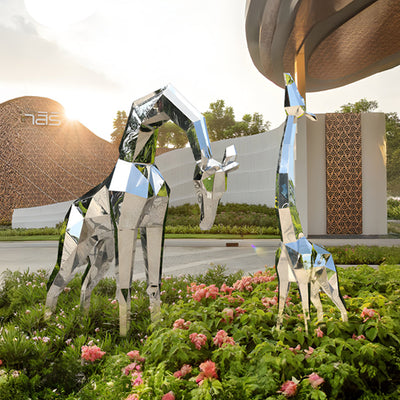
For wider placement ideas, Deer Statues for the Garden: Why Three Figures Read Better Than One is useful companion reading before finalising the setting and sightlines.