





































































































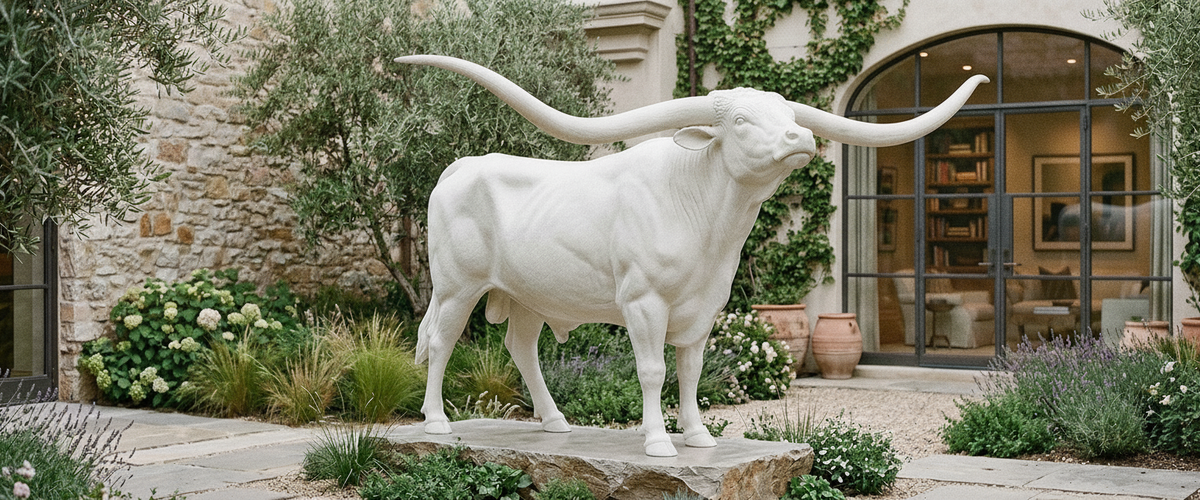

Measure the horns first. Everything practical about owning a longhorn bull resin sculpture follows from that single number: the crate footprint, the freight quote, the doorway it has to clear, and whether your installer needs two people or four. Body length barely registers by comparison. We have quoted pieces where the animal itself would slip through a standard opening with room to spare, and the horns turned a simple delivery into a glazing panel removal job. Plan the project around the span and the rest of the logistics falls into line.
Key Takeaways Before You Shortlist
Span rules the project. Horn tip to horn tip sets crating, access and handling, not nose-to-tail length.
Laminate thickness is the quality tell. Thin shells flex, thick shells with a proper internal armature do not.
Horn joins fail before anything else. Ask where the seam sits and how it is reinforced.
Skull and full body need completely different rooms even at identical span.
Finish changes perceived weight more than most buyers expect. Matte chalk reads light; metallic lacquer reads heavy.
A longhorn bull resin sculpture is an interior and sheltered-exterior piece. For exposed gardens, cast bronze is the honest recommendation.

Horn Tip to Horn Tip Sets the Crate, the Doorway and the Delivery Quote
Texas Longhorn cattle are registered and celebrated on tip-to-tip measurement, and documented spans run far wider than most people picture when they imagine a bull. The Texas State Historical Association records how the breed's horn architecture became its defining trait, and sculptors lean into it hard. That is exactly why a longhorn bull resin sculpture behaves differently from any other animal piece of similar height.
Work backward from the narrowest point on the route: elevator car width, stairwell turns, gallery door leaf, the gap between a pair of columns in a hotel lobby. A 7-foot (2.1 m) span will not pivot through a 6-foot opening no matter how you angle it, and resin horns are the wrong thing to force. For a Houston restaurant fit-out we shipped the horns as a separate sub-assembly with a bolted internal spigot, and the piece went up the service elevator in three crates instead of one oversize pallet. That decision was made at quote stage, not on delivery day.
Tip-to-tip span, not body length, sets the crate size and the access plan.
Laminate Thickness, Armature and Joints Inside a Longhorn Bull Resin Sculpture
A large longhorn bull resin sculpture is a hollow laminate, not a solid casting. Resin is brushed or sprayed into a mold, backed with fiberglass matting, and built up in layers over a steel or aluminum armature. Quality lives in that build-up. Too few layers and the flank panel flexes under thumb pressure; too much unsupported span and the piece develops a slow sag over years of warm gallery lighting.
Ask three things of any maker. Where does the armature run, and does it carry into the horns or stop at the skull? How many laminate layers sit at the high-stress points, meaning the neck, the horn bases and the hoof-to-plinth connection? And where do the mold parting lines sit? Those become visible seams under raking light if they are filled lazily. On our own bespoke work the parting line is usually pushed along a natural anatomical break, such as the dewlap edge or the spine ridge, so the eye reads it as form rather than repair.

The Horn Join That Fails First
If a longhorn bull resin sculpture is going to break, it breaks at the horn root. The horn is a long cantilever on a narrow section, and it is the part that gets grabbed, leaned on and caught by a passing cart. A cheap build bonds a solid resin horn straight onto the skull shell with adhesive and a dab of filler. That join will craze, then crack, and it will crack in the display position where everyone sees it.
A properly made join has a metal spigot running well down into the skull, wet-laminated fiberglass wrapping the transition rather than surface filler alone, and a flow of laminate that thickens toward the root instead of thinning. Run your palm over the underside of the horn near the skull on any piece you are inspecting. If you feel a hard step where filler meets resin, you are feeling the future failure line.
Skull or Full Body: Same Span, Two Completely Different Rooms
A longhorn bull skull resin sculpture and a full-body longhorn bull resin sculpture can share an identical horn span and still belong in entirely different interiors. The skull is graphic and flat, closer to wall art than to sculpture, and it reads best above a fireplace, over a bar back or centered on a broad hallway wall. It takes almost no floor plan away from you, which is why designers reach for it in lodges and tasting rooms where circulation is tight.
The full body is a floor object with a real footprint and sightlines on four sides. It needs standoff distance, ideally at least the horn span again as clear space, or the animal looks caged. If you want that presence outdoors at a ranch entrance or in an open garden, a longhorn bull resin sculpture is the wrong long-term choice and we will say so. At full height in an exposed setting, a cast piece such as the Life-Size Traditional Standing Bull Bronze Sculpture (Head Lowered) - 170cm handles freeze-thaw, UV and sprinkler overspray in a way composite shells do not, and it gives you the same standing silhouette without the horn-root vulnerability. The wider bronze bull statues range is the place to look if the location is genuinely exposed.
Wall Mount or Floor Stand? The Fixings a Wide Span Forces on You
A wall-mounted longhorn bull resin sculpture is deceptively demanding on the fixing. The load is light, but the use is not: horns project forward and sideways, so the fixing sees a pull-out force, not a simple shear. Drywall anchors alone are not the answer. Get into studs or masonry, use a French cleat or a keyhole plate bonded into the laminate at the time of manufacture rather than screwed on later, and confirm the mounting plate is laminated in, not surface-glued.
Floor-standing longhorns want a base that is wider than instinct suggests. A weighted steel plate hidden inside the plinth lowers the center of gravity and stops the piece rocking when someone brushes past. In public venues we will often specify a concealed floor fixing. It is cheap at the build stage and impossible to retrofit neatly.
Matte Chalk, Bronze Effect or Metallic Lacquer
Finish is the fastest way to change the apparent weight of a longhorn bull resin sculpture. A matte chalk white or bone finish makes the piece feel weightless and sculptural, which suits pale plaster walls and modern ranch interiors. Cold-cast bronze effect, where bronze powder is loaded into the surface resin and then burnished, gives real metallic depth and reads considerably heavier. Where the brief actually calls for solid metal rather than a convincing metallic surface, the fair comparison is a foundry piece like the Large Modern Abstract Bull Bronze Sculpture, 120cm, and seeing the two side by side usually settles the question quickly. High-gloss automotive lacquer in black, oxblood or gold is the boldest option and the least forgiving, since every ripple in the laminate shows.
Cold-cast bronze effect adds metallic depth and makes the same shell read heavier.
One care note that matters for resin specifically: pigmented composites and coatings are sensitive to prolonged UV, and conservation guidance on caring for plastic objects from the Canadian Conservation Institute is worth reading before you place a piece in a south-facing window. Keep resin out of direct sustained sun, dust with a soft dry cloth, and avoid solvent cleaners entirely.

Questions We Ask Before Quoting a Bespoke Longhorn
Commissioning a bespoke longhorn bull resin sculpture starts with span, then works outward. Our quoting checklist looks roughly like this:
What is the finished horn span? Everything downstream depends on it.
What is the narrowest access point between the truck and the final position?
Skull or full body, and at what mounting height?
Indoor, covered exterior or fully exposed? This decides resin versus bronze, stainless or Corten.
Head position: raised, lowered, turned. Head angle changes the silhouette more than scale does, and the difference between a lifted head and a lowered charge is easiest to judge against something like the Life-Size Traditional Charging Bull Bronze Sculpture (Head Lowered Charge) - 200cm before you commit a pose to mold.
Finish and sheen level, plus any color matching to existing joinery or metalwork.
Is a split build acceptable with demountable horns for future moves?
Public or private setting, which drives fixing specification and laminate thickness.
Budget follows those answers rather than leading them, because material, scale, engineering, finishing and installation all shift the figure. Send us the span and the access photos and we will come back with a tailored quote.
If you are still weighing material against location, look through the bull statues and sculptures collection alongside our resin sculptures, then tell us the room. Whether the brief lands on a longhorn bull resin sculpture or a cast metal alternative, Giant Sculptures builds large-scale bespoke work in resin composite, bronze, stainless steel and stone, and the right answer for a covered lobby is rarely the right answer for an open paddock entrance.
For wider placement ideas, Garden Deer Statues Resin: What Lasts Outdoors and What Quietly Fails is useful companion reading before finalising the setting and sightlines.