






































































































A hallway is the one space in a home or venue that every single person walks through and almost nobody designs on purpose. It carries the most foot traffic and gets the least thought, which is exactly why the right hallway art does so much work. Get it right and the corridor stops being a pass-through; it becomes the first impression, the transition, the thing guests mention on the way in. Get it wrong and you have a coat hook and a blank wall.
We ship sculpture into homes, hotels, and corporate lobbies where the entrance corridor sets the tone for everything behind it. What follows is how we think about hallway art when a client asks us to make a narrow, awkward, high-traffic space feel deliberate.
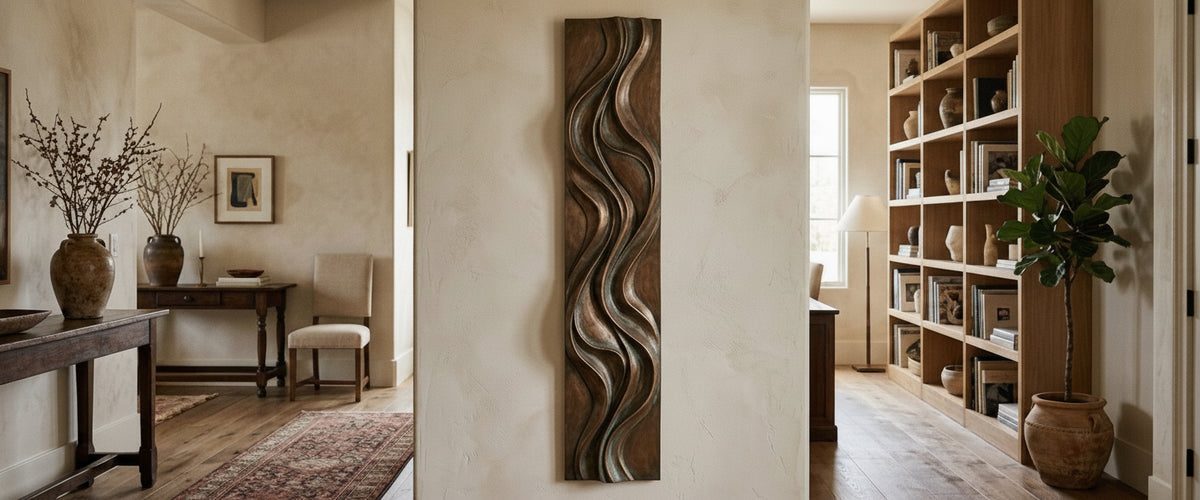
A wall-mounted bronze relief anchors the entrance sight line without stealing walking room.

At a Glance: Hallway Art Key Takeaways
Scale matters more than quantity. One considered piece beats five small frames fighting for a sight line.
Depth is the enemy. In narrow corridors, favor wall reliefs, low-profile metalwork, or slim freestanding forms that do not steal walking room.
Durable materials win. Hallways take knocks, bags, and traffic. Bronze, stainless steel, and stone shrug it off; delicate finishes do not.
Sight lines drive placement. Position art where the eye lands as you enter or turn, not wherever the wall happens to be empty.
Bespoke solves the fit problem. Most hallway frustration comes from buying stock sizes for non-stock spaces.

What Hallway Art Means and Who It Is Best For
Hallway art is any piece chosen to hold a transitional space: an entrance corridor, a landing, a stairwell run, a gallery-style passage between rooms. It covers wall-mounted work and freestanding sculpture, and the search term itself spans everything from casual hallway clip art printables to serious hallway wall art and full sculptural installations. This guide is about the durable, statement end of that scale, the kind of piece you commission once and keep.
It suits a specific buyer. Homeowners in California and the Hamptons who want the entrance hall to signal the quality of the house. Interior designers dressing a long apartment corridor in NYC where every foot of wall counts. Hotel and restaurant owners who know the walk from door to desk is part of the brand. Collectors who have run out of primary wall space and want art in the circulation routes. If you are looking for cheap prints to fill a gap, this is not your guide. If you want hallway art ideas that read as intentional and last decades, keep reading.
How to Compare Hallway Art Options Before Buying
The corridor changes the rules. A piece that works over a sofa can overwhelm a four-foot-wide passage, and a small frame that shines on a feature wall vanishes in a long run. Use these decision criteria before you commit.
Read the corridor width first
Measure the walkable width, then subtract for circulation. A hallway under 4 feet (1.2 m) wide cannot carry deep work without becoming a hazard; you want reliefs, panels, or sculpture that projects a few inches at most. Wider entrance halls and galleried landings can take freestanding pieces on a plinth or console, provided the base does not narrow the path awkwardly.
Match the run length to the piece count
Short hallways want a single anchor. Long ones can support a rhythm of pieces at even intervals, which the eye reads as a curated sequence rather than clutter. The mistake we see most often is a random scatter of small frames; three well-spaced sculptural panels read as design, nine mismatched frames read as an accident.
Decide wall-mounted versus freestanding
Wall-mounted metalwork and relief sculpture keep the floor clear and suit true corridors. Freestanding pieces belong in wider entrance halls, at the end of a sight line, or on a landing where they get breathing room. If your hallway ends in a blank wall or a window, that terminal point is prime real estate for a single strong piece.
Key Materials, Finishes, and Scale Decisions
Hallways are unforgiving. Bags, shoulders, vacuum cleaners, luggage, and daily traffic all pass within inches of the work. That rules out fragile finishes and rewards materials built to take contact.
A polished steel wall piece bounces light down a windowless internal corridor.
Bronze is our default recommendation for hallway sculpture that will get touched. It patinates gracefully, handles handling, and a wall-mounted bronze relief brings warmth to a corridor that painted plaster never will. The Metropolitan Museum of Art notes that bronze has been cast for durable sculpture for thousands of years precisely because it holds fine detail and survives, which is exactly the quality you want in a high-contact space (see the Met's overview of bronze sculpture and casting).
Stainless steel suits contemporary interiors and reflective corridors. A polished or brushed steel wall piece bounces light down a dim passage, which is a genuine advantage in windowless internal hallways. Our stainless steel sculptures collection shows how mirror and satin finishes behave differently: mirror amplifies light and movement, satin stays calmer and hides fingerprints better in a busy home.
Stone and marble bring gravity to entrance halls with the width to carry them. A carved relief panel or a slim marble form on a plinth signals permanence the moment someone steps inside. These are heavier commissions and need wall or floor structure that can take the load, which is a conversation we have early.
On scale: err larger than instinct suggests. Corridors compress perceived size because you view the work at close range and in passing. A piece that looks bold on a mood board often reads as modest once it is up. When in doubt, we mock up dimensions on the actual wall before casting anything.
Where to Place Hallway Art for the Strongest Visual Impact
For wider placement ideas, Professional Office Wall Art That Earns Its Wall: A Placement Guide is useful companion reading before finalising the setting and sightlines.
Placement is where hallway art succeeds or disappears. The rule is simple: put the piece where the eye naturally lands, not where the wall is convenient.
The entrance sight line. As someone opens the front door, their eye travels straight ahead. Whatever sits at the end of that line is the first impression of the whole property. That terminal wall deserves your strongest single piece.
The turn. Where a hallway bends or meets a stair, the eye pauses. A sculpture at that pivot point rewards the pause and pulls people through the space.
Above eye level in tight runs. In a genuinely narrow corridor, hanging relief work slightly higher keeps it clear of shoulders and bags while staying in view. This is a practical fix for hallways where lower placement invites damage.
Landings and galleried stairwells. These often have double-height walls and are the best-kept secret for large sculpture in a home. A tall vertical piece or a suspended metalwork form fills volume that framed prints cannot touch.
Lighting deserves a line of its own. A directional spot or a discreet picture light transforms a relief; without it, even good work flattens in a dim corridor. Plan the lighting as part of the commission, not after.
Budget, Commissioning, and Delivery Considerations
The honest answer on budget is that it depends. Material, scale, complexity, engineering, finishing, and installation all move the number, and a slim brushed-steel wall panel and a carved marble relief sit in very different places. Rather than quote a band that would mislead you, we price each piece to its brief. Tell us the corridor, the material direction, and the effect you want, and we will give you a tailored quote.
A few things worth planning for early. Fixings and structure: heavier wall pieces need secure mounting into studs or masonry, and we specify this per piece. Access: getting a large sculpture through a front door, up a stair, and into a corridor is its own puzzle; we assess access before we build so a finished piece never arrives at a doorway it cannot pass. Lead time: bespoke casting and fabrication take time, and we would rather set a realistic schedule than rush a finish. We ship worldwide, crated to survive the journey, whether the destination is a Napa entrance hall or a hotel lobby in Texas.
How Giant Sculptures Can Help With Bespoke Projects
Most hallway frustration is a fit problem. The space is non-standard, the wall is an odd width, the sight line ends somewhere a stock frame was never designed for. Bespoke work exists precisely for this. As a supplier of large-scale, bespoke sculpture, Giant Sculptures makes pieces to the corridor rather than making the corridor cope with a piece.
That means we can scale a relief to your exact wall run, choose a finish that flatters your existing light, engineer a slim freestanding form that respects your walking width, and match a landing piece to a double-height void. We have worked corridors from tight period hallways to sweeping hotel entrances, and the process starts the same way: measurements, sight lines, material direction, and a clear picture of the effect you are after. If you already have a design or a reference in mind, bring it. If you have only a blank wall and a feeling, we can work from that too.