






































































































Stand two classical figures side by side and most buyers cannot say which tradition they are looking at. That is the problem with shopping for Greek Roman statues online: the thumbnails all read as "white marble man, vaguely heroic". Yet the two traditions were made for different reasons, by different workshops, with different levels of care, and the copies on the market today inherit those differences. Learn four or five tells and you will never mistake a serious piece for a mold-line special again.

Key Takeaways
Greek work idealizes. Perfect proportion, calm expression, athletic anatomy that no actual person owns.
Roman work portrays. Real faces, receding hairlines, jowls, crooked noses, often on a borrowed Greek body.
Struts and tree stumps in a marble figure usually mean the original was bronze; that support is a copyist's structural fix, not a design choice.
Drapery is the quality test. Deep undercut folds that cast real shadow separate careful carving from shorthand.
Format follows architecture. Full figures need height and air; busts and torsos work where ceilings do not.
Bronze outlives marble outdoors in freeze-thaw and coastal climates, which is why most of the large exterior Greek Roman statues we make are cast, not carved.
Idealized Greek Bodies, Roman Faces You Could Pick Out of a Crowd
Classical Greek sculptors were chasing a system. Proportion, balance, the weight shifted onto one leg so the hips and shoulders tilt against each other. Faces are composed to the point of blankness because the subject is usually a god, an athlete or an idea rather than a named neighbor. Roman patrons wanted something else entirely: recognition. Republican portrait heads carry warts, deep nasolabial lines and thinning hair, because political credibility came from looking like a man who had lived through things. That gap in intention runs through almost every pair of Greek Roman statues you will ever compare.
That split is the fastest way to sort Greek Roman statues in a catalog. If the head could belong to anyone and the body is flawless, you are in Greek territory. If the head has a specific, slightly unflattering personality and sits on an athletic torso, you are looking at a Roman convention: a portrait head grafted onto an idealized body. A life-size Greek warrior reads as an archetype from thirty feet away. A pair of Roman soldiers reads as two individuals standing guard.
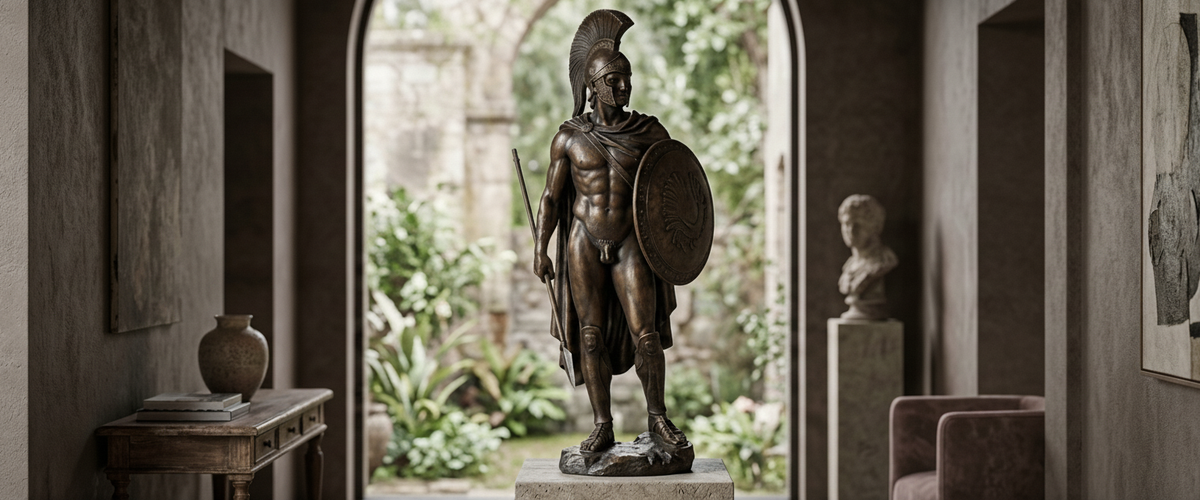
The idealized Greek body next to a Roman portrait head: the same silhouette, two very different intentions.

Marble Copies of Bronze Originals: The Strut Gives the Game Away
Most of the famous "Greek" marbles, and a good share of the Greek Roman statues sold today, are Roman marble copies of Greek bronzes. Bronze is strong in tension, so an original could throw an arm out into space or balance on one foot. Marble cannot do that; it snaps. Copyists solved it with struts between wrist and hip and with tree trunks, dolphins or rocky supports jammed against a leg. The British Museum collection is full of these giveaways once you know to look, and the Townley marbles are a good place to start.
For a buyer of Greek Roman statues, this matters practically. If you like a pose with extended limbs and you want it outdoors, cast bronze removes the support entirely and gives you a cleaner silhouette. Where an extended spear arm and a free-standing leg need to be legible from every angle, a cast figure such as the Life-Size Classical Greek Warrior Bronze Statue at 250cm holds the pose without a stump propping it up. If you love the strut and the stump, keep them; they are historically honest. What you should not accept is a resin or composite figure that copies a marble strut it does not structurally need, because that is a copy of a copy of a solution to a problem nobody was solving.
Hellenistic Drapery Versus the Roman Workshop Shorthand
Hellenistic carvers treated fabric as a performance. Wet drapery clinging to a thigh, folds cut deep enough that the shadow does the modeling, fabric that behaves as if wind is moving through it. Later Roman production workshops, turning out copies at volume for villas and baths, often flattened all of that into parallel grooves. Same pose, a fraction of the labor, and that same gap still splits the Greek Roman statues being carved and cast today.
Run your eye along the folds on any of the Greek Roman statues you are considering. Do they cross and pool where the body is actually holding the cloth, or do they run down in tidy tram lines? Undercutting is the expensive part of carving and the first thing a cut-price studio abandons. In bronze, the equivalent tell is chasing: after casting, a good foundry spends days working the surface back so hair, sinew and cloth edges stay crisp. Skip that stage and everything softens.

Which Greek Roman Statues Suit a Formal Garden, and Which Belong in an Entrance Hall
Greek figures hold their own in open space. The silhouette is simple, the pose is self-contained, and a single athlete or deity at the end of a long allée or on a lawn axis will carry the view without competing with planting. Roman narrative pieces want architecture around them. Portrait busts, soldier pairs, chariot groups: these were designed for courtyards, colonnades and thresholds where you approach them head-on.
A flanking pair at 210 cm framing an entry: Roman narrative pieces want architecture behind them.
We shipped a pair of Roman soldiers at around 6 ft 11 in (210 cm) to a Dallas motor court, set either side of the entry rather than out on the lawn, and the flanking arrangement did more work than a single larger figure would have. Bigger Greek Roman statues change the logic again: a Monumental Classical Roman Chariot with Warrior and Horses Bronze Sculpture - 350cm needs a long approach so the horses can be read in profile as you drive or walk past. Set it in a tight courtyard and you lose the movement.
Climate should decide material before taste does. Marble is calcium carbonate and dissolves slowly in acidic rain, and conservation guidance on collections care is consistent about the rest: outdoor stone suffers most from water ingress and freeze-thaw cycling. That is why we steer clients in cold-winter and coastal regions toward bronze for exterior Greek Roman statues and save marble for loggias, atriums and interiors.
Full Figure, Bust or Torso: Match the Format to the Ceiling You Actually Have
Buyers routinely order full-figure Greek Roman statues for a room that cannot take one. A life-size figure plus plinth wants headroom above it, and a good rule is at least 18 in (45 cm) of clear air between the crown of the head and the ceiling, more if there is a light fixture nearby. Below about 9 ft (2.7 m) of ceiling, a full figure starts to feel like it is ducking.
That is where busts and torsos earn their place. A Roman portrait bust on a pedestal delivers the whole character of the tradition at a fraction of the footprint, and our marble busts and torsos suit hallway consoles, library niches and stair landings where a standing figure would crowd the circulation. Fragmentary torsos read as modern even though the convention is ancient, which makes them the easiest of the Greek Roman statues to place in a contemporary apartment.
Carving and Casting Checks Before You Buy
Check the back. Cheap Greek Roman statues are finished on the display side only. A serious piece is modeled all the way around.
Look into the hair and beard. Drill work and undercutting should create genuine shadow, not surface scratching.
Find the seams. On bronze, welded section joins should be chased and patinated invisibly. Visible ridges mean rushed finishing.
Ask about wall thickness and armature. Large outdoor bronzes need internal steel and drainage so water cannot sit inside.
Ask how the patina was applied. Heat-applied chemical patina with a wax or lacquer topcoat behaves very differently from sprayed paint.
Confirm the fixing detail. Anchor bolts, dowel positions and a rated base plate matter more than any surface detail once wind loads are involved.
Check the eyes. Ancient originals often had inset eyes; flat, lifeless eye treatment is where budget reproductions collapse.

Commissioning Greek Roman Statues at Scale
Plenty of clients start by searching for Greek-Roman statues for sale, then realize the pose, height or subject they want does not exist off the shelf. That is normal, and it is most of what our studio does. A bespoke route lets you set the exact height for a specific sightline, adjust a pose so an arm does not project into a walkway, or commission a portrait head in the Roman manner from photographs.
Budget on bespoke Greek Roman statues depends on material, finished scale, anatomical complexity, engineering for wind and seismic loads, base and plinth work, and the level of hand finishing you want, so the only honest answer is a tailored quote against your drawings or site photos. Giant Sculptures crates and ships worldwide, and enquiries for Greek and Roman statues for sale in Australia, Canada and across the US all follow the same process: agreed maquette, approved finish sample, then production. Browse the classical Greek and Roman collection to fix a reference point, then tell us what needs to change.
For wider placement ideas on Greek Roman statues, How to Read a Roman Marble Torso Sculpture Before You Buy is useful companion reading before finalizing the setting and sightlines.