





































































































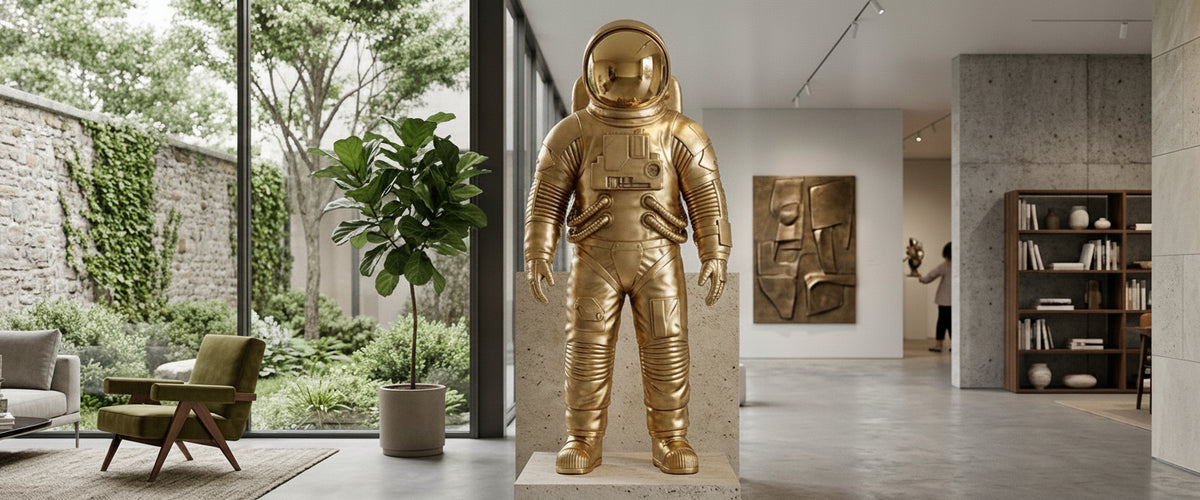

Gold reads as either confident or cheap, and there is almost no middle ground. Get the finish and the scale right and a gold astronaut sculpture becomes the piece everyone photographs on the way into a building. Get them wrong and you have a shiny mannequin in a hard hat.
The astronaut has become one of the most requested contemporary figures we quote on, and gold astronaut sculptures dominate that demand. The look borrows from a real visual source: the gold-coated visor used on flight helmets to filter solar radiation, which is why the figure feels futuristic and historic at the same time. What buyers rarely think about is that "gold" describes at least four very different manufacturing routes, each with its own cost, lifespan and maintenance profile.

At a Glance
Gold is a finish, not a material. Gilded bronze, golden patina, gold-toned lacquer over steel and PVD titanium nitride coating all look different in daylight.
Outdoors changes everything. UV, salt air and pollution attack coatings long before they attack the metal underneath.
Scale beats detail. A gold astronaut sculpture at 8 ft (2.4 m) reads as a figure; at 20 ft (6 m) it reads as architecture.
Mirror-bright gold shows every fingerprint. Satin and brushed golds are far more forgiving in high-traffic lobbies.
Budget depends on material, scale, engineering, finishing and installation. Ask for a tailored commission quote rather than working from a headline figure.
A head-on approach and a plain backdrop do more for the figure than any amount of surface detail.
What a Gold Astronaut Sculpture Says, and Who Buys One
The astronaut is a rare contemporary subject that works across wildly different briefs. Tech campuses read it as ambition. Hotels read it as playfulness. Private collectors tend to read it as optimism, which is why we see the figure going into Napa courtyards and Aspen entry drives as often as into corporate atriums. Adding gold pushes it further from science and closer to iconography: the suit stops being equipment and starts being a monument.
Three buyer types come to us most often for a gold astronaut sculpture. Developers who need a landmark at a plaza entrance and want something that photographs well from a phone at street level. Hospitality groups fitting out a lobby or rooftop who need a single object to carry the whole room. And private clients, usually with a modern build and a long sightline, who want a figure that does not look like a garden ornament. Each of those needs a different height, a different finish sheen and a different base strategy.
It is worth being honest about the risk. Because the subject has become popular, a badly proportioned gold astronaut sculpture looks derivative fast. The details that separate a serious piece from a novelty are the suit's fabric folds, the depth of the joint rings, the weight of the boots and whether the helmet has real optical presence rather than a flat painted disc.
Gilding, Golden Patina or Coated Steel: The Finish Decision
This is the single most consequential choice you will make on a gold astronaut sculpture, and it is the one most buyers skip past.
Gilded Bronze
Genuine gold leaf applied over a prepared bronze surface gives a warmth and depth that no paint reproduces. Gold does not corrode, which is why gilded surfaces on historic architecture survive centuries when the substrate and size layers are sound. The technique itself is old and exacting; Tate's summary of gilding is a good primer on why the preparation layers matter as much as the leaf. On a large figure it is labor-heavy, and outdoor gilding needs specification for exterior-grade materials rather than interior leaf. If you want to judge how leaf behaves across deeply modeled surfaces before committing to a gilded gold astronaut sculpture, a piece like the Monumental Classical Winged Angel Bronze Sculpture (Gilded Gold) - 300cm (roughly 9 ft 10 in) is the closest analogue we have to a spacesuit's ribbing and pressure seams: the same folds, undercuts and tight junctions where gilding either sings or fails.
Golden Patina on Bronze
A chemically induced warm patina gives you a gold register without the reflectivity or the leaf budget. It ages honestly, deepening rather than failing, and it is easier to touch up in place. If your site is coastal or heavily shaded, a patinated gold astronaut sculpture is often the smarter long-term route. Put a patinated piece such as the Large Classical Kneeling Angel Bronze Sculpture (Golden Patina) - 200cm beside a gilded one in daylight and the choice usually makes itself: less flash, more depth, and a maintenance schedule that forgives a missed season.
Coated and Plated Stainless Steel
For a hard, mirror-bright gold astronaut sculpture, stainless steel with a PVD-applied titanium nitride coating gives that machine-made sci-fi quality. It suits minimalist architecture and reflects sky and surroundings, which can be an asset or a distraction depending on the site. Coatings are thin. Scratches are difficult to repair invisibly, so specify this route where the piece is protected from trolleys, luggage and hands.
Lacquered Gold Over Metal
The most cost-controlled route and the most variable in quality. Done well with automotive-grade systems and UV-stable clear coats, a lacquered gold astronaut sculpture holds up. Done cheaply, it yellows or clouds within a few seasons. Ask what the clear coat is, how many layers, and what the refresh interval looks like.
Close up, the joint rings and pressure seams reveal whether a finish was applied by hand or sprayed on.
Scale: The Number Most Buyers Get Wrong
Astronauts are deceptive. The suit's bulk makes the figure look larger in a photograph than it feels on site, so a gold astronaut sculpture ordered at life size often lands underwhelming. Our rule of thumb: in an open plaza or a large garden, start at 10 ft (3 m) before you consider anything smaller. Indoors, measure your ceiling height and subtract at least 3 ft (0.9 m) of visual breathing room above the helmet.
At the top end, a Monumental Contemporary Astronaut Bronze Sculpture - 800cm (about 26 ft) stops being a sculpture you look at and becomes a landmark people orient by. That scale needs foundation engineering, wind-load calculation and crane access planned months ahead, not as an afterthought. Browse the large astronaut sculptures range to calibrate what different heights actually feel like against a person.
One more scale note from the studio floor: a gold finish visually enlarges a piece outdoors because it catches light against sky and foliage, but it visually shrinks a piece in a dark interior. If your lobby has low light and dark stone, size up.

Where to Place a Gold Astronaut Sculpture
For wider placement ideas, The Astronaut Sculpture in a Church: How Space Age Figures Read Against Sacred Stone is useful companion reading before finalizing the setting and sightlines.
Arrival points. Hotel porte-cochere, office plaza, gallery forecourt. The figure works best where people approach it head-on and slow down.
Against sky, not against clutter. Gold needs a plain backdrop. A hedge wall, a rendered facade or open sky. Never a busy planting scheme.
Water and reflection. A shallow reflecting pool doubles a gold astronaut sculpture and works especially well on contemporary builds with long, flat sightlines.
Stairwell and atrium voids. A suspended or seated figure viewed from multiple floors gives you three different compositions for one purchase.
Avoid full-day southern sun on lacquer. If the site is brutal, choose gilding or patinated bronze over coated finishes.
A useful test before you commit to a gold astronaut sculpture: mock up the footprint in plywood or cardboard at true height and live with it for a week. We have had clients move a planned location by 15 ft (4.5 m) after doing exactly that, and the piece was better for it.
Care Checklist for Gold Finishes
Rinse outdoor pieces with clean water every few months; more often within a mile of the coast.
Use pH-neutral soap and soft cloths only. No abrasives, no solvent wipes, no pressure washing.
Inspect coated steel annually for chips at edges and joints, where failures start.
Wax patinated bronze on the schedule your supplier specifies, usually seasonally in exposed sites.
Keep sprinkler heads pointed away. Hard water spotting on gold is the most common complaint we hear.
Photograph your gold astronaut sculpture each year from the same angle so you can spot slow change.
Budget, Commissioning and Delivery
Cost on a gold astronaut sculpture is driven by six things: the base metal, the finished height, the complexity of the form, the internal armature and engineering, the finishing method, and installation access. A gilded 12 ft bronze and a lacquered 12 ft fabricated steel figure are not remotely comparable pieces even though they occupy the same silhouette. We quote each project individually because the site usually dictates more than the design does.
Lead times reflect casting or fabrication, finishing, curing and freight. Monumental work involves sectional casting, welding, chasing and on-site assembly, so bring us in during the design phase rather than after the paving is poured. Site access is the detail that derails schedules most often: gate widths, turning circles, overhead cables and crane standing positions.
Shipping worldwide from a UK base means crating, customs documentation and insurance are part of the conversation from day one. We have shipped monumental bronze into gated communities where the only viable approach was a 4 a.m. crane lift before residents woke up. That kind of logistics planning is not glamorous, but it is what keeps an installation from becoming a story.
Commissioning a Bespoke Gold Astronaut Sculpture with Giant Sculptures
Bespoke is where this subject gets interesting. A catalog figure gives you a proven form; a commission lets you change the pose, the helmet treatment, the suit detailing, the base integration and the finish sheen to suit a specific building. Clients have asked us for seated figures on plinth benches, figures caught mid-stride, and helmets treated as polished mirrors against a satin gold suit. That last combination photographs exceptionally well and is one of the few times we recommend mixing two sheens on one piece.
Our process runs from reference sketches to a scaled maquette, then material and finish samples you can view in your own daylight before anything is committed to full scale. For clients weighing a gold astronaut sculpture against other contemporary figures, the wider astronaut sculptures and space art collection is a good place to compare poses and heights before the brief is fixed.
Buy for the next twenty years, not the next twenty photographs. A gold astronaut sculpture specified properly in bronze or engineered stainless steel will outlast the building trends around it. Send us the site plan, the sightlines and a sense of the mood you want, and we will tell you honestly what scale and finish the location can carry.