





































































































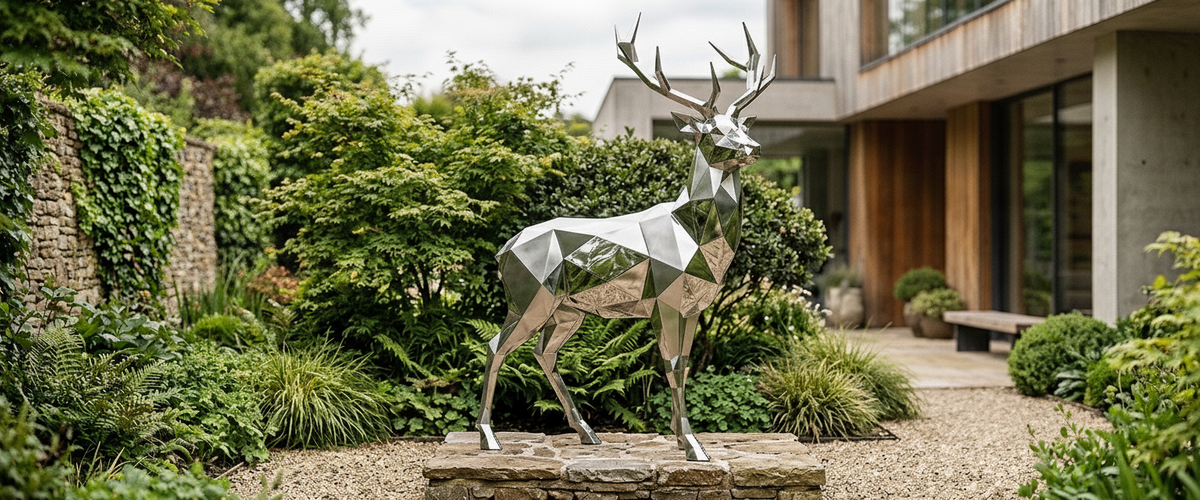

A geometric sculpture can look razor sharp in a catalog photograph and then read like a gray lump in your entrance hall. Same object, same finish, same angles. The variable is light, and light is the thing most buyers never test before they commit. Get the planes deep enough and the position right, and a geometric abstract sculpture will redraw itself three or four times between breakfast and dusk.

Key Takeaways
Depth over count. Twelve deep, decisively angled planes outperform forty shallow ones at any scale.
Overhead light kills angles. Grazing or raking light at a low angle rebuilds them.
Finish changes behavior. Mirror-polished steel throws light outward; patinated bronze keeps it in the creases.
Shadow needs a surface. A faceted form stranded in the middle of an open floor loses half its drawing.
Photograph a mock-up in the actual spot at morning, mid-afternoon and after dark before anything gets cut.
What a Geometric Sculpture Actually Is
Strip it back and a geometric sculpture is a form built from flat planes, straight edges and measurable angles rather than smooth organic curves. The subject can be pure abstraction, a block, a crystalline mass, or a recognizable animal reduced to polygons. The vocabulary descends from Cubism and early twentieth-century constructivist work, where artists broke figures into intersecting planes instead of modeling them in the round. The Museum of Modern Art's summary of Cubism is a useful primer on where that language started.
If you need to describe a geometric sculpture to a designer or a fabricator, skip adjectives and give numbers. How many major planes? Which direction do the dominant edges run, vertical, diagonal or horizontal? Is there a single symmetry axis or none? How much of the silhouette is solid mass and how much is void? Four answers like that communicate more than a paragraph of prose, and they are exactly what our studio needs when a client sketches an idea on hotel notepaper.
Facet Depth Beats Facet Count
Buyers often assume more facets means more drama. The opposite is usually true. Forty shallow planes on a five-foot form create dozens of near-identical tonal steps, and from ten feet away they blur into one soft gradient. Twelve deep planes with real angular difference between them hold separate values of light and dark, so the geometric sculpture stays legible across a lawn or a double-height lobby.
Scale amplifies this. The larger the piece, the deeper the planes need to be, because viewing distance grows with height. Where a faceted animal has to hold its shape from across a lawn, a form like the Noble Deer III Geometric Steel Sculpture survives at roughly six and a half feet (198 cm) because the planes running down the neck and haunch are long and committed, not nibbled. When we develop a bespoke geometric sculpture, plane depth is the first thing we push before anything else is refined.

Flat Ceiling Light Flattens Angles, Raking Light Rebuilds Them
Recessed downlights sitting directly above a geometric sculpture are the most common lighting mistake we see in new-build interiors. Light falling straight down hits every upward plane with the same intensity and leaves the vertical planes in identical shade. The result is two tones instead of eight.
Move the source. A narrow-beam fitting positioned off to one side, throwing light across the surface at a low angle, gives each plane a different value and pulls the edges into focus. Conservators call the same technique raking light when they use it to reveal surface detail on an object, and it works for the same reason in a living room. One well-aimed low-angle source beats four symmetrical ceiling cans every time.
One Form, Three Sculptures in a Single Day
Track a geometric abstract sculpture outdoors and you get three distinct objects. At nine in the morning, low sun rakes across one side and the shadowed planes go almost black, so the silhouette dominates. By two in the afternoon, high overhead sun compresses the tonal range and the piece reads as a bright, graphic mass with a tight shadow pooled underneath. After dark with a single uplight, the whole logic inverts: shadows climb upward and the facets you barely noticed at noon become the loudest part of the form.
A mirror finish pushes that swing further. Where the setting has sky, gravel and planting worth borrowing, a reflective block such as the Silver Mirror-Polished Geometric Block Stainless Steel Sculpture at just under five feet (150 cm) will change with weather as well as time of day. Place one near vines or autumn planting and the polished planes borrow that color, running warm and coppery in late afternoon, then flattening to plain silver under cloud.
Polished Steel Throws Light Outward, Patinated Bronze Holds It In
Choosing between finishes is really choosing how you want light to behave across a geometric sculpture. Mirror-polished stainless steel reflects its surroundings and projects brightness back at the viewer, which suits contemporary architecture, water features and open skies. It also shows fingerprints and pollen, so it wants cleaning more often than buyers expect. Browse the wider geometric sculptures range and you can see how differently a satin-brushed surface behaves against a polished one.
Patinated bronze does the opposite. A dark or verdigris patina absorbs light and lets it collect in the valleys between planes, so the piece reads as depth rather than shine. That suits mature planting, stone terraces and older properties where a mirror surface would feel loud. Corten steel splits the difference, sitting warm and matte against green. Long-term care differs too; outdoor bronze wants periodic waxing, and the Getty Conservation Institute publishes solid technical background on protecting metal sculpture outdoors. Our bronze abstract sculptures show how faceted geometry translates into cast metal.

Plinth Height and the Angle That Stops a Solid Reading as a Lump
A faceted solid placed straight on the ground presents its top planes to nobody. You look down at it, the silhouette is lost against paving, and the piece reads as a boulder. Lifting it changes the geometry of your sightline, not just the height of the object.
Work out where people will stand first, then set the plinth so the widest, most angular section of the geometric sculpture falls near eye level from that spot. For a seated terrace, that usually means a lower base than you would choose for a driveway where people pass standing. Get the plinth material to disagree with the work as well: a honed stone base under polished steel reads intentional, while a polished base under polished steel dissolves the join.
Shadow Needs a Wall
Here is the placement rule that saves the most regret. A faceted form set in the middle of a wide open floor or a big lawn has nowhere to project its shadow, so you lose the second half of the artwork. Put a surface behind it, a rendered garden wall, a hedge run, a limestone chimney breast, and the piece starts drawing on that surface as the sun moves.
Where floor space is genuinely tight, wall-mounted work is the better answer. Metal wall sculptures with geometric designs solve this exact problem: a relief panel lit from one side gives you the shadow play without asking for square footage. The contemporary and modern sculptures collection is a good place to compare freestanding and wall-based options side by side.
Test the Light Before You Cut
Mark the exact footprint with tape or a cardboard mock-up at full height.
Photograph the spot at roughly 9am, 2pm and 8pm, same position, same phone, no filters.
Check the 2pm shot hardest; if the form flattens there, plane depth needs increasing.
Look at what sits behind the piece in every frame. That background becomes part of the artwork.
Test your intended night lighting with a single handheld lamp before you wire anything.
Confirm the base pad, fixings and access route for delivery while the tape is still down.
A small faceted piece is a cheap way to run this test properly. Set something like the Cubic Geometric Steel Sculpture at around 30 inches (75 cm) in the intended position for a week, and you learn how angles behave in your specific light before committing to a full-scale geometric sculpture.

Commissioning a Geometric Abstract Sculpture
Bespoke geometric work is largely an engineering conversation. Plane count, wall thickness, internal framing, wind loading, fixing detail and finish all move the cost, as do scale, site access and installation. Rather than guess, send us the site photographs, ceiling or sky height, and the viewing distances, and we will quote the piece properly. Giant Sculptures builds large-scale bespoke geometric sculpture in stainless steel, bronze, Corten and stone, and the pieces that succeed are the ones where light was tested first and the metal was cut second.
For wider placement ideas, Geometric Wall Art Lives or Dies on Facet Depth is useful companion reading before finalising the setting and sightlines.