





























































































Most geometric wall art fails for a reason nobody puts in the product description: the facets were cut to the wrong depth for the room they ended up in. A panel designed to be read from ten feet (3 m) gets hung at the far end of a forty-foot (12 m) lobby and the pattern dissolves into texture. Run it the other way and a deep sculptural relief lands above a sofa, where by mid-afternoon the recesses have merged into one dark mass. Depth is the deciding variable, and it is the one buyers almost never ask about before they order.
Looking for the full range in this category? Browse our Wall Art & Wall Decor collection for every available finish, size, and configuration.

Quick Answer
Shallow relief, roughly half an inch to an inch and a half (13 to 40 mm), holds a crisp pattern at close range and near-frontal light.
Deep relief, three inches (75 mm) and beyond, needs distance and side light or it turns into shadow soup.
Measure the actual viewing distance before you pick a panel. Sofa at ten feet and reception desk at forty feet are two different commissions.
Judge the finish on the corner, not the flat face. Powder coat softens an arris; brushed metal sharpens it.
Ask what goes behind the panel. Cleats, standoffs and wall flatness decide whether it sits true or bows.
Shallow Facets Hold Their Pattern, Deep Ones Collapse into Shadow
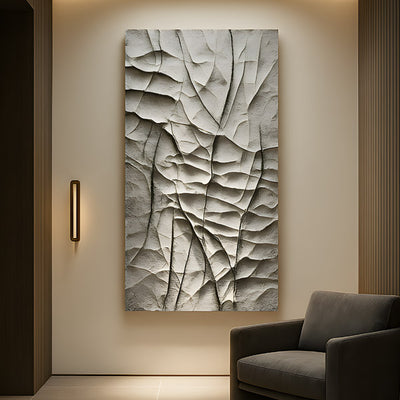
A faceted panel only exists because of the shadow it casts on itself. Change the light angle and you change the artwork. Shallow geometric wall art keeps its lines legible under almost any lighting because each facet throws a thin, controlled shadow that follows the edge. Deep faceting throws long shadows, and long shadows overlap. Once they overlap, the individual planes stop reading as planes and the whole surface goes murky.
Grazing light is the usual rescue. Aim a wash from roughly thirty degrees off the wall plane and the facets pick up a bright face and a dark face; light it flat from the front and the same panel looks like a photograph of itself. The Illuminating Engineering Society publishes guidance on wall-grazing and wall-washing angles that is worth reading before you finalize a lighting plan, because the fixture position matters at least as much as the sculpture you hang under it.
A shallow relief read under a thirty-degree graze: bright face, dark face, legible pattern.
The Viewing Distance Nobody Measures
Stand where people will actually stand. In a living room that is usually eight to twelve feet (2.5 to 3.7 m) from the wall, seated, with eye level lower than the panel center. In a hotel lobby it might be forty feet (12 m), moving, with the artwork seen at an angle first and head-on second. Module size in geometric wall art should scale with that distance. Facets that are four inches (100 mm) across read beautifully over a dining table and vanish at the far side of a corporate atrium.
We shipped a modular relief to a Napa winery tasting room where the client insisted on a fine, shallow pattern. It looked superb from the bar, six feet away. From the terrace doors, thirty feet back, it read as a beige rectangle. The fix was not a new panel; it was a second, larger-module band added above, so the composition worked at both distances. Two viewing distances, two scales of geometry.

3D Printed Panels, Welded Steel and Cast Facets Each Give Away Their Seams
Every fabrication route leaves a signature, and raking light finds it. Geometric wall art 3D print work is fast, precise and excellent for prototyping complex parametric surfaces, but layer lines run horizontally across every facet and catch side light exactly where you wanted a clean plane. Good print work is sanded, filled and coated; unfinished print work announces itself the moment a spotlight hits.
Welded steel gives the crispest arris of any method, provided the welds are dressed back flush before finishing. Large steel geometric panels are almost always built in sections, so ask where the section joints fall and whether they land on a facet edge (invisible) or mid-plane (obvious forever). Cast facets, in bronze or aluminum, need draft angles to release from the mold, which quietly rounds off the very corners you were buying the piece for.
Carved and machined timber sits somewhere in the middle: warm, matte, and forgiving of tool marks because the grain absorbs them. For a residential wall lit by daylight and a couple of table lamps rather than a dedicated fixture, a shallow carved grid such as Barwick Taupe Grid Abstract 3D Carving Wall Art holds its rhythm better than a deep metal relief that depends on a tight grazing angle to make sense.
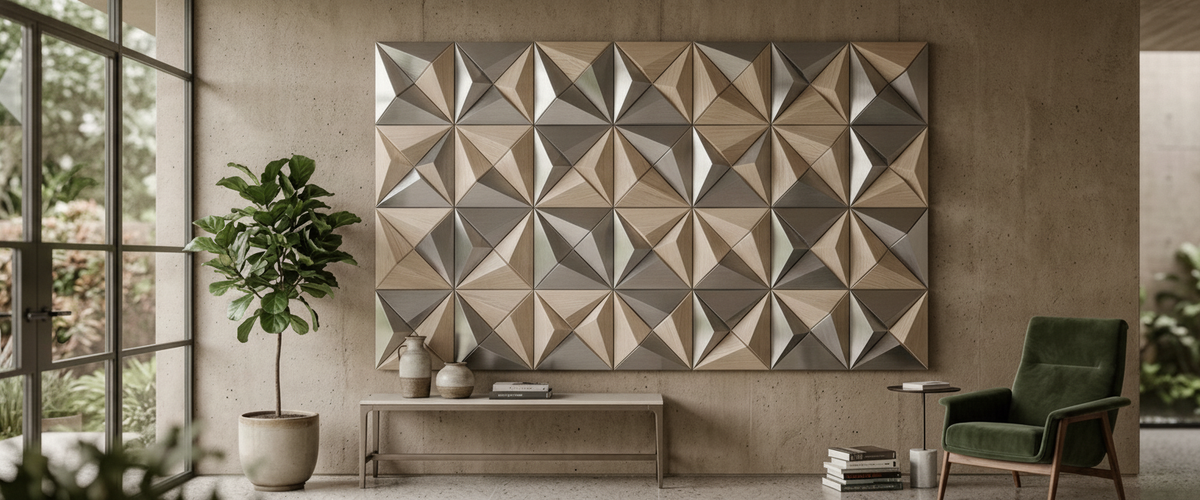
A module grid sized for long-range viewing, with joints hidden on facet edges rather than mid-plane.
One Continuous Form or a Repeating Module Grid
Hotels and offices almost always choose modular geometric wall art. It ships flat, it goes up the service elevator, damaged units can be swapped without replacing an entire wall, and the grid can grow to fit an unusual bay. Private homes lean the other way, toward one continuous form with a composition that has a clear beginning and end, because a single sculptural gesture reads as art rather than as cladding.
Color changes the calculation too. Where the geometry has to carry the wall without help from the lighting, a gradient or multi-tone treatment like Alverton Multicolour Geometric Stripe Acrylic 3D Wall Art adds a second layer of pattern that survives flat, frontal light, while a single-tone relief in the same position would rely entirely on shadow. Browse the wider geometric art and 3D wall art collections to see how modular and continuous compositions behave differently at scale.

Finishes Are Judged on the Corner, Not the Face
Samples of geometric wall art are usually photographed flat-on, which hides the only thing that matters. Powder coat lays down a measurable film, and that film builds and rounds where two planes meet, blunting the edge slightly; the Powder Coating Institute covers film-build behavior in detail. It is a fine choice for softer, painterly geometry. Brushed stainless does the opposite: the directional grain runs to the arris and stops dead, so the corner reads as a bright line. Mirror polish is the riskiest, because it reflects the room instead of describing its own form, and every ripple in the substrate shows.
Where reflection is the actual intent rather than an accident of finish, a lens-based composition such as Lumicast Gold Cascade Crystal Lens 3D Wall Art is closer to the right design language than a polished faceted panel, because the room is broken across many small elements instead of distorted across one large mirror.
When you request samples, ask for a corner sample, not a swatch. Look at it from forty-five degrees. That is the honest view.
Wall Depth, Standoffs and Cleats
A faceted panel is only as flat as the wall behind it. Long panels telegraph any bow in the substrate, and the shadow lines exaggerate it. Interlocking French cleats spread load and let a heavy panel sit tight; standoffs push the piece off the wall by an inch or two (25 to 50 mm) and add a floating shadow gap, which can rescue a shallow design by giving it one strong outer shadow. Confirm stud spacing, substrate type and total weight early, because a masonry wall, a metal-stud partition and a timber frame each need a different fixing schedule.
A Buyer's Checklist Before You Commit
Measure the primary viewing distance and the secondary one, if people also see the wall from a corridor or mezzanine.
Decide the light source position first, then the facet depth.
Ask for facet depth in inches or millimeters, not adjectives.
Request a corner sample in the exact finish.
Confirm whether the piece is one panel or a module grid, and where the joints fall.
Check wall substrate, stud spacing and total weight with your installer.
For interiors near south-facing glass, ask about UV stability of any pigmented surface.
Ask what cleaning the surface tolerates; deep recesses collect dust faster than flat canvases.

Fixing Geometric Wall Art That Already Reads Flat
Three options, in order of cost. Relight it: move the fixture closer to the wall and raise the grazing angle before you do anything drastic. Respace it: if the piece is modular, widening the gaps between units introduces new shadow lines and can transform a dull grid. Rebuild deeper: when the wall is genuinely too big for the geometry, the answer is a commissioned panel cut to the room's real dimensions.
That last route is what our studio does most. Giant Sculptures builds bespoke geometric wall art to specified depth, module size, finish and fixing method, in metal, timber, stone and engineered composites, for residences, hotels and commercial atriums. Cost depends on material, overall scale, facet complexity, structural engineering, finishing and installation, so the sensible next step is a tailored quote with your wall dimensions, ceiling height and lighting positions to hand. If you are leaning toward metal, the metal wall art range is a useful starting point for judging how different finishes hold an edge.
For wider placement ideas, Black Metal Wall Art Lives or Dies on the Wall Behind It is useful companion reading before finalising the setting and sightlines.