

































































































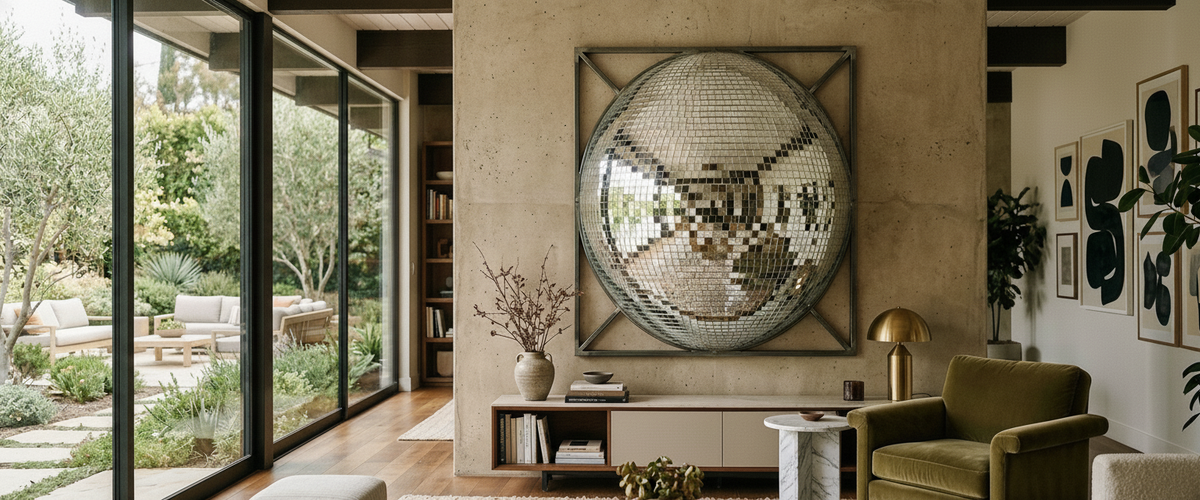

The mirror ball spent a century on the ceiling, spinning on a motor, spraying light over everybody's head. Then designers took it down, cut it in half, and bolted it to the wall. Disco mirror wall art is what came out of that decision: mirrored half-spheres, faceted discs and tiled fields that stay perfectly still while the room moves around them. Done well, it turns a flat wall into the most photographed surface in the building. Done badly, it fires reflected light straight into a guest's eyes at dinner.

Key Takeaways Before You Buy
Movement comes from the room, not the piece. Disco mirror wall art only reads as alive where people, drinks and light are already moving.
One large form beats a scattered grid in almost every architectural setting, especially stairwells.
Ceiling height decides everything. Under about 8 ft (2.4 m), reflected point sources hit people at eye level.
Glass tile reads richer; mirrored acrylic is lighter and safer in high-traffic or elevated positions.
Budget depends on scale, substrate, tile density, engineering and install access. Ask for a tailored quote rather than assuming a wall piece costs less than a freestanding one.
The Mirror Ball Came Off the Ceiling and the Wall Gave It a New Job
A hanging mirror ball is a light machine. It needs a motor, a beam and a dark room. Take that same faceted surface, mount it flat or as a relief on a wall, and its job changes completely. It stops distributing light and starts collecting the room: bodies, glassware, neon, the amber of a back bar. Mirrored glass has been made by silvering since the nineteenth century, and it holds colour rather than simply bouncing brightness, which is exactly why it works better as a static composition than most buyers expect. The Corning Museum of Glass is a good place to see how differently silvered, antiqued and clear mirror surfaces behave.
That is the mental shift. You are not buying a light effect. You are buying a surface that edits whatever is in front of it, which is why placement decides the success of disco mirror wall art long before finish does.
Behind a Bar, Reflections Read as Movement
Back bars are the single most forgiving home for disco mirror wall art. The room already moves: bartenders reach, glassware swings, pendant lights sit low and warm. A mirrored half-sphere or a tiled panel set behind the bottle line picks up all of that and multiplies it without a motor or a single extra fixture.
Scale matters more than tile size here. A piece under roughly 3 ft (0.9 m) across disappears behind bottles and hardware. We fitted a pair of oversized mirrored half-spheres for a members' club in Austin where the first mockup was too polite; going up to a form closer to 5 ft (1.5 m) wide was what finally made the wall hold the room. If you are working out proportions against a long bar, the mirror art collection viewed alongside larger sculptural panels gives you a realistic sense of how quickly a wall swallows a modest piece.
A 5 ft mirrored half-sphere behind the bottle line, collecting glassware and pendant light instead of throwing beams.
Salon and Studio Walls: Mirrored Tiles That Flatter Clients
Salons, treatment rooms and photography studios want reflection without glare, and that is a lighting problem as much as an art problem. Disco mirror wall art belongs in these rooms only once the lighting is solved. A dense field of small mirror tiles under a bright downlight creates hundreds of hard points, and clients sitting still for forty minutes will feel every one. Diffuse the light source, or choose a piece with larger facets and some depth so the reflections break up softly.
Mixed-material work is often the smarter buy in these rooms. Where a wall needs light-catching rhythm rather than mirrored glare, something like Aurelios Cosmic Blue Crystal Porcelain & Gold Orbit 3D Wall Art keeps the orbital language of a mirror ball while the porcelain and metallic passages absorb enough light to stay comfortable to sit opposite. The Illuminating Engineering Society publishes useful guidance on glare control if your fit-out team is specifying the lighting at the same time.

Stairwells and Landings: One Sphere on the Half-Turn Beats a Scattered Grid
Stairwells tempt people into grids. Resist. A scattered arrangement of small mirrored discs up a flight looks busy from the treads and chaotic from the landing, because your sightline changes with every step. Disco mirror wall art earns its place on a stair through a single hero form: one substantial sphere or disc positioned on the half-turn, seen from three different heights, gives you three different pieces of art for the price of one commission.
Reflective work is not always right for a stair, though. Double-height stairwells with south-facing glass can turn a mirrored surface into a nuisance by mid-afternoon. In those situations a carved relief with real depth does the same architectural job with none of the glare, and at that height a tall panel such as Apollo and the Muses Marble Relief Wall Art, 180cm holds the wall through shadow rather than shine.
Low-Ceiling Rooms and Dining Walls: Where Reflected Glare Ruins the Evening
Here is the failure case nobody warns buyers about. In an apartment with an 8 ft (2.4 m) ceiling, a mirrored piece sits at roughly seated eye level. Add a chandelier or a run of spots and every guest on one side of the table spends the meal looking into small bright points. It is worse in homes with big west-facing windows, where late sun turns the whole surface into a floodlight for an hour.
If the room is low and the wall is long, go textural instead. A sculpted timber piece such as Barwick Charcoal Flow Abstract 3D Carving Wall Art delivers relief and shadow play across a wide span without a single reflective facet. Save the disco mirror wall art for the hallway, the bar corner or the powder room, where people pass through rather than sit.
Glass Tile or Mirrored Acrylic: Which Venue Forgives Which Surface
Real silvered glass tile has depth. The reflection sits slightly behind the surface, colours stay true, and the piece ages like a mirror, not like plastic. It is heavier, it needs proper fixings into structure, and a hard knock chips it.
Mirrored acrylic is lighter, safer overhead, and easier to curve over a large sphere. It also scratches, and cheap grades develop a faint distortion that shows badly at scale. Our rule of thumb for disco mirror wall art: glass tile for reachable interior walls in controlled environments; acrylic for high mounting positions, event installs, or anywhere the piece will be moved. For permanent exterior work we steer clients toward mirror-polished stainless steel instead, which holds a reflective face outdoors for decades where tiled surfaces will not.
Silvered glass tile on the left, mirrored acrylic on the right: same brief, very different weight, depth and durability.
Stand Where the Guests Stand Before You Commit a Single Fixing
Run this checklist before signing off a piece of disco mirror wall art:
Sit down in the room. Take the seat your guests will use and look at the wall from there, not from the doorway.
Test at the worst hour. Late afternoon sun and full evening lighting, both.
Tape the footprint. Mark the full outline on the wall and live with it for two days.
Check the reflection content. A mirror facing a fire exit sign or a storage rack will show you that, faithfully, forever.
Confirm the substrate. Stud, masonry or plasterboard changes the fixing spec and sometimes the piece.
Plan cleaning access. Tiled surfaces above 10 ft (3 m) need a ladder plan, not good intentions.

Commissioning Disco Mirror Wall Art at Scale
Most of the reflective wall commissions we handle at Giant Sculptures start the same way: a client has seen a small piece and needs it four times bigger. Scaling mirrored work is not a straight enlargement. Facet size, curvature, substrate weight and backing frame all get re-engineered, and a sphere that worked at 2 ft (0.6 m) may need internal bracing and a split-panel install at 6 ft (1.8 m).
Tell us the wall, the lighting, the sightlines and how long the piece needs to last, and we will spec the material rather than the other way around. Pricing follows scale, tile density, engineering and installation access, so we quote per project. If you want to compare disco mirror wall art against carved, cast and metal options before deciding, the wider 3D wall art range and the full wall art and wall decor collection are the right places to look next.
For wider placement ideas, 3d Wall Art for Office Spaces: The Two Distances That Decide Everything is useful companion reading before finalising the setting and sightlines.