






































































































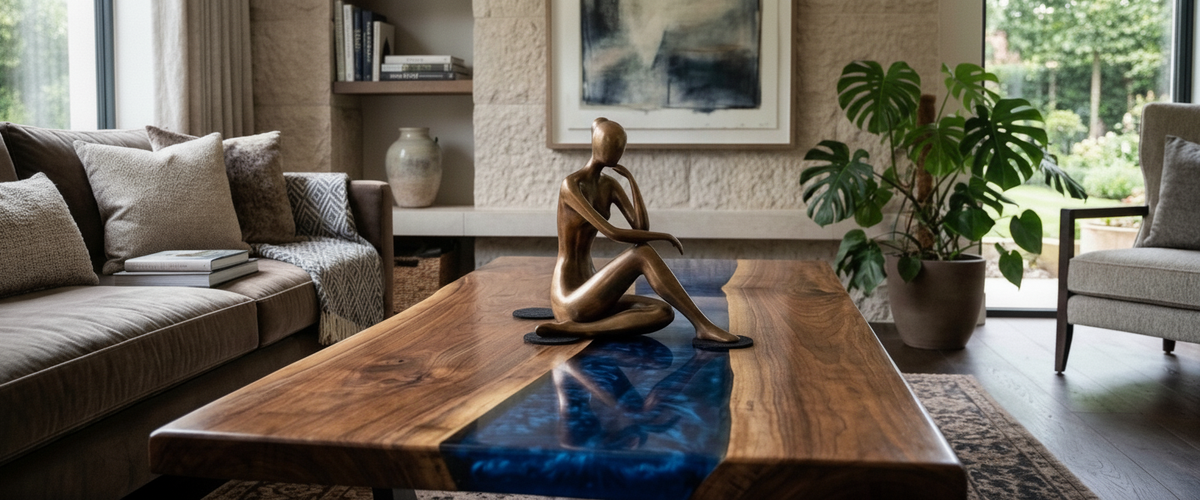

Most coffee table resin art looks perfect on the day it arrives. The trouble starts around month four. A ring appears under the morning mug, the clear channel has gone faintly yellow by the window, and a hairline crack opens where the walnut meets the pour. We see the photos because buyers send them to us when they want a sculpture to sit on top of the table, and the table has already started arguing with them.
The good news is that coffee table resin art fails in predictable ways. If you know what to ask before you pay, you can buy a table that ages as well as the bronze you eventually put on it.

At a Glance
Know which product you are buying: river table, full pour and inlay behave very differently over time.
Resin type decides aging: deep-pour epoxy for the body and a proper hard top coat on the surface.
Test before you commit: heat, scratch and UV are the three common failure points.
Timber keeps moving: ask about moisture content and kiln drying.
Pad anything heavy: point load, more than total weight, is what marks a glossy top.
River Table, Full Pour or Inlay: Three Products Under One Name
A river table is two slabs of live-edge timber with resin filling the gap between them, usually tinted blue or smoky gray. A full pour is a top made mostly or entirely of resin, sometimes cast around stones or swirled with pigment into an ocean effect. An inlay is mostly solid wood, with resin filling knots, cracks or a routed pattern. In online listings for coffee table resin art, the three look alike. They behave nothing alike.
A river table bonds a thick resin channel to timber that keeps moving, so the joint is the part to inspect.
The ratio of resin to wood matters more than the look. In a river table, the bond between a thick body of resin and seasonally moving timber is the weak point. A full pour has little wood movement to fight but a huge resin surface exposed to heat and light. An inlay carries the least risk because the resin is a small, well-supported filler. If you want the effect with the fewest surprises, choose inlay. If you want drama, a river table rewards the buyer who asks good questions.
Deep-Pour Epoxy Versus Tabletop Coat
Two chemistries go into most resin tables. Deep-pour casting epoxy cures slowly, so it can go down in thick layers (often an inch or more, about 2.5 cm, per pour) without overheating. Tabletop or coating epoxy is thinner and cures faster; it is designed for coats of roughly 1/8 inch (3 mm) and gives the high-gloss surface. A well-made table usually uses casting resin for the body and a harder coat or finish on top.
Problems start when a maker cuts corners. Tabletop coat poured too thick runs hot as it cures, which can leave internal stress, bubbles and a soft core that dents months later. Casting resin left as the final surface tends to scratch more easily. Ask which products were used, how many layers went down, and whether the top was sanded and refinished afterward. A maker who answers without hesitation usually knows the craft.

The Hot Mug, the Key Scrape and the South Window: Three Tests for Coffee Table Resin Art
Before you pay for any coffee table resin art, run these checks on an offcut or put them to the maker directly.
The hot mug. Many standard epoxies begin to soften below the temperature of freshly brewed coffee. Ask for the heat rating of the top coat and whether coasters are essential. A vague answer means rings.
The key scrape. Drag a key lightly across a sample. A properly cured, finished surface should resist a casual pass; an under-cured top marks immediately. Phone cases and sculpture bases do the same damage, only slower.
The south window. Epoxy yellows under UV. Clear and white pours show it first, while deep blues and blacks hide it longer. UV-stabilized resins slow the change without stopping it.
The last test is the one buyers most often skip. Picture a white-and-clear full pour beside floor-to-ceiling glass: within a year, the half nearest the window can turn the color of weak tea while the shaded half stays crisp. If your table will sit in strong light, choose a darker tint or add UV-filtering film to the glass.
Clear and white pours show UV yellowing first; darker tints and window film slow it down.
Walnut, Oak or Burr: Why the Timber Keeps Moving
Wood never stops responding to humidity. Cured resin barely moves at all. That mismatch is why river tables crack along the bond line, usually in the first dry winter after delivery. The Wood Database's notes on dimensional shrinkage show how widely species differ as moisture changes.
Walnut is the classic timber for coffee table resin art for good reason: it is relatively stable, and its dark tone flatters tinted resin. White oak is harder and takes knocks well but moves more with the seasons, so it needs properly dried stock. Burr (burl in US usage) is gorgeous and unpredictable; its swirling grain moves in every direction, which suits small inlays better than wide slabs. Whatever the species, ask for the moisture content at the time of the pour. A table built in a damp workshop and shipped to Phoenix or a radiator-heated NYC apartment will reveal its history quickly.

Heavy Bronzes, Felt Pads and What a Glossy Top Can Carry
This is where our own work meets the furniture. Most coffee table resin art is happy with books and a tray. A cast bronze is a different conversation, since even a modest tabletop figure can weigh well over 20 pounds (9 kg).
On a well-built frame, total weight is rarely the problem. Point load is. A bronze with a small, rough-cast base concentrates its weight onto a few square inches, and every nudge turns those edges into sandpaper. In the studio we fit felt or cork pads to table pieces before they ship, and we tell buyers to check them yearly because pads compress and collect grit.
Lighter resin figures are the gentler choice for a glossy surface, and height matters as much as weight. Around 20 inches (50 cm) is close to the upper limit for coffee table scale before a piece starts blocking sightlines across a seating group, so a figure sized for side tables, such as the Lunar Silver Astronaut Glow Side Table Figure, sits more comfortably on a resin top than a taller statue on a heavy base would. Whatever you choose, give it the same padded base you would give a bronze.
If the table is the star and you would rather keep its surface clear, move the art to the wall. Where you want the room to repeat the poured, liquid color of a river table without anything touching the gloss, a wall piece such as the Ocean Blue Resin Splash & Character Wall Relief carries that language upward instead, and our wall sculptures include heavier metal options for larger rooms.
Before You Buy: A Short Checklist
Which resin was used for the body, and which for the top coat?
What heat rating does the finished surface carry?
Was the timber kiln dried, and what was its moisture content at the pour?
Is the resin UV-stabilized, and will the tint suit your light?
Can the top carry the sculpture you plan to display, with padding?
Will the maker send an offcut to test?
Giant Sculptures works mostly in bronze, stainless steel and stone at large scale, but plenty of our commissions end up on or beside furniture. If you are planning a room around coffee table resin art, explore our resin art collection or ask us about a bespoke piece sized and padded for the surface it will live on. Budget depends on material, scale, finishing and shipping, so we quote each commission individually.
For wider placement ideas, Clear Resin Sculpture for Sale? What the Listing Photos Won't Tell You is useful companion reading before finalising the setting and sightlines.