





































































































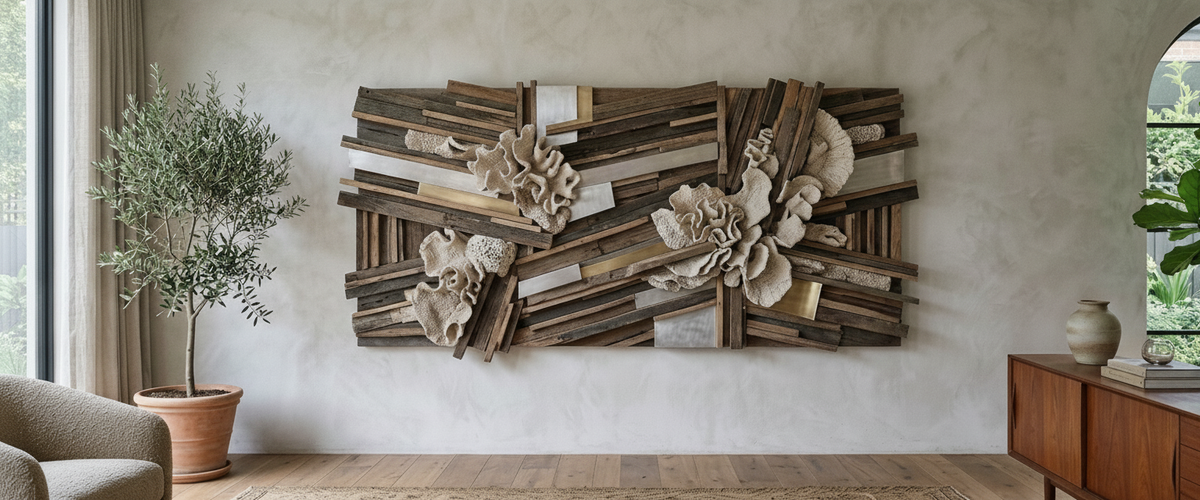

Most mixed media art fails at one of two distances. From across a room it collapses into a gray smudge with no shadow to give it structure, or you walk up to it and the illusion falls apart: rubbery adhesive squeeze-out, a screw head where no screw should be, a paper edge already lifting. Good layered work survives both viewpoints, and the difference is almost always decided in the making rather than the styling.

Quick Answer: What to Check Before You Buy
Definition: mixed media art combines two or more materials that do genuinely different jobs, not two materials chosen for variety.
Long read: at ten feet (3 m) you are buying relief depth and shadow, not subject matter.
Close read: at three feet (1 m) joins, fixings and adhesives are the first thing an eye finds.
Substrate: ask what the layers are mounted to and how that panel is braced against movement.
Environment: humid rooms quietly eat porous layers; steam rooms and unheated pool houses are the usual culprits.
Budget: cost tracks material, scale, relief depth, engineering and finishing, so ask for a tailored quote rather than a ballpark.
The Mixed Media Art Definition That Earns Its Keep
Every textbook mixed media art definition says the same thing: artwork made from more than one medium. True, and almost useless when you are spending real money. The version worth using as a buyer is stricter. In strong work, each material carries a different structural job. One holds the plane. One creates the shadow. One reflects. One absorbs. Strip any of them out and the piece stops functioning.
Collage was the origin point for this way of thinking, and museum collections still trace the shift back to early twentieth-century artists gluing oilcloth and newsprint into painted compositions, treating everyday material as pictorial matter rather than decoration (the MoMA glossary on collage is a good short history). What changed since is scale. Contemporary mixed media collage art often sits in relief, several inches proud of the wall, closer to low-relief sculpture than to a framed picture. That is the category we work in most.

The Ten-Foot Read: Texture and Shadow Arrive First
Stand back and your eye registers depth long before it registers subject. This is why so many mixed media art examples photograph beautifully in a studio and disappoint on arrival: the studio had raking light from one side, and the client's hallway has flat downlights directly overhead.
At distance you are reading shadow hierarchy, not subject matter.
When you assess a piece at distance, look for a clear shadow hierarchy. Are there two or three depth levels, or fifteen tiny ones that blur into noise? Where a wall needs to hold attention from the far end of a room, a nested organic relief such as Pearlash Coral Nest Mixed Media 3D Wall Art carries further than a flat collage in the same palette, because the stacked forms throw shadows that shift as you cross the floor rather than sitting still like wallpaper.
The Three-Foot Read: Where Collage Starts Telling You Something
Close up, the job changes. Pattern has to become information. This is where you find out whether the maker had something to say or simply filled a surface: a torn edge that follows the composition rather than fighting it, a metal insert that catches light where the eye needs a stop, a passage of raw substrate deliberately left visible.
Ask to see close-range photography before you commit. Anyone confident in their mixed media art will send macro shots without hesitation. If the only images available are three-quarter views from eight feet away, that tells you something.
Joins, Fixings and Adhesives Are the Piece
Search for mix media art online and you will see thousands of surfaces and almost no discussion of how they are held together. That is the part that ages. Adhesive creep, differential expansion between timber and metal, and fasteners that were never designed to carry a cantilevered layer are the three failures we see most in older pieces brought to us for repair.
Our questions to any maker are short. Is the layer mechanically fixed as well as bonded? Is the substrate a braced panel or a single sheet that will bow? Are the fixings hidden by design or hidden by hope? On commissions we build in concealed mechanical fixing wherever a component projects more than a couple of inches, because adhesive alone eventually loses an argument with gravity and temperature.

Reclaimed Timber Against Poured Resin
A common pairing, and a revealing one. Reclaimed timber moves with humidity, carries visible history, and absorbs light. Poured resin holds a dead-flat plane, refracts light, and moves very little. Put them side by side and you get contrast that works at both viewing distances, provided the maker allowed the timber room to move. Rigid capture of a wide timber board inside a resin field is how pieces crack.
Up close, the join between timber and metal is the thing being judged.
For buyers wanting more permanence than resin offers over decades, we often steer toward metal and stone components instead: patinated bronze inserts, brushed stainless panels, Corten fragments, honed marble tiles set into a timber ground. Those combinations sit comfortably alongside our abstract art commissions and carry far better into exterior-adjacent spaces.
Hanging Height and Light for a Surface With Real Depth
Flat art is hung to a center line. Relief work is hung to its shadow. A deep panel hung at the standard 57-inch (145 cm) center often looks wrong, because the projecting layers throw shadow downward and the composition appears to sink. Raising the piece an inch or two and lighting it from a steep side angle usually fixes it in minutes.
One practical lesson from a recent dining room install: the client's ceiling wash lights killed every shadow in a three-inch-deep panel. A single adjustable spot mounted eighteen inches off the wall, aimed at roughly thirty degrees, brought the whole surface back. Pieces with clustered, cupped forms behave the same way; the undercuts in something like the coral nest panel linked earlier only read as depth when light arrives across them rather than straight on. Ask for the maker's recommended lighting angle before your electrician sets positions.
Rooms That Flatter Layered Work, and Ones That Do Not
Stairwells, long corridors and double-height entries are ideal, because you get the ten-foot read and the three-foot read within a few steps. Dining rooms and boardrooms work when lighting is adjustable. Bathrooms, indoor pool enclosures and unconditioned porches are where porous mixed media quietly dies; swings in relative humidity move timber, paper and plaster at different rates, which is precisely what conservation guidance on stable interior environments is designed to prevent (see the Canadian Conservation Institute's environmental guidelines).
If the wall you love happens to sit in a humid zone, that is a specification problem rather than a dead end. Metal, stone and sealed composite layers handle it. Say so at the enquiry stage and the build changes accordingly.

Commissioning: Turning Mixed Media Art Ideas Into a Buildable Brief
Most clients arrive with a mood board and a wall measurement. That is enough to start. What sharpens a commission is deciding early which material owns the shadow, which owns the light, and how deep the relief needs to be for the room's actual viewing distance. From there we can talk substrate, fixing method, crating and installation.
Giant Sculptures builds bespoke wall and freestanding work at scale, and the same engineering thinking we apply to large bronze and stainless commissions applies here: nothing relies on adhesive alone, and nothing goes out untested for the environment it is heading into. Browse the mixed media art collection or the more sculptural organic art pieces to establish a starting language, then send us the wall dimensions, the light sources and the humidity conditions.
For wider placement ideas, Mixed Media Abstract: A Buyer's Guide to Materials, Scale, and Placement is useful companion reading before finalising the setting and sightlines.