






































































































Point a camera at a mirror polished steel sculpture and you photograph almost everything except the sculpture. The sky, the lawn, the pool coping, your own reflection stretched across a flank. That is the whole appeal, and it is also the reason so many of these pieces disappoint once they land. Buyers choose the form and forget the setting, and the setting is doing at least half the work.
Key takeaways
A mirror polished steel sculpture borrows more from its backdrop than from its silhouette. Green, sky and water flatter it; flat gray render and deep shade flatten it.
A true mirror is a labor cost, not a coating. The last polishing stages take the longest and buy you depth, not just shine.
Weld seams show. On a reflective skin there is no texture to hide a poorly dressed join.
316 stainless for coastal and pool-side sites. 304 is fine inland; near salt it will tea-stain.
Care is light but not zero: rinse, dry, and stay away from anything abrasive or chloride-based.

A Mirror Polished Steel Sculpture Borrows Its Color From the Setting
Plan the site before you plan the piece. A polished surface has no local color of its own, so the work becomes a lens for whatever surrounds it. Set one in front of a hornbeam hedge and it reads as a green-black form with silver highlights. Put the same piece on a pale gravel terrace under a hard midsummer sky and it turns bright and almost weightless. Neither is wrong. But if you have not decided which effect you want, you will get whichever one the site hands you.
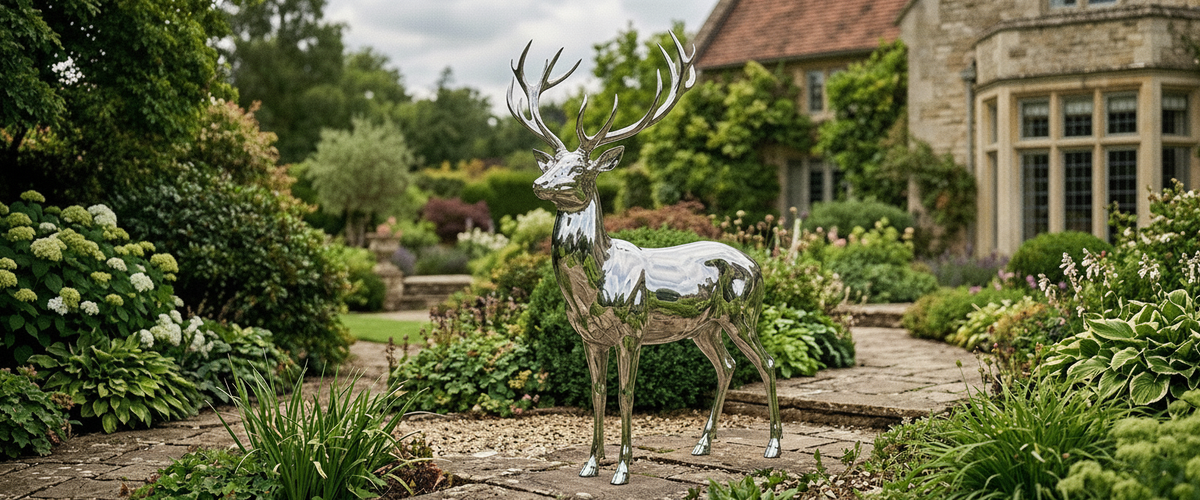
We shipped a mirror-polished stag to a property outside Aspen where the client had earmarked a spot against a pale stone retaining wall. On a site call we moved it thirty feet onto the lawn edge, with aspens behind it. The difference was not subtle. Against the wall the animal read as a silver blob; against the trees, the legs and neck picked up the vertical trunks and the whole form snapped into focus. Same mirror polished steel sculpture, different setting, completely different object.
Moved thirty feet onto the lawn, the same stag reads as a drawing in silver rather than a blob.
Backdrops That Flatter, and the Ones That Turn It to Gray Mush
Good backdrops give a reflective surface something to reflect: movement, contrast, or depth.
Mature planting. Deep green with texture. Beech, yew, olive, ornamental grasses. The best all-round choice.
Water. A pool, rill or lake doubles the reflection and adds moving light onto the underside of the form.
Open sky. A piece set on a rise or plinth against sky becomes a piece of moving weather.
Warm brick or timber. Adds a copper cast to the reflection that reads richer than people expect.
The problems are flat mid-tone surfaces and deep shade. Gray render, unbroken concrete and sunless courtyards with no sky access all give a mirror polished steel sculpture nothing to work with. The surface picks up a uniform mid-gray, the highlights vanish, and the form goes soft. If your only available wall is flat and gray, either introduce planting in front of it or consider a satin or brushed finish instead. Our stainless steel sculptures are a useful place to compare how mirror, satin and brushed finishes behave against different settings.
Sky, Hedge or Brick: How the Reflection Changes Hour by Hour
A mirror polished stainless steel sculpture is never the same twice in a day. Morning light picks out the top surfaces and leaves the belly dark. At midday the piece goes brightest and loses some modeling. Late afternoon is usually the moment it earns its money: low sun rakes across the curves, the reflected landscape warms, and the highlights run in long ribbons along the form.
That daily cycle should decide where a mirror polished steel sculpture sits. If you only see it at breakfast, orient the strongest curve to face east. Pieces with big, sweeping surfaces reward that thinking most: at 205cm, roughly 6 ft 9 in, the Silver Mirror-Polished Abstract Whale Stainless Steel Sculpture - 205cm carries a full sweep of reflected sky along an uninterrupted back. Smaller, leggier subjects fragment the reflection instead, which can be the more interesting effect in a tight courtyard.
Water doubles the effect: a poolside mirror polished steel sculpture catches sky above and moving light below.

From 320 Grit to True Mirror: What the Final Polish Actually Buys You
Polishing is sequential. Fabricators work up through progressively finer abrasives, and each stage exists only to remove the scratch pattern left by the one before. Reaching a 320 grit satin is relatively quick. Getting from there to a genuine No. 8 mirror, where the reflection is undistorted and the surface has depth rather than just brightness, takes several further stages with fine compounds and buffing wheels. The Specialty Steel Industry of North America sets out how these standard finish designations work, and it is worth knowing the vocabulary before you approve a sample.
What the last stage buys you is clarity. A half-polished piece looks shiny in a photograph and cloudy in person. A properly finished mirror polished steel sculpture holds a crisp reflected edge; you should be able to read the shape of a distant tree in it, not just a smear of green. Ask for a finish sample or a photo of the actual piece outdoors, not a studio shot under diffused lights, which flatters everything.
Weld Seams Have Nowhere to Hide
On Corten or patinated bronze, a slightly proud weld disappears into texture. On a mirror skin it becomes a visible ripple that catches light differently from the panels either side. Look for it at low angles. Panel joins on curved forms are the usual culprit, along with the tight transitions where a leg meets a body. Good fabrication dresses the weld back flush, then blends the polish across the join so the reflection runs continuous. This is where cheap mirror polished steel sculptures give themselves away within a season, and it is why we specify weld dressing and blend polishing as separate line items on every commission.

Fingerprints, Pollen and Rain Spotting Across a Full Year
Mirror stainless is low maintenance, not no maintenance. Here is the realistic annual pattern for an outdoor mirror polished steel sculpture:
Spring: pollen film. Rinse with clean water and dry with a soft microfiber cloth in straight passes, not circles.
Summer: fingerprints, especially at hand height near a pool or entrance. Warm water with a drop of pH-neutral soap lifts oils fine.
Fall: leaf tannin and bird debris. Remove promptly; tannin left to dry can leave a faint shadow.
Winter: rain spotting from hard water and, in snow regions, road salt drift. Rinse after any salting.
Never use scouring pads, steel wool or chloride-based cleaners. A single abrasive wipe leaves a scratch band that only a re-polish will remove. Two thorough cleans a year plus spot rinsing is enough for most sites.
316 Versus 304 Stainless: The Grade Coastal Buyers Regret Getting Wrong
Grade 304 is the workhorse and it is genuinely fine for inland gardens: Napa, Dallas, a Colorado ranch, a walled garden in Atlanta. Grade 316 adds molybdenum, which markedly improves resistance to pitting and to the brown tea-staining that chlorides cause. Specify 316 for any mirror polished steel sculpture within a few miles of salt water, beside a chlorinated pool, or on a road that gets salted every winter. The cost difference at commission stage is far smaller than re-polishing a stained piece two years in. The British Stainless Steel Association has a clear breakdown of how atmospheric chlorides drive that decision.
One caveat worth hearing: even 316 will develop light surface staining in an aggressive marine setting if it is never washed. Rain does most of the work on exposed surfaces, but sheltered undersides need an occasional rinse.
Buyer Checklist Before You Commit
Photograph the intended site at 9am, noon and 5pm. Check what will be reflected at each hour.
Confirm the stainless grade in writing: 304 or 316.
Ask how welds are dressed and whether the polish is blended across joins.
Request an outdoor photograph of the actual finish, not a studio shot.
Check scale against the backdrop, not against the room. Reflective surfaces read smaller outdoors than people expect.
Plan the foundation and fixing. Large polished pieces need concealed anchors so no bolt heads interrupt the surface.
Agree who handles the first clean after installation. Site dust settles on everything.

Commissioning at Scale
Most mirror polished steel sculpture commissions we handle at Giant Sculptures are bespoke, because the interesting decisions are site-specific: how high the plinth sits, which way the strongest curve faces, whether the piece runs one grade throughout or takes 316 at the base where splash and salt collect and 304 above. Existing designs are the quickest way to calibrate proportion before you commit to a drawing. For a lawn-level accent that reflects grass and low planting rather than sky, a settled form such as the Silver Mirror-Polished Reclining Deer Stainless Steel Sculpture - 113cm (about 3 ft 8 in) is the right register; where the brief calls for a piece that holds a whole terrace and breaks the skyline, an upright subject on the scale of the Silver Mirror-Polished Stag Stainless Steel Sculpture - 170cm is closer to the mark. Budget depends on scale, grade, polishing hours, engineering and installation, so the honest answer is a tailored quote rather than a headline figure.
If you are still weighing finishes, compare polished work against patinated and painted pieces in our wider metal sculptures range. Mirror is the boldest of the three. Sited well, it is also the one that keeps changing long after everything else in the garden has settled.
For wider placement ideas, What a Great Abstract Stainless Steel Sculpture Hides: Welds, Ripples and Finish is useful companion reading before finalising the setting and sightlines.