





































































































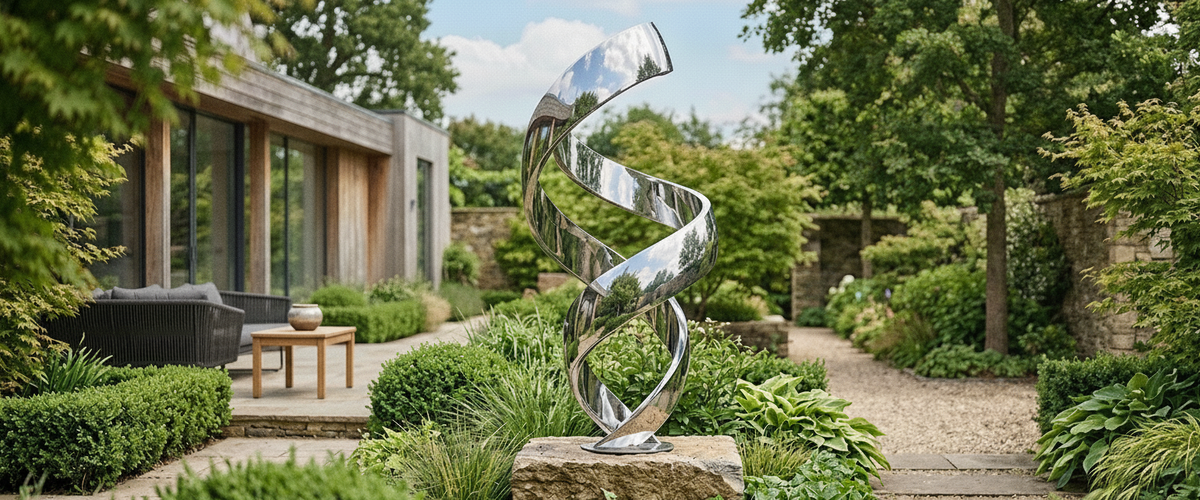

Run your hand along the curve of an abstract stainless steel sculpture and you learn more in five seconds than any photograph will tell you. If your fingertips catch a faint ridge where two panels met, someone stopped grinding and polishing too early. That ridge will never disappear. It will simply become the thing your eye returns to every time you walk past, for the next forty years.
An abstract stainless steel sculpture is unforgiving in a way that cast bronze is not. Bronze hides sins under patina. Polished steel amplifies them.

At a Glance: What to Check Before You Buy an Abstract Stainless Steel Sculpture
Weld seams: should be ground, blended and polished until the form reads as one continuous surface, not a set of panels.
Sheet thickness: too thin and large flat faces ripple; ask about internal ribbing and framing.
Finish: mirror polish, satin brush and bead blast produce three genuinely different sculptures from the same shape.
Grade: 304 inland, 316 within reach of salt air or chlorinated pool spray.
Reflection: a mirrored form borrows whatever surrounds it, including the parking court.
Budget: driven by scale, sheet gauge, hand-finishing hours, engineering and install. Ask for a tailored quote rather than guessing.
Weld Seams Are Where the Hours Actually Go
Cutting and forming panels is the fast part. Making the joints vanish is the slow part. On a complex abstract stainless steel sculpture, hand-finishing can absorb more studio hours than everything else combined, and it is the line item buyers rarely think to ask about.
A blended joint should read as one continuous curve, with no gray halo in raking light.
The sequence matters. TIG welds are laid, dressed back, then worked through progressively finer abrasives before any polishing compound touches the surface. Skip a grit and you get a shadow: a faint gray halo along the joint that only shows in raking afternoon light. We have turned pieces down at final inspection for exactly that. On a mirror-polished piece, the work is only as good as its worst inch of blending.
When you view a piece in person, do two things. Stand at an oblique angle to the largest curve and look along it, not at it. Then crouch. Joint shadows tend to hide near the base where the light dies.

Sheet Thickness, Ribbing and the Ripple That Ruins a Mirror Face
Oil canning is the industry term for the soft, wandering waviness that shows up on broad flat metal panels. It is a visual problem, not a structural one, and it destroys a mirror finish faster than any scratch. Reflected sky becomes reflected funhouse.
Two things fix it: heavier gauge sheet and intelligent internal structure. Tight compound curves are naturally stiff, so they tolerate thinner material. Large gentle planes need either more thickness or a hidden framework of ribs welded behind the skin. Take a form like the Silver Mirror-Polished Abstract Whale Stainless Steel Sculpture - 205cm at 205cm (roughly 6 ft 9 in): the flank runs long and only gently curved, which is precisely the surface where thin material betrays itself, so the build behind the skin matters as much as the polish on it. Ask any maker how a large flat area is supported. A vague answer is an answer.
Mirror Polish, Satin Brush and Bead Blast: One Form, Three Sculptures
Finish is not a detail decision. It changes what an abstract stainless steel sculpture does in a space.
Mirror polish
Maximum drama, maximum honesty. It dissolves the object into its surroundings and makes people want to touch it, which means fingerprints on a piece placed inside a hotel lobby. Best on sculptural forms with real curvature.
Satin brush
A directional grain that reads as gray silk. Forgiving with fingerprints, quieter in bright sun, and far kinder to broad planes. Our most requested finish for residential terraces in Texas and Arizona where midday glare is a genuine consideration.
Bead blast
A soft matte pewter that emphasizes silhouette and volume over reflection. If a client wants a sculptural mass rather than a light event, this is the answer. It also pairs well with colored and metallic coatings, and where the setting calls for warmth against pale stone rather than the cool glare of raw metal, a coated piece such as the Gold Abstract Panther Stainless Steel Sculpture - 64cm at 64cm sits in a different register entirely from a polished silver surface.

Grade 304 or 316? Salt Air Decides
Stainless steel resists corrosion because chromium forms a passive oxide film. Chlorides attack that film. Grade 316 contains molybdenum, which gives it materially better resistance to chloride pitting than 304, which is why it is the standard specification for coastal and poolside work; the Nickel Institute sets out the metallurgy clearly if you want the technical detail.
Practically: an abstract stainless steel sculpture heading to a Napa hillside or an Aspen garden is fine in 304. One going to a Hamptons oceanfront lawn, a Miami rooftop or anywhere within a mile of surf should be 316. We shipped a large mirrored commission to a beachfront property on Long Island where the client initially resisted the upgrade. The salt haze there leaves a film on everything within a season. 316 plus a quarterly rinse has kept that piece clean; 304 would have developed tea staining, the faint brown surface bloom that requires professional attention to remove.
A Mirrored Form Borrows the Sky, the Lawn and, Unhelpfully, the Car Park
This is the placement lesson nobody expects. A reflective abstract stainless steel sculpture has no fixed appearance. It takes on whatever sits in front of it, and that includes the neighbor's white SUV, the pool equipment enclosure and the trash store.
Rotating the base plate a few degrees decides whether the piece gathers tree canopy or the motor court.
Before you set a plinth position, stand where the work will stand and look outward through 360 degrees. Whatever occupies the widest, brightest field of view is what the piece will show back to you. Sky and mature planting are generous. Hardstanding and vehicles are not. On one Bay Area commission we rotated the base plate by about thirty degrees so the primary convex face pulled in oak canopy instead of the motor court. Same form, entirely different piece of art.
Height helps too. Lifting a form so its main curve catches sky rather than ground works especially well with rising, gestural shapes; a tall vertical such as the Gold Abstract Swooping Bird Stainless Steel Sculpture - 236cm at 236cm (about 7 ft 9 in) is drawn to be read against open air, and loses most of its argument set against a hedge line. The wider stainless steel sculptures and abstract sculptures collections are useful for seeing how form and scale interact before you settle on a height.

The Questions We Ask Before Quoting a Bespoke Abstract Stainless Steel Sculpture
How far is the site from salt water or a chlorinated pool?
What is the widest sightline, and what sits in it?
Wind exposure and required footing design; is engineering sign-off needed?
Finish preference, and who will maintain it?
Access route for delivery: gate widths, crane or forklift availability, ground protection.
Is the form to be developed from a sketch, a maquette or an existing reference?
Budget follows those answers, not a catalog page. Scale, sheet gauge, geometric complexity, hand-finishing hours, structural engineering, coating and installation all move the number, which is why bespoke work is quoted individually rather than banded.
Care Checklist for Long-Term Ownership
Rinse with clean water, then dry with a microfiber cloth to avoid water spotting.
Wash with mild detergent; never use chloride-based or abrasive cleaners.
On brushed finishes, always wipe with the grain direction.
Coastal sites: rinse quarterly at minimum, monthly in exposed positions.
Keep iron tools, steel wool and fertilizer granules away from the surface; embedded iron particles cause spot rust.
Treat tea staining early with a proprietary stainless cleaner rather than waiting.
Get the welds, the gauge and the grade right and an abstract stainless steel sculpture becomes one of the most durable works you can own, as patient as any metal we work in. Get them wrong and no amount of polish will save it. That is the whole argument for asking harder questions before you commission.
For wider placement ideas, Stainless Steel Garden Sculptures That Still Look Right in January is useful companion reading before finalising the setting and sightlines.