
















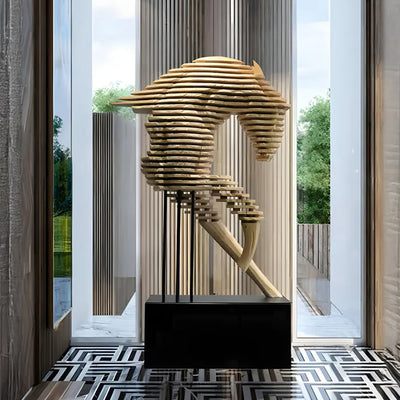
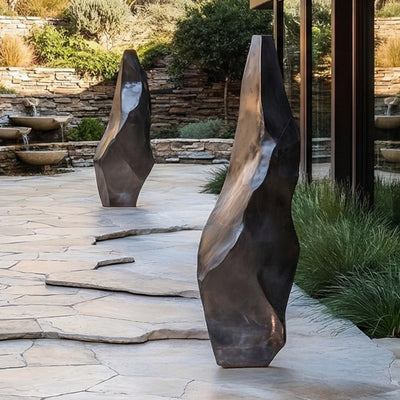

















A giraffe is the most structurally demanding animal in outdoor sculpture. Everything a designer loves about the shape, the height, the taper, the impossibly slim legs, is exactly what fails when a maker cuts corners. So before you fall for a photograph, judge a metal garden giraffe sculpture the way a fabricator would: at the neck weld, at the ankles, and at the point where steel meets soil.

Key Takeaways Before You Buy
The neck-to-shoulder joint is the failure point. Ask what is inside it, not just how it looks outside.
Four slim ankles need one hidden ground plate. Independent spikes into lawn will sway within a season.
Material decides your maintenance. Corten stains, painted mild steel needs recoating, stainless and bronze ask least of you.
Silhouette carries the piece. At 60 feet (18 m) away, surface texture disappears and the outline does all the work.
Size against your tree line, not your lawn. A giraffe read against sky looks tall; one read against mature oaks looks small.
Budget follows scale, engineering and finish. Ask for a tailored quote rather than assuming a figure from height alone.
The Neck-to-Shoulder Weld Carries the Whole Gale
Wind does not push evenly on a giraffe. It catches the head and upper neck, then multiplies that force through a long lever arm down into one small area of steel above the shoulder. That is the joint that cracks. We have inspected imported pieces where the neck was a hollow tube slipped over a stub and tacked at four points, which is fine in a showroom and grim in a January storm off the Atlantic.
What good practice looks like on a metal garden giraffe sculpture: a continuous internal spine running from the ground plate up through the shoulder into the neck, gusseted where the angle changes, with full-penetration welds rather than cosmetic beads. Welds should be ground and blended so water cannot sit in a crater. The Nickel Institute guidance on stainless fabrication is a useful reminder that weld areas and heat-affected zones are usually the first place corrosion starts, which is why finishing matters as much as strength. When you ask a supplier about a garden giraffe sculpture, the answer should be technical and immediate. Vagueness is the tell.
The neck-to-shoulder joint takes the full lever arm of the wind.

Four Slim Ankles on One Hidden Ground Plate
The second question is what happens below grade, because a metal garden giraffe sculpture is only ever as steady as its footing. A tall animal on four thin legs behaves like a sail on a tripod, and the fix is boringly simple: tie all four feet to a single steel base plate, then bolt that plate to a poured concrete pad sized for the height and exposure of the piece. Independent footings almost always settle at different rates, and once one leg drops a quarter inch the whole animal starts to rock.
For a piece installed on a Napa hillside we set the plate below finished grade and dressed gravel over it, so the giraffe appears to stand directly on the ground with no visible hardware. That detail costs almost nothing at the fabrication stage and is close to impossible to retrofit. Decide it before the steel is cut.
Corten, Stainless or Painted Mild Steel After Five Wet Winters
All three are legitimate choices. They just age very differently.
Corten (weathering steel) forms a stable oxide layer that slows further corrosion, but only where it gets proper wet and dry cycling. Sheltered spots under dense canopy, or anywhere the steel stays damp, will keep shedding rust. Highway engineering guidance from the Federal Highway Administration makes the same point about uncoated weathering steel in wet or salted environments. Expect bleed onto anything porous below.
Painted mild steel gives you color control, which suits a modern Texas courtyard or a bold poolside scheme. It also commits you to a recoating cycle, and the first failures appear at edges, bolt heads and the underside of the belly where nobody looks.
Stainless steel holds its finish with the least intervention. Within a mile of surf, specify a marine-appropriate grade; standard grades tea-stain in salt air. The metal sculptures collection is a useful way to see how differently brushed, mirrored and patinated surfaces behave in the same garden.
Bronze sits outside the steel argument but belongs in the conversation, because for a permanent centerpiece it is often the honest answer. Cast bronze holds fine anatomy for generations and takes a patina that deepens rather than degrades.

Silhouette Does the Work: Why Surface Detail Disappears
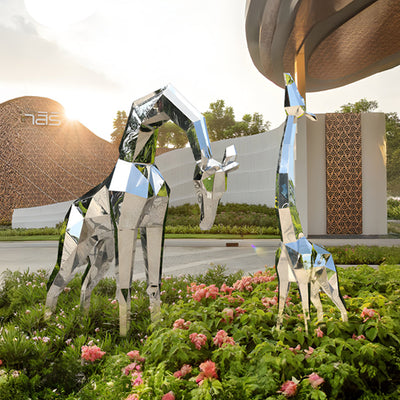
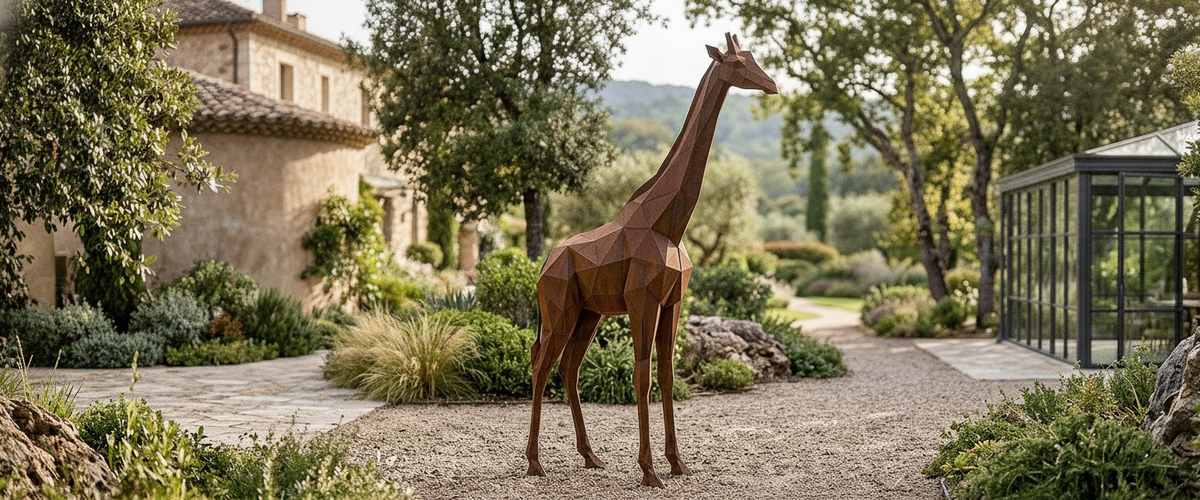
Stand 60 feet (18 m) back and you are no longer looking at texture. You are reading an outline against sky. Faceted, plate-built interpretations understand this instinctively: a form such as the Giraffe Geometric Steel Outdoor Sculpture, 181cm, roughly 6 feet (1.8 m), holds as a clean shape from the far end of a lawn and only gives up its plate joints as you walk in. Highly modeled naturalistic work does the opposite: it rewards close range and can look surprisingly flat from a distance if the pose is static.
Choose based on viewing distance. Long sightlines want strong negative space between neck and body. Close terraces can carry detail.
At distance the outline, not the texture, carries the piece.
Calf, Adult or Sixteen Feet: Sizing a Metal Garden Giraffe Sculpture Against Your Tree Line
The most common mistake is sizing to the lawn. Buyers pace out an open space, decide 8 feet (2.4 m) feels big, then install it in front of 40-foot maples and wonder why it looks like a garden ornament. Your reference is the vertical backdrop, not the horizontal one.
Rules of thumb we use when advising on a metal garden giraffe sculpture:
Calf scale, up to about 4 feet (1.2 m): terraces, courtyards, planting beds, close-range charm.
Adult scale, 8 to 13 feet (2.4 to 4 m): the workhorse range for private gardens with mature planting. Where the backdrop is established trees rather than open sky, a figure with the height and mass of the Life-Size Standing Giraffe Bronze Sculpture, 400cm, around 13 feet (4 m), keeps its presence where a 6-foot piece simply recedes into the canopy.
Monumental, 16 feet (5 m) and above: estates, hotels, sculpture parks, corporate arrivals. Plan craneage and access early.
Groups change the math. Two or three animals at mixed heights read as a family and fill space that a single figure cannot.

Rust Bleed, Bolt Corrosion and Repainting: A Year One, Five and Ten Checklist
Year one: check base bolts for movement after the first freeze-thaw or storm season. Rinse salt or fertilizer residue off the legs. Watch where Corten runoff lands and protect pale stone.
Year three to five: inspect welds at neck, shoulder and hip with a flashlight from below. Touch up paint chips before they creep. Replace any fastener showing pitting; stainless hardware on a steel plate is cheap insurance.
Year ten: expect a full repaint on painted mild steel. Corten and stainless normally need cleaning and hardware checks only. Bronze may want a wax refresh depending on exposure.
After any hurricane, blizzard or heavy tree fall: re-level and re-torque. Two minutes of checking beats a structural repair.
Siting for the Second Look
Height only lands when you approach it correctly. Placing a giraffe dead ahead on axis flattens it; the eye takes it in once and moves on. Offset it 20 to 30 degrees from the main path so the animal is glimpsed through planting first, then revealed at full height as you turn. That second look is where the money shows.
Backlighting matters more than uplighting for tall subjects. Grazing light from behind separates the neck from the sky at dusk. On larger grounds the same logic applies to grouped work: a composition on the scale of the Monumental Contemporary Herd of Six Giraffes Bronze Sculpture, 450cm is worth siting so the path runs through the herd rather than past it, putting the visitor inside the arrangement rather than in front of it.
Commissioning a Bespoke Giraffe
Most of our giraffe work is bespoke, because gardens rarely match a catalog height exactly. A commissioned metal garden giraffe sculpture typically starts with your sightlines and backdrop, then moves to material, pose, patina or paint color, base engineering and installation method. Cost depends on scale, material, structural complexity, finishing and access on site, so ask for a tailored quote rather than working from height alone. Get the engineering right once and a garden giraffe sculpture becomes the piece your grandchildren argue over.
For wider placement ideas, Metal Bird Sculptures for the Garden: The Rod Gauge Nobody Checks is useful companion reading before finalising the setting and sightlines.