
























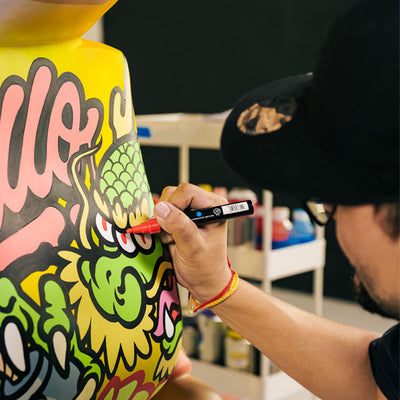






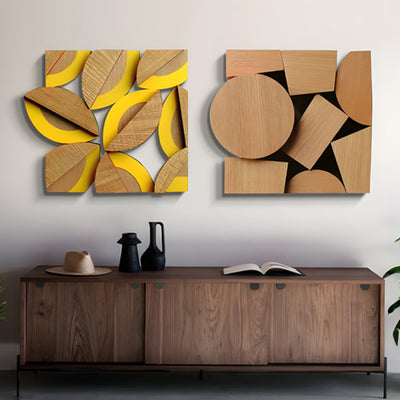

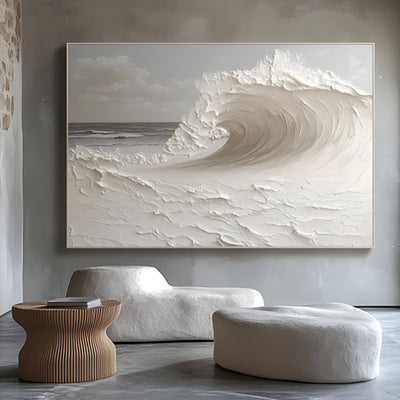












Stand six feet (1.8 m) back from a painted panel and you can usually tell within seconds whether a hand held the brush or a machine copied one that did. The tells are small. A ridge of paint where the artist changed direction. A color that shifts half a tone across a carved slat. An edge that was cut in rather than taped. Hand painted wall art is bought on those tells and returned on them too, because a rushed hand looks worse on a wall than a clean print. Read the panel properly first.

At a Glance: What You Are Actually Paying For
Decided brushwork. The marks in hand painted wall art should look chosen, not corrected six times.
Substrate discipline. A primed panel holds a flat color field; open-grain oak drinks it and changes the tone.
Edges and backs. The parts nobody photographs tell you the studio's real standard.
A sample board. On any bespoke color, the two-week delay pays for itself.
The right finish. Sealed, waxed or bare decides whether the color survives a south-facing room.
Honesty about print. Some rooms are better served by a good print, and we will say so before taking the order.
Brush Marks That Read as Intention, and Brush Marks That Read as a Rushed Friday
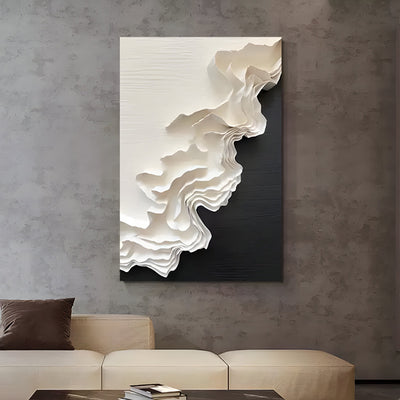
In hand painted wall art, confident brushwork has direction. The stroke starts loaded, ends where the artist meant it to end, and does not double back to fix itself. Hesitant work shows the opposite: stuttered edges, patchy coverage where a second coat went on before the first had settled, and pooling in the low points of a relief. On carved pieces the giveaway is how paint behaves against a machined ridge. Good work respects the carving; poor work fills it.
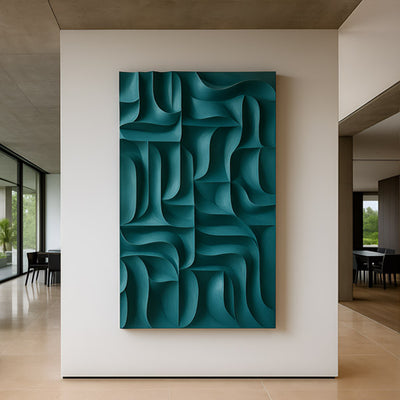
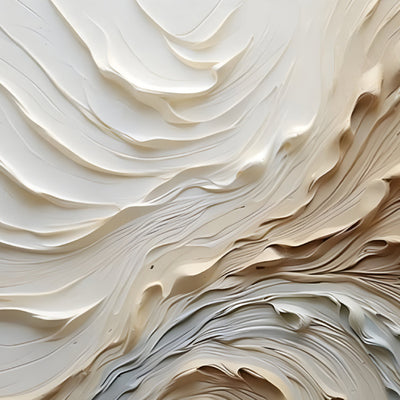
Relief panels make this easy to inspect because the surface geometry is already doing half the visual work. A densely cut field such as the Barwick Charcoal Grid Abstract 3D Carving Wall Art has to carry a single color evenly across dozens of cut faces without clogging the valleys between them. If the shadow lines are still crisp, the painting was controlled. If they look soft and gummy, the panel was flooded.
Raking light exposes the ridges a print cannot fake.

Primed Panel Versus Raw Oak: How Open Grain Eats a Flat Color Field
Buyers often ask for a flat, matte, single-color field on solid oak and are then surprised when it arrives looking mottled. That is grain, not error. Open-pored timber absorbs unevenly, so the same paint reads darker over early wood and lighter over late wood. Sealing and priming closes that down and gives you the even field you imagined. Leaving it open gives you texture and warmth. It is the first decision to settle on any hand painted wall art built in solid timber, and you should choose it deliberately rather than discover it on delivery.
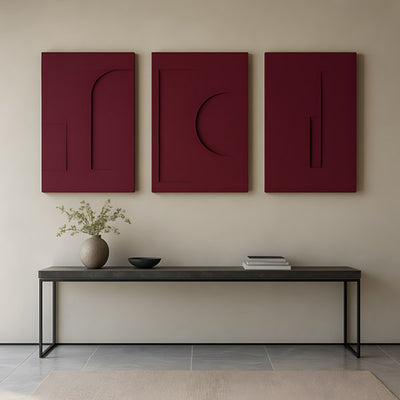
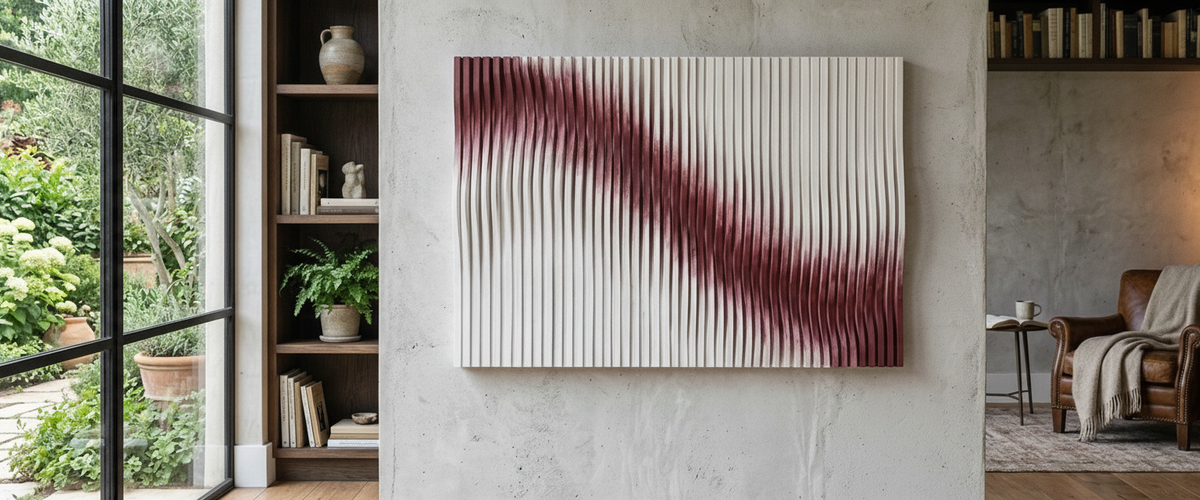
Wood also moves with the moisture in the room, which is why panel construction matters as much as the paint. The USDA Forest Products Laboratory's Wood Handbook is the standard reference on dimensional change, and it is the reason we build hand painted wood wall art on engineered backing rather than a single wide board whenever a piece runs past a few feet. A graded run of slats like the Wenlock White & Burgundy Wood Relief 3D Wall Art holds its line for exactly that reason: the slats sit on a stable substrate that will not cup behind them and drag the gradient out of true.
The Premium Sits in the Edges, the Layering and the Corrections You Cannot See
Most of what you pay for in hand painted wall art is on the parts nobody photographs. Turn a panel over. Look at the side returns. A studio that paints the edges properly, seals the reverse, and sets the hanging hardware square is a studio that painted the front the same way. We have seen imported panels arrive with a beautiful face and bare, unsealed backs, which is an open invitation for the board to take up moisture from one side only and bow within a season.
Layering is the other hidden cost. A single flat coat is fast. Depth comes from three or four passes, each thin enough to stay honest, with scumbles and glazes that let the layer below show through. Corrections cost more again, because a genuine repair means sanding back and rebuilding rather than dabbing over. None of that is visible in a product photo. All of it is visible in five years.

Where a Good Print Genuinely Wins
Print is the better buy in three situations, and we will name them. Rental and hospitality corridors where pieces get knocked and replaced on a cycle. Rooms where the client wants a photographic image with fine detail that brushwork would only approximate. And matched pairs or long repeated runs, where absolute consistency matters more than the mark of a hand. If your brief is a twelve-panel identical sequence down a hotel hallway, hand painting introduces variation you will end up fighting.
Where hand painted wall art wins is the single focal wall: the double-height entry hall, the stairwell landing, the boardroom end wall. One piece, seen up close, where texture repays attention.
Color Drift Between Batches, and Why a Sample Board Earns Its Delay
Pigment lots vary. Sheen levels vary with humidity and drying time. Two panels painted three weeks apart from the same recipe can read differently under warm LED light even when the mix is identical, which makes batch discipline the quiet variable in hand painted wall art. For a Dallas client running a five-panel array across a 20 ft (6 m) wall, we painted the whole set in one session from one mixed batch, and we still sent two sample boards to be viewed on site under their actual lighting before starting. They rejected the first. That two-week detour saved a five-panel remake.
Ask for a sample board no smaller than a dinner plate, viewed vertically on the wall it is destined for, at the times of day the room is actually used.
Sealed, Waxed or Bare: The Finish That Decides Whether the Color Holds
South-facing glass is the enemy of pigment. Light damage to colorants is cumulative and irreversible, as the Smithsonian's Museum Conservation Institute has long documented, so the finish specification on hand painted wall art is a longevity decision rather than a cosmetic one.
Graded color fades unevenly, so bright rooms need a sealed finish from the start.
Sealed with a UV-inhibiting clear coat. The default for bright rooms and any commercial venue. Slight sheen lift; best color retention.
Waxed. Beautiful hand feel and a soft matte, but it needs refreshing and offers limited UV protection.
Bare. Only for shaded interiors and only when the client accepts a natural shift over time.
Colored gradients are the most exposed of all, because fading is rarely even across a graded field. Where the color is graded rather than flat, as in a warm run such as the Wenlock White & Sunset Gradient Wood Relief 3D Wall Art, and the wall catches afternoon sun, specify the sealed route at order stage rather than retrofitting it later.

Signing Off a Commission: The Checks That Matter
Inspect hand painted wall art at six feet (1.8 m) first, then at arm's length. They are different jobs.
At six feet: Does the composition read? Is the color balanced left to right? Any dead zones or bright spots that pull the eye wrongly?
At six feet: Does the panel sit flat against the wall along its whole length?
At arm's length: Edges painted and sealed, including returns and the bottom edge.
At arm's length: No dust nibs, brush hairs, or runs in the low points of the relief.
At arm's length: Consistent sheen. Patchy gloss means uneven coats.
Reverse: Sealed, hardware square, weight rating suitable for your wall type.
Paperwork: Finish specification and care instructions recorded, so a future owner knows what they have.
Commissioning Hand Painted Wall Art at Scale
Big walls change the calculation. Past roughly 6 ft (1.8 m) in any direction, a single panel becomes awkward to ship, hang and repair, so we usually design multi-panel arrays with a planned reveal gap that absorbs wall irregularity. Giant Sculptures builds bespoke wall pieces the same way we build large freestanding work: substrate first, engineering second, surface last. Browse the wood wall art range for carved and painted relief, or the wider 3D wall art collection if you are weighing timber against metal. Commission cost depends on scale, layering, substrate build, finish specification and installation access, so send dimensions and a photograph of the wall and we will quote it properly.
For wider placement ideas, Paper 3d Wall Art: How to Buy a Panel That Holds Its White is useful companion reading before finalising the setting and sightlines.