





































































































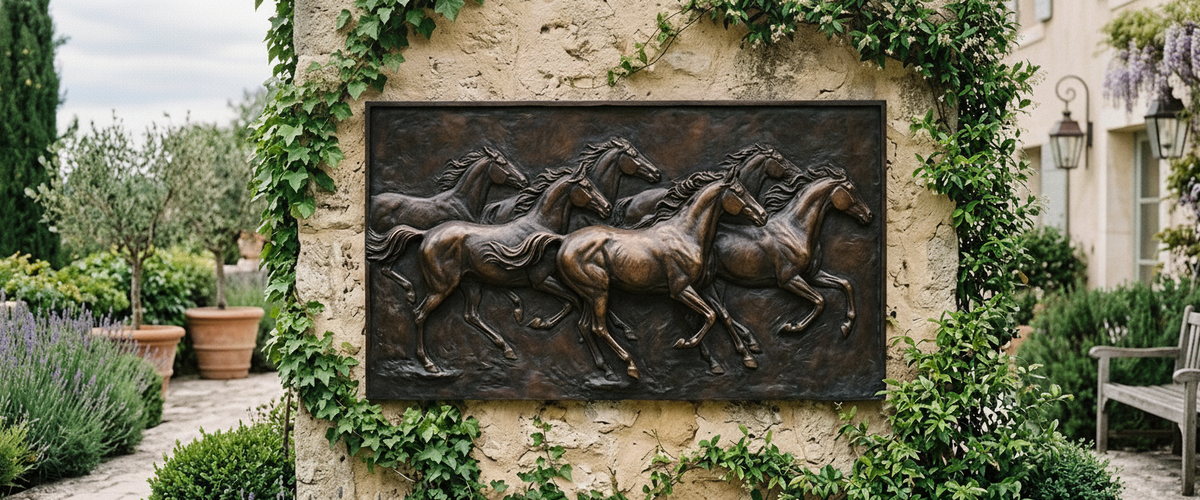

Hang a relief panel directly under a ceiling downlight and watch it die. The metal flattens, the modeling vanishes, and a piece you chose for its muscle and movement reads like a brown smudge above the sofa. Most people shop for bronze wall art by color and finish. What actually carries a panel across a room is shadow, and shadow is a product of two things you control at the point of purchase: how deep the relief is cut, and how light hits it.

At a Glance
Depth beats color. A shallow panel in gorgeous patina still disappears at 12 feet (3.6m). A deep one holds its shape.
Match depth to viewing distance. Roughly a quarter inch (6mm) for close-range corridors and powder rooms, five-eighths of an inch (15mm) for standard living room walls, an inch and a half (40mm) or more for double-height spaces.
Cast bronze throws cleaner shadow than a bronze-look coating over a molded substrate, because the undercuts are genuinely undercut.
Overhead downlights are the enemy. Side light at a raking angle is the single cheapest fix available.
Patina is contrast control. Polished highs against darkened recesses make depth look greater than it measures.
Budget depends on material, scale, relief depth, finishing and fixing method. Ask for a tailored quote rather than guessing from a photograph.
Shadow Is the Real Material
A bronze relief is a drawing made in light. Every raised edge casts a dark line beside it, and those lines are what your eye reads as a horse's shoulder, a cheekbone, a fold of cloth. Remove the shadow and you remove the drawing. This is why two panels with identical imagery can perform completely differently on the wall: one was modeled with confident undercuts and sharp transitions, the other was smoothed flat so it could be released from a cheap mold.
In our studio we check every relief against a single raking worklight before it leaves. If the piece only works under flat frontal light, it has not been modeled hard enough. That test has killed more prototypes than any complaint about color ever has.

Three Relief Depths and How Far Each One Reads
Depth is the specification buyers skip and then regret, and it decides whether bronze wall art holds a room or quietly fades into it. Use distance to set it.
Quarter Inch (6mm): Intimate Range
Low relief in this band is for hallways, stairwell landings, dining room alcoves and anywhere a viewer passes within 4 to 6 feet (1.2 to 1.8m). Detail can be exquisite at this depth. Fine linework, hair, drapery and text all survive. Step back to the far side of an open-plan room and it softens into texture. A finely worked panel of around 12 inches (30cm) belongs in this category: close-up work that rewards someone standing in front of it, not a piece asked to anchor a 20 foot wall.
Five-Eighths of an Inch (15mm): The Living Room Standard
Mid relief is the workhorse for bronze wall art for living room settings. It holds form from 10 to 15 feet (3 to 4.5m), which covers most sofa-to-wall distances in a Texas great room or a Manhattan apartment. You lose some micro-detail and gain readable silhouette.
An Inch and a Half (40mm) and Beyond: Architectural Range
High relief with genuine undercuts, limbs that break free of the ground plane, and negative space behind projecting forms. This is what you want in a double-height entry, a hotel lobby or above a 10 foot (3m) fireplace breast. Where a wall has to carry movement at that distance, something like Galloping Herd Bronze Relief Wall Art - 120cm at about 4 feet (120cm) wide works because the leading horses pull away from the backplate; the shadow gap behind them does the heavy lifting from across the room.
The same motif at three relief depths under one raking worklight: 6mm, 15mm and 40mm.

Cast Bronze or Bronze-Look Coating
Two very different things get sold as bronze wall art, and they behave differently on the wall. Judge them by the shadow each one throws, not by the swatch. Sand-cast or lost-wax bronze reproduces true undercuts, sharp arrises and tool marks from the original model, which is why centuries-old cast bronzes in collections such as the V&A sculpture collection still hold their edges. Weight is honest, temperature is honest, and the surface can be re-patinated decades later.
Bronze-look coatings, including cold-cast bronze and metal-filled resins, can look convincing in a photograph. The compromise usually shows up at the edges: draft angles get eased so the part releases from the mold, and eased edges throw blurred shadow. For a small piece viewed up close, that can be acceptable. For a large panel meant to read at distance, it rarely is. Our position is straightforward: if the piece is over about 3 feet (90cm) and working at range, cast metal earns its cost.
Living Room Light After 4pm
Daylight does most of your modeling for free. A west-facing window rakes across a wall late in the day and makes a mid-relief panel look far deeper than it measures. Then the sun drops, the recessed cans come on, and the same panel flattens to a stain.
The reason is geometry. Ceiling downlights placed near the wall wash light straight down the face of the relief, filling recesses instead of darkening them. Shadow disappears, contrast collapses, and you are left staring at brown. This is the most common complaint we hear about bronze wall art in residential rooms, and it is almost never the sculpture's fault.
Raking Light: The One Fixture Change That Rescues a Shallow Panel
Move the light source off the vertical. An adjustable spot set at roughly 30 degrees to the wall, aimed from the side rather than straight down, restores the shadow lines on bronze wall art you already own and costs a fraction of replacing the panel. A discreet linear fixture mounted on the return of an adjacent wall does the same job in a slimmer profile. Lighting specialists describe this as grazing light, and it is the standard technique for reading surface texture in gallery display.
An adjustable warm spot aimed from the side at about 30 degrees, dimmed to roughly 40 percent.
Two practical notes from installs we have shipped. First, keep the beam warm; cool white pushes patinated bronze toward gray and drains the warmth out of the alloy. Second, put the spot on its own dimmer. Full output at night is harsh, and 40 percent gives you the shadow without the glare bouncing off polished highs.
Polished Highs Against Darkened Lows
Patina is the finishing move that makes depth look deeper. A relief finished with darkened recesses and gently polished raised edges reads with far more force than one patinated evenly, because you are adding pigment contrast on top of shadow contrast. Where the drama has to come from finish rather than projection, a two-tone piece such as the Classical Medusa Head Bronze Relief (Black and Gold Finish) - 80cm at around 32 inches (80cm) takes the idea to its most theatrical: the serpents catch the highlight while the ground behind them goes almost black.
Patinas are chemical films, and they are maintainable rather than permanent. Indoors, a wax coat renewed every year or two and a soft dry cloth is the whole regime. Outdoors the exposure is harsher and the film keeps reacting; the Getty Conservation Institute is a useful primer on why protective coatings matter for outdoor bronze. For covered terraces and courtyard walls, browse the outdoor wall art range and ask us about coating specification for your climate.

Sofa Distance, Wall Height and Viewing Angle
Before you choose a panel, measure three things and write them down.
Seated eye distance. Tape measure from the front edge of the sofa cushion to the wall. That number sets your relief depth band.
Seated eye height. Around 42 to 48 inches (107 to 122cm) for most adults. Center the visual mass near that line, not at the builder's default of 60 inches (152cm), if the room is used seated.
Approach angle. If people enter the room from the side, the panel is seen obliquely most of the time. Oblique viewing exaggerates relief, which means you can get away with less depth. Head-on viewing needs more.
Fixing matters too. Cast bronze wall art is heavy and wants mechanical fixing into studs, masonry or a plywood backer, with a spacer that lifts the piece off the plaster by a fraction of an inch so the edge throws its own shadow line. That small gap is a detail buyers never ask for and always notice afterward.
Commissioning Bespoke Bronze Wall Art
Stock pieces solve most rooms. Some walls need their own answer, whether that is a 12 foot (3.6m) frieze for a lobby or a portrait relief scaled to a specific chimney breast. On bespoke work we start from the wall, not the image: distance, light sources, mounting substrate, then subject and depth. When the brief calls for a figure breaking out of the plane rather than sitting within it, a half-emerged form such as the Contemporary Emerging Male Figure Bronze Wall Sculpture - 60cm at roughly 24 inches (60cm) is a useful gauge of how far a body can project before the plate needs structural support behind it.
Pricing follows material, scale, relief depth, pattern and mold work, finishing and installation engineering, so we quote per project rather than publishing bands that would mislead you. Start with the bronze wall art collection to fix your subject and depth preference, then send us the wall measurements and a photo taken at the time of day you use the room most. That photograph tells us more than any brief.
For wider placement ideas, Black Gold Wall Art That Still Reads Gold at 4pm is useful companion reading before finalising the setting and sightlines.