





































































































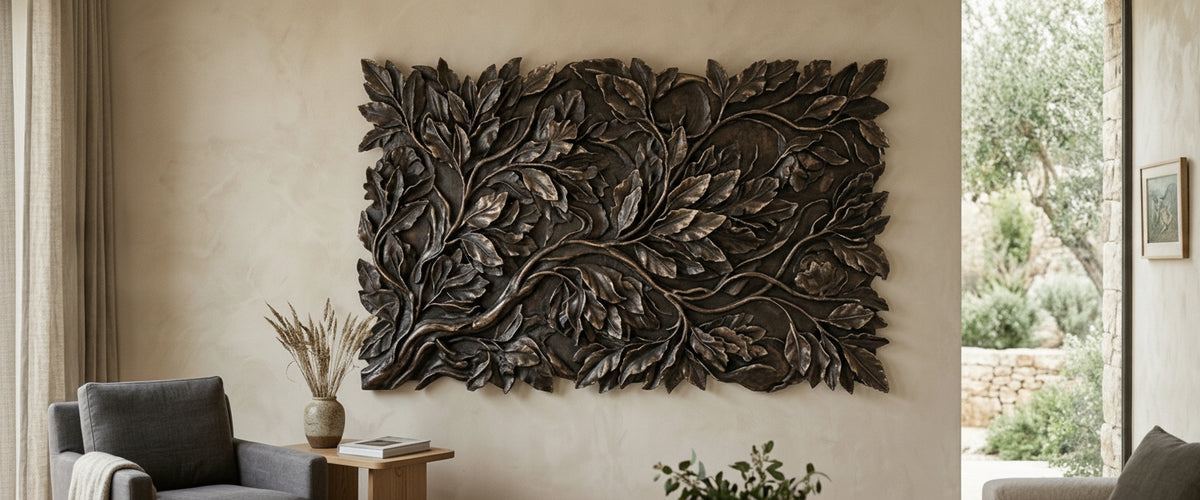

A leaf motif in hammered steel can anchor a twenty-foot entry wall, or it can look like a clearance-aisle afterthought pinned above the console table. The difference is almost never the design. It is scale, material, and how the finish behaves under the light in the actual room. Botanical metal wall art gets bought on a photo and hung in a space nothing like the photo, and that is where most disappointments start.
Here is the practical version of how to choose a piece of botanical metal wall art that earns its wall, whether you are furnishing a Napa great room, a lobby in Dallas, or a covered terrace in the Hamptons.

Key Takeaways
- Scale first. Measure the wall, not the sofa. A piece of botanical metal wall art usually needs to fill 60 to 75 percent of the visual field to read as a focal point.
- Material sets the mood and the maintenance. Bronze and Corten age; stainless steel and coated aluminum stay put.
- Finish reacts to light. Brushed, polished, and patinated metals throw completely different results in the same room.
- Indoor and outdoor are different specs. A coastal terrace needs marine-grade thinking, not a decorative panel meant for a hallway.
- Bespoke solves the awkward wall. Odd proportions, curved surfaces, and precise color matching are where a commission pays off.

What Botanical Metal Wall Art Means, and Who It Suits
Botanical metal wall art is any wall-mounted piece built from metal that draws on plant forms: leaves, branches, seed heads, ferns, blossoms, or looser abstracted growth. It runs from delicate laser-cut panels to heavy welded relief work with real depth and shadow. The plant reference is what separates it from purely geometric or figural metalwork.
Botanical metal wall art suits people who want organic movement on a wall without hanging a painting. Designers reach for it when a room has gone a little hard-edged, all stone and glass and straight lines, and needs a natural rhythm to soften it. Collectors like it because good metalwork carries texture you can read from across a room and detail you only catch up close. And it works for buyers who want one confident statement rather than a gallery wall of small frames.
If you want something with sculptural depth rather than a flat printed image, the Metal Wall Art collection is the right starting point, and it sits alongside our broader work in relief and freestanding pieces.

Materials, Finishes, and Scale Decisions
Metal choice decides almost everything downstream on a piece of botanical metal wall art: weight, cost, how it ages, and whether it can live outdoors.
The Metals Worth Knowing
Bronze is the classic for relief and botanical detail. It holds fine casting well, takes a range of patinas from deep brown-black to green, and lasts generations outdoors. A cast bronze branch or seed-head panel reads as a serious art object rather than wall decor. To gauge how much shadow and depth casting can deliver on a wall, a piece like the Traditional Horse Head Bronze Relief - 80cm shows the same relief language botanical commissions rely on.
Stainless steel (specify 316 grade for coastal or poolside settings) stays bright and needs almost nothing from you. Polished, it mirrors the room and the sky; brushed, it diffuses light into a soft satin. It suits contemporary interiors and modern architecture where you want clean, cool metal that will not patina.
Corten (weathering steel) develops a stable rust-orange surface that suits gardens and rugged modern exteriors. It is the outdoor favorite for a reason: the warm oxide tone reads beautifully against greenery and stone. Note that Corten can leach runoff onto light paving as it settles, so placement matters. The American Institute of Steel Construction has good technical background on how weathering steel forms its protective layer.
Coated aluminum is lighter, which matters on drywall or over long horizontal runs, and takes powder-coat color well if you want a specific green, black, or metallic tone.
Finish Changes the Room
The same leaf design in polished stainless versus dark patinated bronze produces two different pieces of botanical metal wall art. Polished and mirror finishes bounce light and can look restless in a busy room but electric in a calm one. Brushed and satin finishes are forgiving and read as quiet luxury. Patinas add age and depth and hide fingerprints and minor wear, which is why we often steer high-traffic commercial walls toward them. Where a wall also needs to carry a light source, a cast bronze form such as the Classical Figural Torso Wall Sconce Bronze Sculpture - 90cm shows how patinated metal handles both function and shadow, worth keeping in mind if your piece has to work near lighting rather than under it.
Getting Scale Right
This is where buyers stumble most. On a photo, everything looks generous. On the wall, a 24-inch (60 cm) piece can vanish above a large sofa. As a working rule, a single focal piece should span roughly two-thirds the width of the furniture or wall zone beneath it. Over a fireplace, favor width over height. On a tall stairwell wall, a vertical composition (a climbing branch or a stacked run of panels) uses the height instead of fighting it.
For big architectural walls, think in feet, not inches. We have shipped botanical metal wall art in relief runs measured in whole wall bays, weighing well over 100 pounds (45 kg) across the mounted assembly. At that point, fixings and wall type stop being an afterthought and become part of the design conversation.

Where to Place Botanical Metal Wall Art for Impact
For wider placement ideas, Flower & Plant Art for Modern Homes: How to Style Botanical Wall Paintings Like a Pro is useful companion reading before finalising the setting and sightlines.
The strongest placements give the metal something to do with light. A raking side light from a window or a wall wash from above will pull every leaf edge and ridge into relief. Flat, even ceiling light kills the drama, especially on patinated or textured surfaces.
Interior spots where botanical metal wall art reliably works:
- Double-height entries and stairwells. Vertical compositions own the empty upper wall most homes waste.
- Above a fireplace or console. A wide, low-relief panel gives weight without crowding.
- Long hallways. A run of related panels turns dead circulation space into a sequence you walk past on purpose.
Outdoors is where these botanical metal wall art pieces really come into their own. On a garden wall, a poolhouse, or a shaded loggia, the metalwork plays against real planting and shifts through the day as the sun moves. For a Texas courtyard or an Aspen terrace, Corten or 316 stainless is the honest answer. Mount it where seasonal planting can grow around and behind it, so the piece and the garden read as one composition rather than a plaque bolted to masonry.
One lesson from the studio: clients almost always underestimate the standoff gap. Relief needs to sit an inch or two (2 to 5 cm) off the wall so the shadow lines register. Flush-mounted, the same piece looks like signage.
Budget, Commissioning, and Delivery
Cost on botanical metal wall art tracks material, scale, complexity of the forms, the finishing process, and installation. A small laser-cut aluminum panel and a hand-welded bronze relief measured in feet are not in the same conversation, and neither is a stock design versus a one-off commission. Rather than guess, define your wall and setting, then request a tailored quote so the number reflects the actual engineering and finishing your piece needs.
A few things that move budget more than buyers expect:
- Depth and layering. Multi-plane relief with individually formed leaves costs more than a single cut sheet, and looks it.
- Finish. Hand-applied patinas and mirror polishing are labor, not paint.
- Outdoor spec. Marine-grade stainless, sealed welds, and concealed fixings add cost but save you from corrosion later.
- Installation. Heavy or multi-panel work often needs a mounting substructure and professional hanging, especially on masonry or over glass-adjacent walls.
On delivery, large botanical metal wall art pieces travel crated and often on custom brackets we supply. Because we ship worldwide from the UK, we plan freight and mounting hardware around the destination wall, not a generic box. Give us the wall type (drywall, brick, concrete, stone) early; it changes the fixing design.
How Giant Sculptures Handles Bespoke Botanical Commissions
Most of the botanical metal wall art we are proudest of started as an awkward wall someone else called impossible. A curved lobby wall, a stairwell that needed a piece read from three floors, an outdoor bay that had to survive salt air and still look intentional against evergreen planting.
Bespoke commissioning with Giant Sculptures usually runs like this. You share the wall, the light, the setting, and any reference imagery. We advise on metal and finish for that specific environment, then develop the composition to your proportions rather than forcing a stock size onto the space. We handle engineering, finishing, crating, and mounting guidance through to install. Because we work at scale across bronze, stainless steel, and Corten, we can match a piece to a genuinely large wall instead of scaling down an idea to fit an off-the-shelf panel.
If you are still gathering ideas, browse the wider Bronze Wall Art range for a sense of relief depth and patina options, then bring us the wall. That is the point where a good piece of botanical metal wall art stops being decor and starts holding the room.