





































































































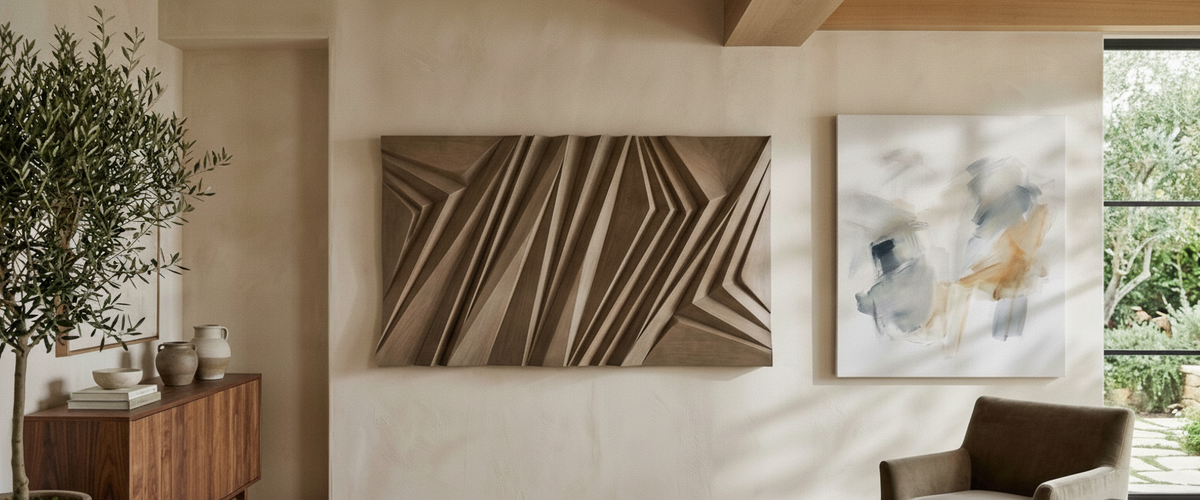

A six-foot canvas looks enormous on a product page and strangely modest once it is on a 20 ft (6 m) great-room wall. That gap between the listing photo and the room is where most art wall art canvas purchases go sideways. The print itself may be excellent; the decision behind it was made on a phone screen, at arm's length, with no sense of how the surface would behave under real daylight at real scale. We see the aftermath regularly: a client asks for a sculptural piece to rescue a wall that already carries one large canvas wall art panel and still feels flat.

Key Takeaways Before You Buy
Surface beats size. A textured or carved panel reads at a distance; a flat art wall art canvas needs scale plus strong composition to do the same work.
Stretcher depth matters more than weave. Thin, shallow bars are where slack and rippling start.
Judge print quality up close. Giclee dot structure and ink density show at 20 inches (50 cm), not from the sofa.
Flat graphic color enlarges badly. Album art and pixel-grid designs lose their edges past roughly 3 ft (90 cm) wide.
One wall art canvas plus one dimensional piece looks more considered than a nine-frame grid.
Size to the architecture, not the furniture catalog: sofa back, stairwell turn, hallway sightline.
The Surface Test: What Canvas Loses When a Cast Panel Hangs Beside It
Hang one of the better canvas art prints next to a carved relief panel and the difference is immediate. The canvas holds one plane of information. The relief holds two: the image and the shadow the image throws. Shadow changes through the day, so a dimensional piece keeps giving you something new at 8am and 6pm, while the print looks identical at both. That is the honest trade. Canvas wall art gives you color range, softness and easy scale; carved or cast work gives you depth, physical presence and a surface your eye keeps re-reading.
Where a neutral palette has to earn its keep through shadow rather than color, a carved panel such as Barwick Taupe Angled Abstract 3D Carving Wall Art does work a flat print of the same width cannot: the angled ridges pull a moving line of shadow across the field while the tone stays quiet. Most buyers browsing art wall art canvas listings and wider canvas art ranges are actually chasing that sense of presence and assume more square footage will deliver it. Sometimes it does. Often the answer is a smaller piece with a deeper surface.

Stretcher Depth, Bracing and the Slack That Shows Up in Year Two
Ask about the bars, not just the print. A wide art wall art canvas on shallow 0.75 in (19 mm) stretcher bars with no cross-brace will eventually show a soft wave near the center, especially above 4 ft (1.2 m) wide. Deeper bars around 1.5 in (38 mm), kiln-dried, with keys in the corners and a cross-brace on anything large, hold their tension far better.
Environment does the rest of the damage. Canvas is hygroscopic, so it tightens and relaxes with humidity swings, which is why the American Institute for Conservation advises keeping paintings on canvas away from fireplaces, HVAC vents and exterior walls prone to condensation (culturalheritage.org). We installed a commission in a ranch house with radiant heat and wide seasonal humidity swings; the client's existing canvas wall art had already gone slack, while the metal and carved pieces on the same wall have needed nothing but dusting. That is the long-term ownership argument in one sentence.
Giclee Ink or a Hand-Finished Surface? Judge It from 20 Inches Away
Step close to any art canvas before you commit. A quality giclee shows smooth tonal transitions, dense blacks and no visible banding in flat areas. A cheap one shows dot patterning in the mid-tones and a slightly chalky matte surface where the coating has been sprayed thin. Pigment inks on a properly coated substrate hold color far longer than dye-based equivalents, which is what separates a long-lived art wall art canvas from one that fades by year five, and print permanence research from the Image Permanence Institute is worth reading if longevity matters to you (imagepermanenceinstitute.org).
Hand-finished pieces sit in a different category. Carved wood, cast metal and applied-texture panels carry tool marks, patina variation and edge detail that a printer cannot fake. In a warm-toned room where a hard geometric relief would feel too severe, a softer carved rhythm like Barwick Mocha Drift Abstract 3D Carving Wall Art is closer to the right design language, and the timber grain keeps reading as material rather than as pattern. Across our 3D wall art the surfaces change depending on where you stand. That is the point.

Album Art Canvas and Pixel Grids: Why Flat Color Breaks Down at Scale
Two popular categories fail predictably at large scale. The first is album art canvas: cover artwork was designed for a 12 in (30 cm) square sleeve, so blowing it up to 5 ft (1.5 m) exposes soft edges, compression artifacts and type that was never set for that viewing distance. The second is anything built with a Canva pixel art generator or a similar grid tool. Pixel graphics have hard stepped edges by design; enlarge them and the steps become blocks the eye reads as a printing fault rather than a style choice.
If you love the source image, keep it intimate. Print that art wall art canvas at 24 to 36 in (60 to 90 cm) in a hallway or study, and let a physical piece carry the main wall. A commissioned relief lets you keep the graphic language while gaining real edges and shadow depth.
One Canvas Plus One Sculptural Piece Beats a Nine-Frame Gallery Wall
Gallery walls were a response to owning lots of small things. If you are buying deliberately, pair instead of stack. A single large art wall art canvas above the sofa, with a carved or metal piece on the perpendicular wall, creates a conversation across the room. For that second position, a darker panel such as Barwick Charcoal Flow Abstract 3D Carving Wall Art tends to work better than another light-toned piece, because the depth of tone anchors the print without competing with it for attention.

Sizing Checklist for Art Wall Art Canvas and Panels
Above a sofa: size the art wall art canvas to roughly two-thirds of the sofa width, with 6 to 10 in (15 to 25 cm) of clear space above the back cushions.
Stairwell turn: measure the sightline from the bottom landing, not from the stairs, and hang to the eye level of someone standing below.
Long hallway: a single piece on the end wall reads better than a run of small frames along the sides.
Double-height rooms: anything under 5 ft (1.5 m) tall will look like a postage stamp. Go larger or go dimensional.
Center height: 57 to 60 in (145 to 152 cm) to the center of the piece in standing rooms; drop it in seated rooms.
Weight: confirm the fixings before delivery. Carved and cast panels need anchors rated well above the piece's actual weight.
Commissioning Something the Wall Deserves
When a wall is the room's main event, a stock size rarely fits it exactly. Bespoke work solves that. At Giant Sculptures we build wall pieces and freestanding sculpture to specified dimensions in bronze, stainless steel, Corten, stone and carved timber, matching finish and tone to the room's existing materials. Budget depends on material, scale, complexity, engineering, installation and finishing, so the sensible route is a tailored quote rather than a guess. Start by measuring the wall, photographing it at two times of day, and telling us what the light does. That conversation usually saves a client from buying the same art wall art canvas twice.
If you want to compare a wall art canvas against a carved surface before committing, the wall art and wall decor range sits alongside the wood wall art collection, which is the easiest way to judge how much presence a textured surface adds at the same footprint.
For wider placement ideas, Blue Wood Wall Art: How to Keep the Carving From Disappearing is useful companion reading before finalizing the setting and sightlines.