






































































































A panel of acrylic art that looks glass-clear in a showroom can read faintly yellow and hazy after a few summers on a hot south-facing wall. That is not bad luck. It is a chain of small decisions made before the piece was ever cut: which sheet stock was used, how the edges were finished, how the fixings were drilled, and which cloth the cleaner reached for on a Tuesday morning. Get those right and acrylic holds its optical punch for decades. Get them wrong and you own a slowly fogging rectangle.

At a Glance: What Actually Determines How Acrylic Art Ages
Cast sheet outperforms extruded for artwork. It is harder, more chemically stable, and machines cleanly without gummy edges.
Yellowing is dose-driven. UV exposure over years, not a manufacturing defect. Placement decides most of it.
Scratches are the one repairable failure. Crazing and cracking are not.
Over-tightened fixings kill panels, usually a few summers in, not on install day.
Thickness buys presence. Thin sheet flexes, ripples reflections, and reads cheap at scale.
Dry dusting is a mistake. Static plus grit equals a permanent haze.
Quick note if you arrived here from a different search. This is not about acrylic art painting tutorials, art acrylic painting techniques or acrylic nail art ideas. We build large architectural and sculptural pieces, not craft projects. The FAQs at the end answer the paint and nail questions straight; everything between here and there is about wall-scale work.
Cast or Extruded: The Sheet Decision That Sets the Clock
Two acrylic panels can look identical under gallery light and behave completely differently in five years. Cast acrylic is polymerized between glass, giving higher molecular weight, better solvent resistance and cleaner cut edges. Extruded sheet is pushed through a die: cheaper, more consistent in thickness, and far more prone to stress crazing when it meets adhesives, cleaners or clamping pressure.
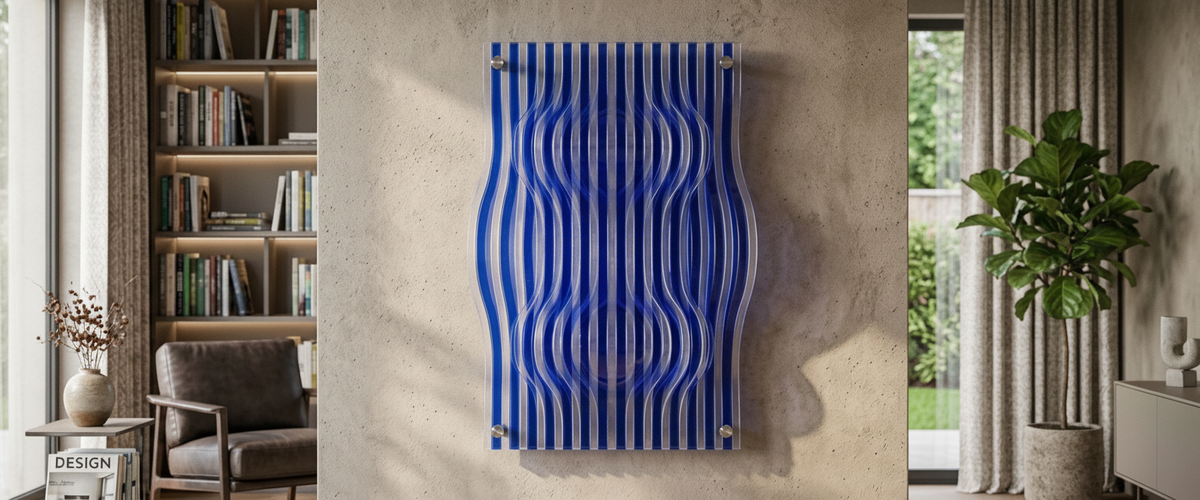
For any acrylic art you intend to keep, insist on cast. The difference shows most at the edges. A cast panel takes a flame-polished or diamond-polished edge that reads like optical glass; extruded stock tends to look slightly milky and picks up micro-fractures where the saw entered. On a striped, layered composition such as the Panthra Cobalt Blue Acrylic Stripe 3D Wall Art, the edges are doing half the visual work, catching light and throwing color onto the wall behind. Cheap edges wreck that effect faster than any surface flaw.
A diamond-polished edge on cast sheet reads like optical glass; saw-cut extruded stock looks milky by comparison.

Yellowing Is UV Arithmetic, Not Bad Luck
Good cast acrylic is genuinely stable under sunlight; it is the material glazing manufacturers reach for precisely because it resists the yellowing that plagues polycarbonate. That said, stable is not immortal. Conservators tracking plastics in collections consistently point to cumulative light dose, heat and pollutants as the drivers of discoloration, and the Canadian Conservation Institute's guidance on caring for plastics is a sober read for anyone placing a large panel in direct sun.
Practically, that means one thing: audit the wall before you buy. A west-facing Scottsdale hallway that bakes from 3pm onward is a harsher environment than a Manhattan lobby with filtered north light. We shipped a run of colored panels to a Napa winery tasting room where the client wanted them opposite full-height glass; we moved the piece to the perpendicular wall instead and specified UV-filtering film on the glazing. Several years on, the color has held. Had we hung it as originally drawn, it would be a different conversation.
Hairline Scratching: The Only Failure You Can Polish Out
Acrylic scratches more easily than glass. It also repairs, which glass does not. Light surface marks come out with a progressive abrasive sequence and a fine polish, and a competent finisher can bring a panel back to near-original clarity two or three times over its life. After that you are removing enough material to soften crisp edges and shallow reliefs, so restraint matters.
What you cannot polish out is crazing: a spiderweb of fine internal cracks that catches light like frost. Once it starts, it spreads. This is why the cleaning protocol below is not fussiness; it is the difference between a repairable surface and a replaceable one.
Stress Crazing Around Fixings, and Why the Damage Shows Up Late
Here is the failure we see most in pieces that were not built for their fixings. Acrylic expands and contracts with temperature far more than the steel or wall substrate holding it. If mounting holes are drilled tight to the bolt diameter, or standoffs are cranked down hard by an installer used to hanging metal, the panel has nowhere to move. Nothing happens on day one. Then a couple of summers of thermal cycling load the hole edges, and hairline cracks radiate from every fixing point.
The fix is unglamorous and non-negotiable: oversized holes, nylon or rubber isolating bushes, standoffs torqued to snug rather than tight, and no direct metal-on-acrylic contact. Ask any supplier how they detail this. If the answer is vague, walk. The calculation changes with the composition, too. A single wide panel concentrates movement into a handful of fixings, whereas a multi-element wall piece such as the Aurelian Butterfly Display Acrylic 3D Wall Art spreads load across many small mounts, which is forgiving in principle and unforgiving the moment one installer decides to make it feel solid by cranking every bolt.

Static, Dust Bloom, and the Cloth That Ruins a Surface
Acrylic carries a static charge and pulls airborne dust toward itself. Wipe that dust dry and you are dragging grit across a soft polymer with a cloth. That single habit accounts for most of the hazing we are asked to correct.
The care checklist:
Flood the surface first with clean water or a dedicated plastic cleaner. Never dry-wipe.
Use fresh microfiber, one direction, light pressure. Retire cloths early.
Ban ammonia glass cleaner, alcohol, acetone and anything labeled degreaser. These are crazing agents.
Keep an anti-static cleaner in the building manual so cleaning contractors do not improvise.
Inspect fixing points once a year for hairline radiating marks; catch them early.
Check reveal gaps behind standoffs; trapped dust builds a shadow line that reads as dirt.
Where Acrylic Art Beats Stone Indoors, and Where It Reads Cheap
Acrylic earns its place where weight, light transmission or color saturation matter. A stairwell over a suspended floor, a yacht interior, a hotel corridor with a structural ceiling nobody wants to core: these are jobs where a carved stone relief is either impossible or absurdly expensive to support. Acrylic gives you internal glow, edge-lit color and a sense of depth that opaque materials cannot reproduce. Where a wall needs light passing through the work rather than bouncing off it, a feathered, layered piece such as the Papillara Blue Butterfly Feathered Acrylic 3D Wall Art is closer to the right design language than any opaque relief.
Isolated standoff fixings and generous thickness keep a wide panel flat and reflection-true.
Where does it fall down? Thin sheet at large spans. Anything under about a quarter inch (6 mm) across a wide panel will flex, wave its reflections and telegraph every mounting point. Also outdoors in full exposure, where we would push you toward stainless steel, Corten or bronze instead. And in rooms built around natural material, an acrylic piece can look like the odd one out; comparing our acrylic art collection against the wider wall art range usually settles that question quickly.

Specs Worth Insisting on Before Anything Is Cut
Cast sheet, stated in writing, with the grade and any UV-stabilized additive named.
Thickness proportional to span. Larger panels need more body, both structurally and optically.
Edge treatment specified: flame-polished, diamond-polished or deliberately matte. Never left saw-cut.
Isolated fixings with oversized holes and bushes, plus a torque note for the installer.
Protective film retained until final positioning, then removed by the install team.
A written care sheet handed to facilities, not just the buyer.
Budget for acrylic art at scale moves with sheet grade, thickness, layer count, color work, edge finishing and the engineering behind the mount, so ask for a tailored quote against your actual wall rather than a per-square-foot guess.
Commissioning Acrylic Art at Scale
Bespoke work is where the material gets interesting. We have built layered panels sized to a specific stair void, color-matched to a fabric sample, and detailed so the fixings disappear behind the composition. Send us wall dimensions, a photo taken at the time of day the room gets its strongest light, the substrate type, and any color references. Giant Sculptures then works back from the wall to the piece rather than asking a room to accommodate a stock size. For clients weighing acrylic against metal or stone, we will say plainly when another material is the better long-term call. Explore the abstract art and modern art collections for form language, then bring us the difficult wall.
For wider placement ideas, 3D Wall Art for the Bedroom: Why Light Angle Beats Everything Else is useful companion reading before finalising the setting and sightlines.