


































































































The fastest way to kill an abstract organic sculpture is to buy it too small. We see it constantly: a beautiful biomorphic bronze arrives, gets set on a wide terrace or in a double-height entry, and simply disappears. The form was right. The scale lost the argument. Getting an abstract organic sculpture to hold a space is less about taste and more about reading proportion, material, and sightlines before you commit.
These are the flowing, curved, non-representational pieces that suggest living things without copying them: a rising wave, a folded seed pod, a torso abstracted down to its essential lines. Done well, they read as calm and confident. Done carelessly, they read as an afterthought.
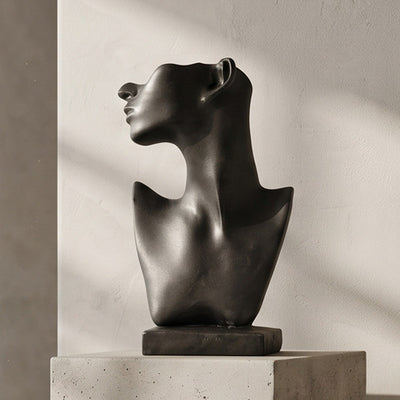
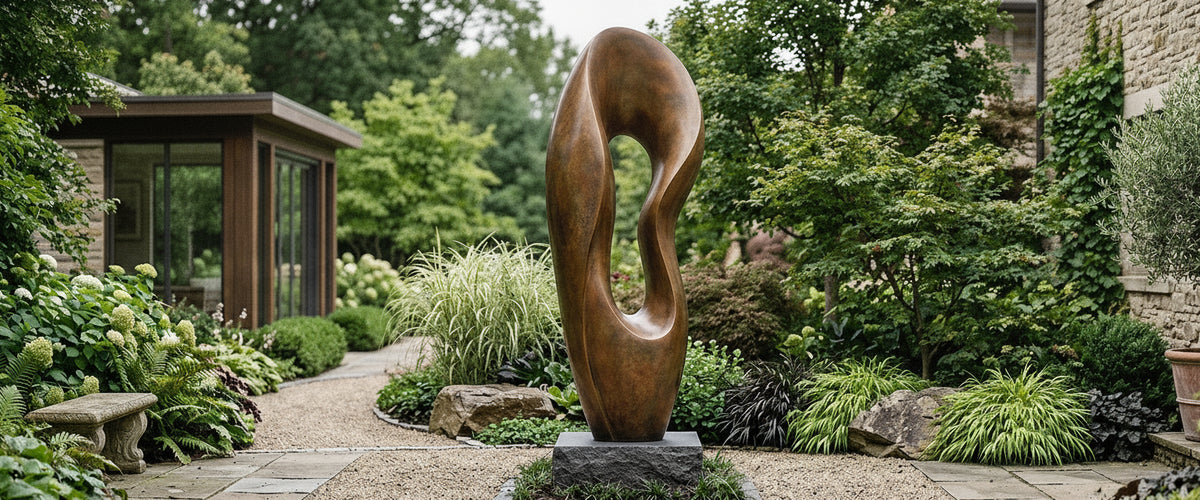
A patinated bronze form catches light softly along its curves against a quiet backdrop.

Key Takeaways for Buying Abstract Organic Sculpture
Scale first. A piece needs to relate to the wall, ceiling, or planting behind it, not just look nice in the studio photo.
Material sets the mood. Bronze reads warm and permanent; stainless steel reads cool and reflective; stone and marble read solid and grounded.
Placement is about approach. Curved forms change dramatically as you walk around them, so plan for the route people take, not one fixed angle.
Budget varies widely. Cost depends on material, size, complexity, engineering, and finish, so a tailored quote beats any published guess.
Bespoke is common. Most large organic pieces we ship are adjusted in scale, patina, or base to suit the site.

What Abstract Organic Sculpture Means, and Who It Suits
Abstract organic sculptural art borrows its vocabulary from nature without describing anything literally. The line is biomorphic: soft, continuous, often asymmetric. You will sometimes see the term applied loosely to abstract sculpture of organs or bodily forms; the more useful idea is that the shape feels grown rather than built. Think of the way a river stone or a bone has no straight edges, yet reads as complete. The term biomorphism itself traces back to early twentieth-century modernism; the Tate glossary entry on biomorphic form is a good primer on where the vocabulary comes from.
This kind of work suits buyers who want presence without a story being spelled out. A figurative statue tells you exactly what it is. An organic form invites interpretation, which is why designers reach for it where a literal subject would feel too heavy: a minimalist Napa living room, a corporate lobby in NYC, a stepped garden in Aspen. Collectors like it because it ages well as taste shifts. It rarely dates the way a trend-driven figurative piece can.
If you are furnishing a space that already has a strong personality, an organic form can hold its own without competing. Our organic sculptures collection leans into exactly this: shapes that feel alive but stay abstract.

Materials, Finishes, and Scale Decisions
Material is the first real decision, because it governs both mood and longevity. Here is how the main options behave in practice.
Bronze
Bronze is the workhorse of serious abstract organic sculpture art, and for good reason. It casts fine curves cleanly, takes a patina in tones from near-black to warm green, and lasts for generations outdoors. A patinated bronze catches light softly along its edges, which flatters a flowing form. Where a courtyard needs a single continuous curve to dominate without a hard edge, a piece like the Monumental Modern Abstract Biomorphic Bronze Sculpture - 340cm shows what that scale of cast form can do.
Stainless Steel
Polished or brushed stainless steel pushes an organic form in the opposite direction: cool, reflective, mirror-bright. It picks up sky, planting, and water, so the sculpture is never quite the same twice. It suits contemporary architecture and works hard next to glass. If you want the piece to feel light despite its size, stainless is the move.
A mirror-bright stainless form reflects its surroundings, changing throughout the day.
Stone and Marble
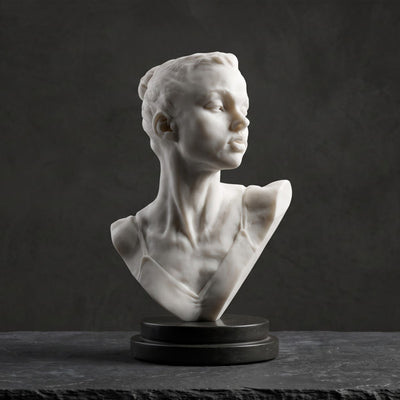
Carved stone and marble give you weight and permanence. A biomorphic form in marble reads ancient and modern at once, and the translucency of good stone rewards close viewing. These are slower to make and heavier to install, but nothing else grounds a space quite the same way.
Corten and Engineered Metalwork
Corten steel weathers to a rich rust-orange skin and sits beautifully against greenery, which is why landscape designers favor it for outdoor forms. For very large or cantilevered organic shapes, engineered fabricated metal lets us build sculptures that would be impractical to cast solid.
On finishes: a matte surface hides fingerprints and softens reflections, while a high polish demands more upkeep but delivers drama. An organic abstract plaster sculpture can be gorgeous indoors and is often used for maquettes or interior-only pieces, but plaster is not an outdoor material; it will not survive weather or handling the way metal and stone do. If a plaster study seduces you, treat it as the starting point for a bronze or stone version built to last.
Scale is where most buyers slip. As a rough studio rule, a floor-standing indoor piece wants to reach at least mid-chest height on an adult to register as sculpture rather than decor. Outdoors, go bigger than instinct suggests; open sky and planting swallow mass. When in doubt, we mock up the footprint on site with cardboard or tape before casting begins.

Where to Place Abstract Organic Sculpture for Real Impact
For wider placement ideas, Contemporary Abstract Metal Sculpture: A Buyer's Guide to Form, Scale, and Placement is useful companion reading before finalising the setting and sightlines.
Curved forms are kinetic. Walk around one and it reorganizes itself, revealing a new silhouette every few steps. That means placement is about the approach, not a single hero angle.
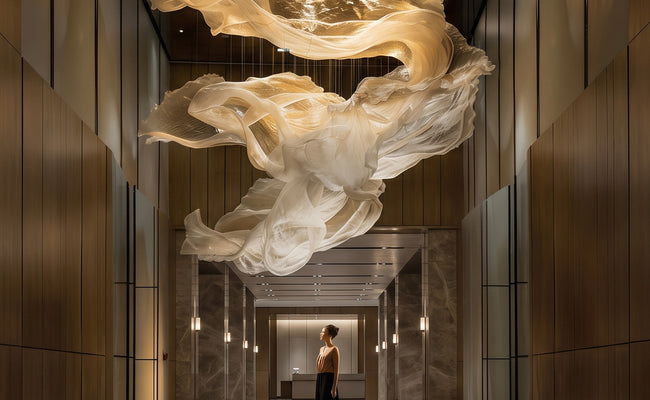
Entrances and arrival points. An organic form at the end of a drive or in an entry hall sets the tone before anyone speaks. Where you want people to move through the composition rather than past it, a threshold-scale form such as the Monumental Modern Abstract Arch Bronze Sculpture - 370cm frames a view or a path as they arrive.
Against a plain backdrop. Organic curves need quiet behind them: a rendered wall, a clipped hedge, a sheet of water. Busy planting or patterned stone fights the silhouette.
In the round. If the piece will be seen from all sides (a lawn in the Hamptons, a lobby island, a Texas courtyard), it must resolve from every angle. Ask the studio for 360-degree renders before you approve, not just the flattering three-quarter view.
Water and reflection. Set a polished form near a still pool and you double it. This is one of the most reliable ways to make a mid-size sculpture feel monumental.
Interior focal points. Indoors, a smaller organic bronze earns a plinth. For a considered anchor at the turn of a staircase or at the far end of a long room where the eye needs somewhere to land, something like the Large Contemporary Abstract Female Torso Bronze Sculpture - 140cm sits at the right intimate scale.
Budget, Commissioning, and Delivery
There is no honest fixed price for abstract organic sculpture, and anyone quoting one without seeing the brief is guessing. Cost is driven by material, size, structural complexity, the finishing work, and installation. A polished stainless form the size of a car and a tabletop bronze study are not in the same conversation. The right move is to describe the space, the material you are drawn to, and the effect you want, then ask for a tailored quote.
A few practical points we tell every buyer:
Weight and access. Large bronze and stone run into the hundreds or thousands of pounds. Confirm crane access, gate widths, and floor loadings early. We have re-planned more than one install because a courtyard could only be reached through a single 30-inch (76 cm) doorway.
Foundations and fixings. Outdoor pieces need a proper base and, often, internal armature and ground anchors. This is engineering, not an afterthought.
Lead time. Casting, patination, and fabrication take real time, especially for bespoke scale. Build that into project schedules.
International shipping. We ship worldwide, crated and insured. Larger works travel in purpose-built crates, and we coordinate customs so the piece arrives ready to install.
Outdoor sculpture succeeds or fails on installation detail as much as on the object itself. The invisible engineering is what keeps a curve standing straight for decades, so treat that budget line as seriously as the sculpture.
How Giant Sculptures Helps With Bespoke Projects
Most of the large organic work we deliver is adjusted in some way: a taller version of an existing form, a different patina to match stonework, a base cut to suit a specific plinth. Giant Sculptures works as a bespoke supplier for exactly this, so a piece you love in the catalog can be scaled or refinished for your site rather than forced to fit.
If you are starting from scratch, bring us a reference, a material preference, and photos of the space. We can develop a maquette, agree the finish, and cast or fabricate at the scale the site actually needs. For designers and architects, that means one point of contact from concept through crated delivery.
Browse the bronze abstract sculptures range to see how patina and form work together, or the wider abstract sculptures collection for the full spread of styles. When you have found the direction, tell us the space and we will build to it.