





































































































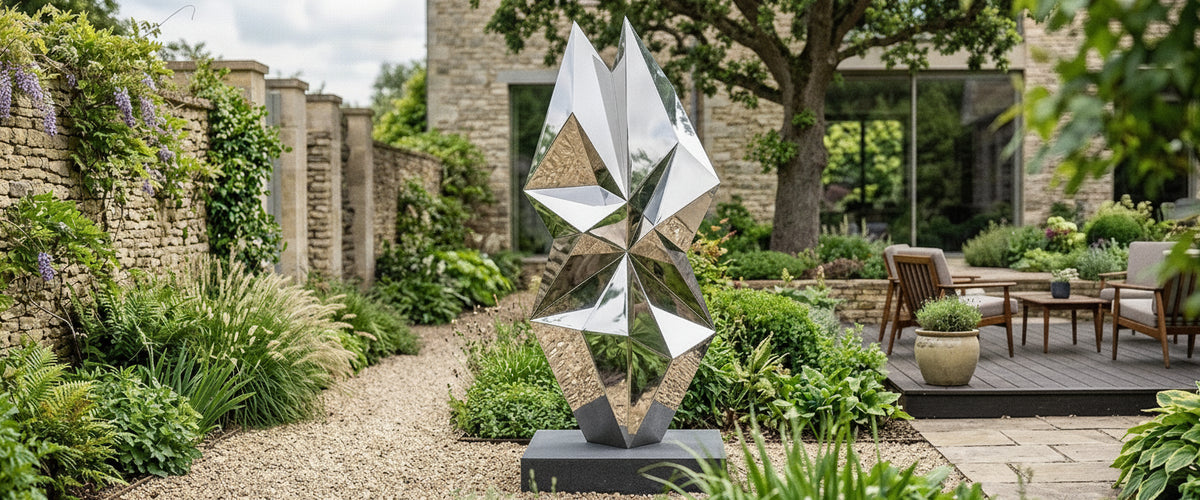

A hard edge reads differently than a soft one. Put an angular steel form at the end of a hallway and it does something a curved bronze never will; it cuts the space, throws a clean shadow, and pulls your eye along its planes. That is the appeal of abstract geometric art, and it is why designers keep reaching for it when a room or garden needs a single confident gesture rather than a crowd of decorative objects.
Looking for the full range in this category? Browse our Geometric Sculptures collection for every available finish, size, and configuration.
Buyers get into trouble when they treat these pieces as flat graphics scaled up. A geometric sculpture is a three-dimensional argument about light, weight, and angle. Get the material and the scale right and it anchors a whole space. Get them wrong and it looks like a prop.

Abstract Geometric Art at a Glance
Best for: Modern and transitional interiors, sculptural gardens, corporate lobbies, and anywhere that needs one strong focal point.
Signature materials: Stainless steel, Corten, bronze, and stone, chosen for how they catch light and survive weather.
Scale matters most: Angular forms read best when they are generous. Undersized geometric pieces disappear.
Finish drives mood: Mirror polish feels sharp and futuristic; brushed or gold-toned steel feels warmer; raw Corten feels earthy and architectural.
Commission-friendly: Clean planar geometry is one of the most controllable things to make bespoke, so custom scale and finish are very achievable.

What Abstract Geometric Art Actually Means
Abstract geometric art strips away representation and works with pure form: planes, angles, facets, and intersecting solids. There is no horse or figure to read, only the relationships between shapes and the way light travels across them. Some pieces lean quiet and meditative. Others go the opposite direction into abstract geometric art with edgy angular shapes, all sharp vertices and aggressive diagonals that feel almost architectural.
It suits buyers who want impact without narrative. A collector furnishing a hillside home, an architect finishing a city lobby, a landscape designer closing a long lawn; these are the people who tend to choose geometry over figurative work. The form does not compete with the space, it organizes it.
The near cousins are worth naming too. Flat angular geometric sketches art and wall panels work in the same visual family, but a freestanding sculpture behaves very differently once it has depth and casts real shadows. If you have been collecting drawings or prints in this style, moving to a dimensional piece is a genuine step up in presence.

Key Materials, Finishes, and Scale Decisions
Material is the first real decision, because it sets both the mood and the lifespan.
Stainless steel is the workhorse of geometric sculpture. Its flat planes take a mirror or brushed finish beautifully, and it holds crisp edges that catch light along every facet. A faceted steel form such as the Diamond Geometric Steel Sculpture throws different reflections as you move around it, which keeps a static object feeling alive. For a warmer register, gold-toned steel softens the industrial edge; where the geometry needs to read rich rather than cold, the Matrix Gold Geometric Steel Sculpture is closer to the right design language.
Corten (weathering steel) is the outdoor favorite. It develops a stable rust-colored patina that protects the metal underneath, so its angular planes read earthy and architectural against planting or stone. Once that patina stabilizes it shields the metal rather than eating into it, which is why it is used on large public and landscape works. The ASTM A242 standard for high-strength weathering steel sets out the corrosion-resistance properties that make it dependable outdoors.
Bronze and stone bring weight and permanence. Bronze can be patinated in cool grays or warm browns to change how the geometry feels, and stone gives you mass that grounds a large facet composition. These suit buyers who want the piece to outlive the building it sits in.
On scale, the mistake we see most often is buying small. Geometric forms rely on generous proportion to deliver their angles. A 12-inch (30 cm) facet on a console table is an ornament; a 5-foot (1.5 m) version in a stairwell is a statement. For garden work, remember that open sky and planting swallow objects fast, so measure against the space, not against your living room. For a lawn-scale accent that has to hold its own against horizon rather than a shelf, an outdoor-engineered form such as the Edge Geometric Steel Outdoor Sculpture is the register to aim for.

Where to Place Abstract Geometric Art for the Strongest Impact
For wider placement ideas, Abstract Geometric Wall Art: How to Place It so It Actually Reads is useful companion reading before finalising the setting and sightlines.
Geometry loves a clean backdrop and directional light. A few placements that consistently work:
End of a sightline. Put an angular piece where a corridor, gallery wall, or long lawn terminates. The eye travels the line and lands on the sculpture.
Against a plain plane. A rendered wall, a limestone facade, a dark-stained fence. Busy backgrounds fight the edges and flatten the whole thing.
In raking light. Low morning or evening sun rakes across facets and doubles the drama with cast shadows. Indoors, a single directional spot does the same job.
On a turning point. A courtyard corner, a driveway pivot, a stair landing. Angular work rewards being seen from multiple angles as you move.
For interiors, a mirror-polished steel piece can bounce light into a darker room and make it feel larger, which is why we get requests from apartment owners in dense cities where daylight is scarce. Outdoors, a gold or silver Matrix-style form near water plays with reflection all day. We once shipped a pair of angular steel forms to a courtyard where the client wanted them flanking a reflecting pool; the doubled reflection at dusk did more work than any additional planting could have.
Budget, Commissioning, and Delivery
There is no honest flat price for sculpture at this level, and you should be wary of anyone who quotes one sight unseen. Cost is driven by material, scale, engineering complexity, finish, installation, and shipping. A brushed steel piece a few feet tall is a very different proposition from an engineered Corten monolith that needs a concrete footing and a crane. The right move is to request a tailored quote once you know your rough scale and site.
A few things that genuinely move the budget:
Finish. A true mirror polish takes far more hand-finishing than a brushed surface, and that labor shows up in the quote.
Structural engineering. Tall or cantilevered angular forms need internal armatures and wind-load calculations for outdoor sites. This is not optional; it is what keeps the piece standing.
Base and installation. Freestanding geometric work often needs a plinth, a footing, or anchoring. Factor it early.
Freight. Large pieces crate up as significant weight and volume. We ship worldwide, and international delivery is routine for us, but it belongs in the plan from day one, not the day before.
Commissioning is where geometric work shines. Because the language is planes and angles rather than anatomy, bespoke scale and finish are highly controllable. You can take a form you like and have it built taller, patinated differently, or produced as a matched pair. That predictability is a real advantage over figurative commissions, where subtle proportion changes ripple through the whole piece.
How Giant Sculptures Helps With Bespoke Geometric Projects
Giant Sculptures is a bespoke supplier of large-scale sculpture, and angular geometric work is one of the areas we field the most custom requests for. Clients usually arrive with a reference; a photograph, a sketch, sometimes an existing piece from our geometric art range they want reworked at a different size or in a different metal. From there we advise on the material that suits the site, the finish that suits the light, and the engineering that keeps a tall angular form safe outdoors for decades.
If you are still exploring the style, browsing our abstract art collection alongside the geometric pieces is a good way to feel where your taste sits between softer abstraction and hard-edged angular work. Once you have a direction, send us the site details and rough scale and we will come back with material options and a proper quote rather than a guess.
Angular sculpture is one of the most rewarding things to own well, because it keeps changing as the light moves and as you move around it. Buy at the right scale, in the right material, for the right spot, and it will earn its place for a very long time.