





































































































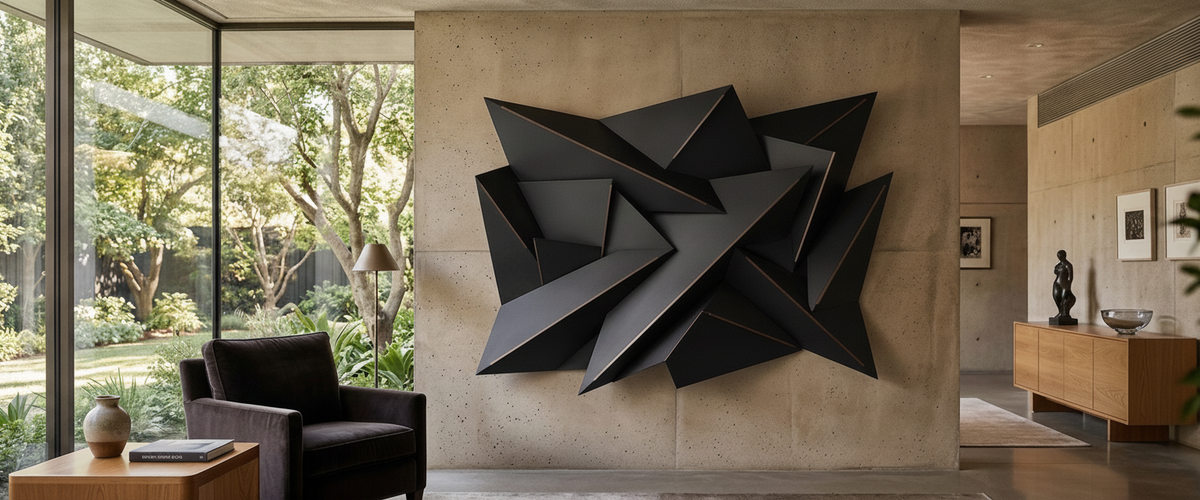

Hang three pieces of abstract black wall art side by side under a skylight and you will see three different blacks. One reads like fresh ink. One turns faintly brown at the edges by mid-afternoon. The third soaks up light like the inside of a fireplace. All three listings said “black.” The finish decides whether a piece sharpens a room or quietly disappears into it, and the word on the product page rarely tells you which you are getting.

Key Takeaways
Powder-coated steel gives the flattest, most consistent black and suits crisp, geometric abstraction.
Blackened bronze and patinated iron drift toward brown or blue as daylight moves, and they keep maturing for years.
Charred or charcoal-toned timber brings grain and warmth but wants a room with steady humidity.
Kitchens, stairwells and humid rooms favor metal over wood.
Matte black on a dark wall needs contrast or lighting, or the silhouette vanishes.
Why “Black” on a Spec Sheet Tells You Almost Nothing
On a wall, black is mostly a question of how the surface handles light. Gloss level, texture and undertone do far more work than the pigment itself. A high-gloss 5-foot (1.5 m) panel can read as silver where it catches a window, while a textured matte finish on the same shape stays dense from every angle.
This matters more for abstract black wall art than for figurative work. Abstraction lives on edges, planes and shadow lines. If the finish swallows the shadow, the composition flattens; if it reflects too much, the shape breaks into glare. Choosing the black is really choosing how legible the piece will be.
Powder-Coated Steel: The Flattest Black for Hard-Edged Abstraction
Powder coating is a dry powder applied electrostatically and cured under heat, which produces an even film with none of the drips or brush marks of liquid paint (the Powder Coating Institute explains the process well). For abstract black wall art built on crisp lines, powder coat delivers the most graphic black you can hang: uniform, predictable and available in matte, satin or fine texture.
Matte powder coat keeps every edge and shadow line legible.
It is the natural finish for laser-cut geometry, stacked planes and anything built on sharp negative space, which is why the hardest-edged designs in our metal wall art collection almost always use it. The trade-offs: under cool LED lighting it can feel industrial, and a deep chip reveals bright steel underneath. Ask whether the steel was blasted and pretreated before coating, because that is where longevity is decided.

Patinated Iron and Blackened Bronze: Blacks That Drift With the Light
Chemical patinas are formed from the metal’s own surface rather than sitting on top of it like paint. Sealed with wax or lacquer, they give a black with depth and movement, and they rarely hold still. Warm evening light pulls out brown; overcast mornings push toward blue-gray.
The shift can be dramatic. Match a blackened bronze relief to a black steel stair rail using a small sample chip, then install it opposite a west-facing window, and by late afternoon the relief can read as dark chocolate while the rail stays jet black. Some owners love that. Anyone expecting an exact match will not. If you want a black that behaves like a living surface, bronze is hard to beat; if you need it to match hardware exactly, choose powder coat.
The same bronze patina reads brown in low evening sun.
Charred Timber: A Black With Grain and a Softer Edge
Charred wood, often called shou sugi ban or yakisugi, gives a black no metal can: open grain, a faint alligator texture and edges that soften rather than slice. Raking light turns the surface into a relief map. Properly brushed and oiled, it will not leave soot on your fingers; poorly finished examples will.
If you like the warmth of timber but want tighter geometry, a charcoal-toned carving such as the Barwick Charcoal Grid Abstract 3D Carving Wall Art pairs a carved wooden surface with a disciplined, gridded rhythm. Our 3D wall art collection has more carved options that trade metal crispness for depth and touch.

Where Abstract Black Metal Wall Art Outlasts Timber
Wood responds to its surroundings. Swings in relative humidity make timber swell, shrink and eventually crack, a risk the Canadian Conservation Institute sets out clearly. That makes abstract black metal wall art the smarter call in three places:
Kitchens: steam and airborne grease settle into grain but wipe off sealed metal.
Stairwells: shoulders, bags and hands brush past daily; powder coat and waxed bronze shrug off contact.
Humid rooms: bathrooms, pool houses and coastal homes all punish timber.
For restaurants and hotel corridors, the same logic applies at larger scale, with the added benefit that metal can be cleaned by staff without special training.
Pairing Each Black With Its Wall
Limewash has soft, cloudy movement. Blackened bronze looks at home against it, because both surfaces shift with the light. Warm white is the safest partner for flat powder coat: it sharpens the silhouette without the clinical contrast of a stark gallery white.
Then there is the dark-on-dark trap. Matte abstract black wall art on a charcoal or navy wall looks dramatic in a render and invisible at dusk. Solve it with a sheen change, a picture light, or a secondary color built into the piece itself. On a moody wall, the green accents running through Nocturna Black & Green Modular Wooden Hand-Painted 3D Wall Art give the eye an edge to follow where a solid black panel would sink into the paint.
Reading the Listing: Finish Terms That Reveal Your Black
Product pages for abstract black wall art lean on a handful of finish terms. Here is what each one usually means.
Powder-coated: flat, uniform, durable; check the sheen level.
Hot patina: heat-applied chemistry on bronze or iron; deeper and more variable.
“Bronze finish” or “bronze effect”: usually paint over another material. Ask.
Blackened steel: often chemical blackening plus wax; beautiful indoors, less forgiving than powder coat.
Charred versus stained charcoal: charring adds texture; stain only adds color.
Hand-painted: expect subtle variation between panels.

Buyer Checklist Before You Commit
Photograph the wall at morning, midday and evening.
Note humidity and how often the piece will be touched.
Size it to the wall: roughly two-thirds the width of the furniture below is a reliable starting point.
Ask for the weight in pounds (and kilograms) and confirm the wall can take it.
Decide how much maintenance you will realistically do.
Commissioning a Bespoke Black
When the catalog does not quite fit, Giant Sculptures can make abstract black wall art to your wall, your light and your chosen material, from powder-coated steel to hot-patinated bronze. We often send sample finishes so clients can test them in place before fabrication begins. Budget depends on material, scale, complexity, engineering, installation and finishing, so the most useful next step is a tailored quote. Our abstract art collection is a good place to settle on shape and composition first; then bring us the wall.
For wider placement ideas, Abstract Beige Wall Art and the Undertone Problem Nobody Warns You About is useful companion reading before finalising the setting and sightlines.