






































































































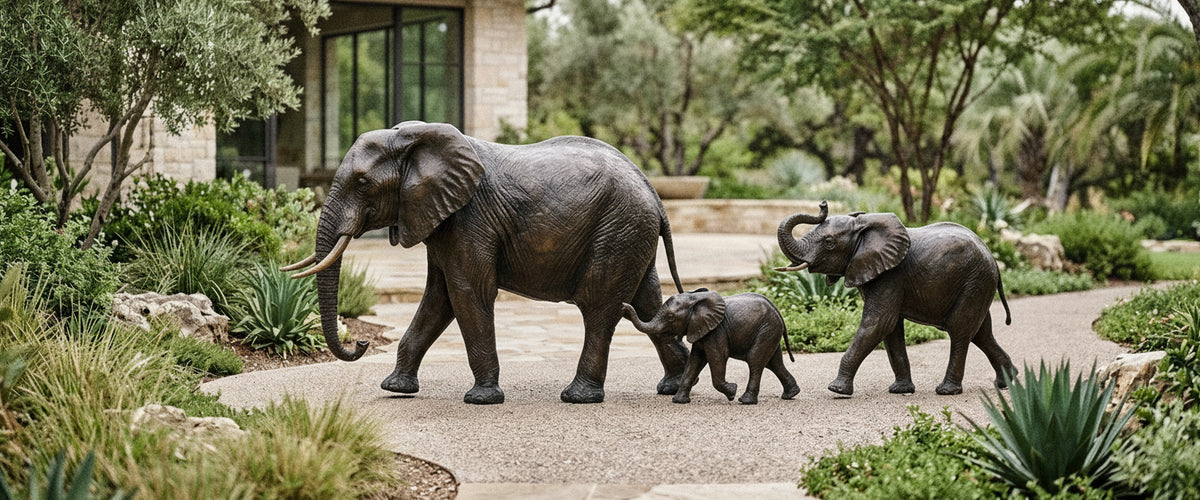

One bronze elephant on a lawn is an ornament. Three of them walking in a loose line toward a pond are a story, and that difference decides whether a wildlife sculpture earns its place on an estate or simply occupies it. Most of the herd commissions we discuss at Giant Sculptures begin with a single animal in mind. The best ones end with a group.
Quick answer
Groups beat singles when the site has long sightlines and room for movement.
Uneven gaps between animals create tension and narrative. Even spacing reads like a showroom.
Borrow real herd behavior: a lead adult, a close calf, a straggler.
Rhinos and giraffes often look more alive set at ground level without a plinth.
Material choice changes sharply when you multiply the weight by three or five.

What City-Wide Elephant Herds Taught the Public
Public art trails that scattered painted fiberglass elephants across city centers did something no gallery could. People stopped to photograph pairs and clusters, not lone animals. A calf beside its mother outside a railway station drew a crowd. A solitary figure on a corner drew a glance. The lesson carried straight into private gardens and commercial venues: numbers create a plot, and a plot keeps people looking.
That is why so many clients now ask for African wildlife sculptures as a set rather than a single centerpiece. An elephant family, a pair of rhinos, a giraffe browsing above a calf. The viewer fills in the story you leave out.
Spacing a Wildlife Sculpture Group: The Gaps Do the Work
The space between animals carries as much meaning as the bronze. Set three elephants at identical intervals and they look parked. Pull the calf tight against the mother, then open a wider gap before the trailing juvenile, and the group suddenly has pace and direction.
A hard-won studio habit: before anything is cast, we ask clients to stake out each animal with garden canes and a length of rope, then view the layout from the house, the drive and the terrace. On one Texas ranch, the original plan looked right from the porch and completely flat from the approach road, where every animal lined up behind the first. Shifting the lead elephant a few paces off the axis fixed it. Two things to check on site:
Overlap from the main viewpoint. Slight overlap reads as depth. Total eclipse hides your investment.
Odd numbers. Three or five animals rarely settle into a static pattern.
Mother, Calf and the Lagging Juvenile
Real herds give you composition for free. Elephant families are led by a matriarch, with calves kept close and young animals drifting at the edges, as the San Diego Zoo Wildlife Alliance describes. Translate that into sculpture and each figure gets a role: the adult striding with trunk raised, the calf half-hidden by her legs, the juvenile a few lengths behind with its head turned back toward something the viewer cannot see.
That turned head is the detail we fight for in the clay stage. It pulls the eye outward, past the group, and makes the lawn feel larger than it is.

Rhinos and Giraffes at Ground Level
Plinths flatter a single classical figure. They often kill a herd. A rhino raised on a block looks like a trophy. The same rhino set on a concealed concrete footing below the turf looks as if it wandered in from the paddock. Giraffes gain even more. An adult can stand around 18 feet (5.5 m) tall, so their height already supplies drama and a plinth tips them into caricature.
Ground-set pieces still need serious engineering. A tall giraffe catches wind load, so internal armatures and anchoring bolts are specified before casting, not improvised on installation day. On hotel and venue lawns, expect guests to climb on low animals. Patina and fixings should be specified with that in mind.
Life-Size or Reduced Scale Across an Estate or Hotel Lawn
Life-size wildlife sculpture earns its keep across long distances. On a Napa estate with a quarter-mile (roughly 400 m) view to the vines, anything smaller vanishes into the grass. In an enclosed courtyard or a Manhattan rooftop, a reduced-scale herd often reads better, because the viewer stands close and life-size animals can feel claustrophobic.
For a sense of scale, our Life-Size Pair of African Elephants measures 260cm (about 8.5 ft) and holds a broad lawn on its own. The 205cm (about 6.7 ft) Arcane Stag sits comfortably on a terrace, while the 125cm (about 4 ft) Luminous Stag II suits a woodland edge or courtyard where guests see it up close.
A useful test: if the main viewing point is farther away than several body lengths of the animal, go life-size. If guests will walk among the pieces, consider reducing scale and adding numbers instead. Smaller native subjects, like the pieces in our bronze rabbit and fox statues, work well as a scattered secondary layer near paths, where they reward the guest who slows down without competing with the herd for the long view.
Bronze, Fiberglass or Corten When the Weight Is Multiplied
Every material decision gets amplified in a group. Weight, footings, crane access and freight crates all scale with the head count.
Bronze. The long-term choice. Wildlife bronze sculptures develop patina gracefully, tolerate heat in Arizona and frost in Aspen, and can be re-waxed for decades. The tradeoff is weight, which means planning crane routes and foundations early.
Fiberglass. Light and paintable, which is why public trails use it. It suits temporary or seasonal displays but will not age with the character of bronze.
Corten. Ideal for stylized silhouettes and fabricated plate animals. Its rust layer protects the steel, but run-off can stain pale paving while the patina stabilizes, a point covered well by SteelConstruction.info. Set Corten herds on gravel or lawn.

Before You Commission a Herd
Stake the layout and photograph it from every key viewpoint.
Confirm crane or vehicle access to each final position.
Decide plinth or ground-set before engineering begins.
Agree the story: who leads, who lags, where heads point.
Ask how patina and fixings will handle public contact.
Budget depends on material, scale, number of animals, engineering, installation and finishing, so a tailored quote is the honest starting point. Browse our wildlife sculptures for poses and species, then talk to us about a bespoke group built around your site rather than around a catalog.
For wider placement ideas, 3d Sandstone Wall Art That Glows: Getting the LED Right is useful companion reading before finalizing the setting and sightlines.