






























Most lion statues go wrong on the day they arrive, long before the first frost. The buyer picked the face they liked and ignored the job the lion has to do. An outdoor lion statue is a piece of architecture with a mane. Put it on a gate pier, at the foot of a stair, or out on an open lawn, and the pose, scale, and stone will either hold that position or look borrowed. This is how we advise clients who come to Giant Sculptures for a pair of guardians or a single estate lion.
Looking for the full range in this category? Browse our Lion Statues & Sculptures collection for every available finish, size, and configuration.

At a Glance
Pose follows purpose: recumbent lions guard, while rampant and dramatic poses perform.
Gate piers: choose low, lying lions. Seated lions set high look top-heavy from the drive.
Steps: size the pair to the flight of stairs, not to the height of the house.
Open lawn: a single lion needs a plinth and a dark backdrop, or it shrinks.
Climate: dense granite, bronze, and well-chosen marble outlast porous cast stone in wet, freezing positions.
Fixing: use stainless dowels and drip clearance so water never sits in the coping.
A Recumbent Lion Guards, a Rampant Lion Performs
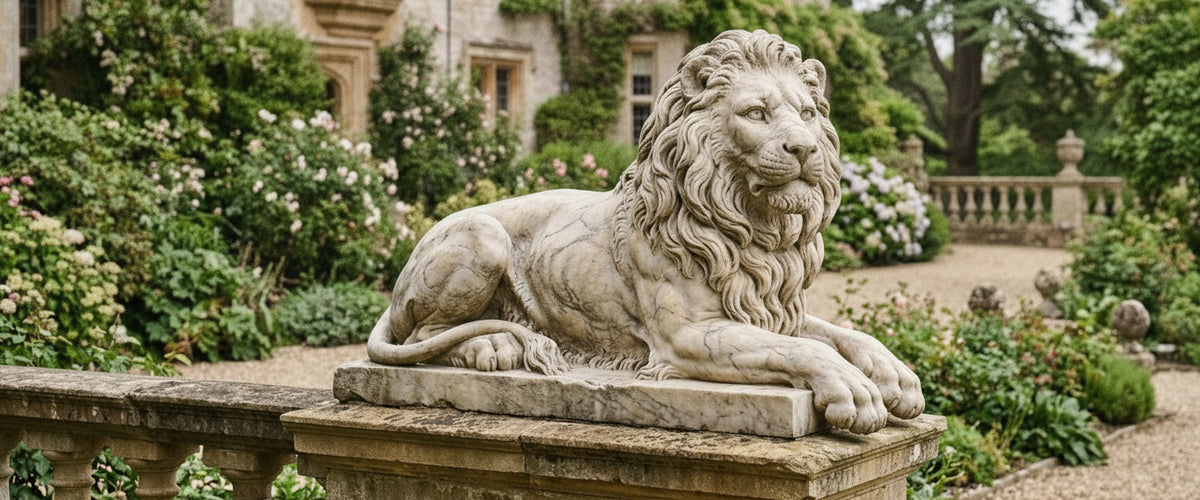
The pose tells visitors what an outdoor lion statue is for. A recumbent lion lies with its head up and its forepaws extended. It looks watchful, and it stays calm from every angle. That is why it has guarded doorways for centuries. A rampant lion rears on its hind legs. The pose comes from heraldry and is built for display, so it works as a centerpiece or a crest. Use one as a sentry and it reads like a costume.
Seated lions fall between the two. Adding the paw-on-sphere motif, borrowed from the standing Medici lions in Florence, gives a seated figure a sense of authority without the theatrics. Carved at around 180cm (roughly 6 feet), a seated lion of this type belongs at ground level beside a grand entrance, where visitors meet it eye to eye.
Gate Piers: Why Recumbent Beats Seated Up High
Pier caps are narrow, and a pier lifts an outdoor lion statue well above the viewer. A lying lion keeps its mass low and its footprint close to the shape of the cap, so it looks settled. A seated lion on the same pier piles its weight upward. From the car, you see a chest and a chin rather than a face.
A lying lion keeps its weight low and its face toward the drive.
We see this problem on paper all the time. A seated pair looks fine on a client's elevation drawing, then looks wrong once you mock up the view from the drive 20 feet away. On a pier, a low recumbent shape such as the lying marble lion at 120cm (about 4 feet) keeps its weight where the cap can carry it and its face where the drive can see it. Measure the cap first. The lion's base should sit back from every edge so rainwater drips clear of the coping instead of running down the face of the pier.

Flanking the Steps: Scale the Pair to the Flight
Buyers with large houses tend to size each outdoor lion statue to the facade. That is a mistake. Visitors experience a lion at the stair, not from across the street. A Connecticut client once sent us photographs of a three-story front, and the pair that suited the full elevation would have swallowed his five-step flight. We cut the scale back and turned the pair to face slightly outward toward the approach. Both lions still read clearly from the gate.
Before you buy, stand cardboard silhouettes on the cheeks of the stair. Then check three things. The lions should not block the view of the door. They should not crowd the handrail. They should still be visible from where guests first catch sight of the house.
The Lone Lawn Lion Needs a Plinth and a Backdrop
On open grass, a single outdoor lion statue loses much of its presence. Light-colored stone dissolves against a pale sky, and the grass makes the base vanish. You fix this with a raised plinth and a dark backdrop, such as clipped yew, boxwood, or a stand of cypress. On a long sightline in Napa or Aspen, the lion also has to be big enough to stop the eye, and an estate-scale figure such as the yellow marble lion at 240cm (nearly 8 feet) has that reach. A smaller lion simply becomes a garden ornament at that distance.
A plinth and a dark hedge give a lawn lion the contrast it needs.

Choosing an Outdoor Lion Statue Material for Your Climate
A damp, north-facing porch in England and a sunbaked drive in Texas punish stone in different ways. In the wet north, the threats are algae and freeze-thaw. Water gets into pores, freezes, and pushes the surface apart. Dense granite shrugs this off. Bronze is also unaffected, and it slowly develops a darker patina. Marble works if you choose a dense block, seal it, and make sure water drains away from the base. Expect a polished finish to soften to a satin sheen over the years. The Natural Stone Institute publishes useful care guidance for granite and marble outdoors.
In Texas, Arizona, or Southern California, the problems are UV and heat. Marble and granite stay stable in these conditions. Bronze gets hot to the touch in direct sun, so think about where children and pets will be. Painted cast stone fades and chalks. Cast stone can be a good material, but its quality varies widely, and the Cast Stone Institute sets out what a properly made architectural mix should achieve.
Fixing a Heavy Lion to a Pier Without Cracking the Coping
When an outdoor lion statue fails on a pier, the damage usually starts with the fixing, not the stone. Mild steel pins rust, and rust expands. The swelling splits the coping from the inside. Use stainless steel dowels set into drilled holes, with a bedding that does not hold water. Seal the joint so rain cannot pool around the pins. For the heaviest pieces, ask a structural engineer to check that the pier can carry the load.
We drill the base of every pier lion in our studio before it ships. Drilling a finished marble base on a ladder in January is how corners get lost.

Buyer Checklist Before You Commission
Define the job first: guard, centerpiece, or crest.
Measure the pier caps and stair cheeks, and photograph the view from the approach.
Mock up the scale with silhouettes before deciding on size.
Match the material to your exposure, not just your color preference.
Plan the fixings, the drip clearance, and the plinth before delivery day.
Ask whether the pair should be mirrored so each lion faces the approach.
Commissioning a Bespoke Lion
Every outdoor lion statue on our site can be adjusted in size, stone, and pose, so a design drawn for one setting can often be reworked for another. The sleeping marble lion at 200cm (about 6.5 feet) is usually made as a lawn piece, but scaled down it sits comfortably along a broad terrace wall. Cost depends on material, scale, carving complexity, engineering, installation, and finishing, so send us your measurements and photographs and Giant Sculptures will prepare a tailored quote.
For wider placement ideas, Marble and Granite Statues Outdoors: Which Stone Belongs Where? is useful companion reading before finalising the setting and sightlines.