










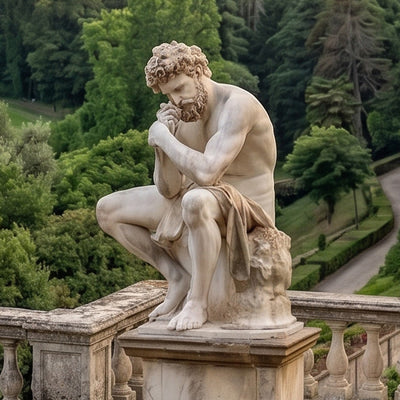
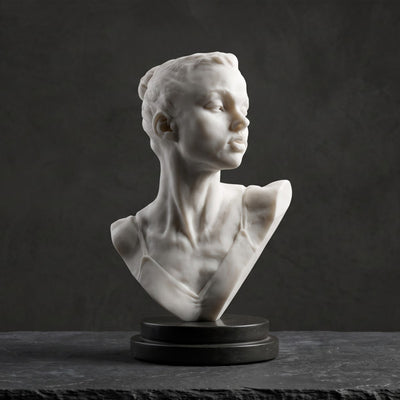
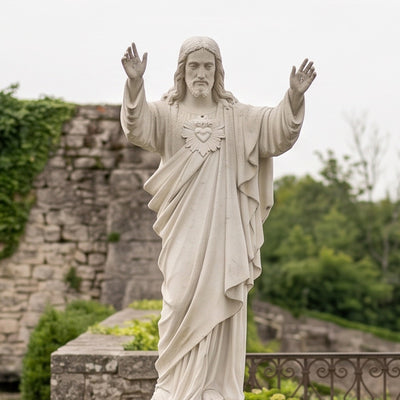
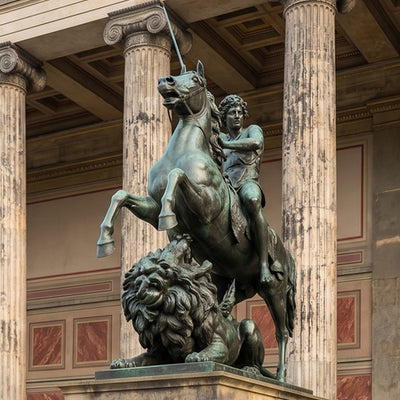
























Most Roman statues for garden settings fail for a simple reason. Someone bought the figure first and looked for a spot second. The Romans did it the other way round. In a villa garden at Pompeii or Tivoli, every statue presided over something: a fruit tree, a spring, a vine, a boundary. The planting told you who belonged where. Borrow that logic and a classical figure looks settled in a Napa courtyard or an Austin terrace. Ignore it and the same statue looks like it is waiting for a delivery truck.

At a Glance
Give every figure a job: guard a threshold, oversee a crop, or mark where the garden changes character.
Match the deity to the planting: Pomona with fruit, Flora with beds, Bacchus with vines, Diana with trees.
Portrait-style Roman figures need architecture behind them. Idealized gods can stand in planting.
In tight plots, a herm or urn does the same work as a full statue.
Size against your hedges and paths, not against the house.
Every Figure in a Roman Garden Presided Over Something
A Roman garden was a working space with a sacred layer folded into it. The figure at the spring thanked the spring. The figure among the pear trees asked for a good harvest. Visitors read the garden through its statues the way we read a building through its signage.
You do not need to share the beliefs to use the system when choosing Roman statues for garden spaces today. Ask what each part of your garden is for, then choose a figure whose story fits. That one question settles most statue placement arguments before they start.
Pomona, Flora and Bacchus: Matching the God to the Planting
Pomona belongs inside the orchard, not in front of it. Set her at the end of a fruit-tree row in dappled shade, so she is found rather than announced. Flora works at the center of a parterre or cutting garden, provided the planting stays low enough for the drapery hem to read. Tall perennials swallow her by midsummer.
Bacchus wants the vine or the terrace where people drink. One commission we shipped to a Napa client began with a lawn site. We talked them up to the top of the terrace steps, where the vines start. Framed by trellis, he reads as the host of the party rather than an ornament on the grass. With Roman statues for garden terraces, that sense of hospitality is the whole point.

Diana at the Woodland Edge
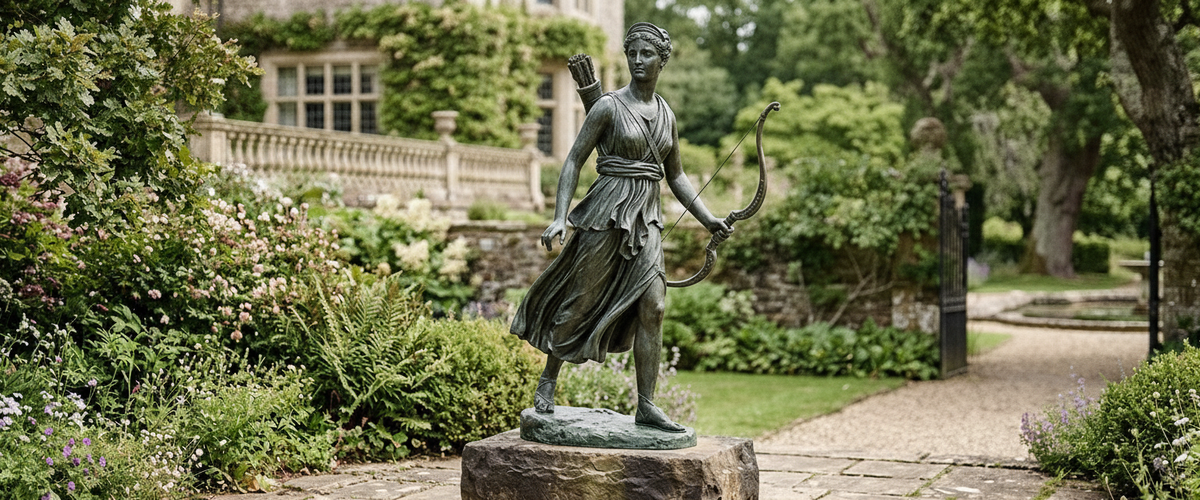
Diana is the goddess of the hunt and of wild places, so put her exactly where mown lawn gives way to trees. That threshold is the most underused spot in most large gardens, and she makes it legible. Step her a few feet into the tree line, partly screened by trunks, and she rewards anyone who walks out to look.
Material matters at the edge. A bronze garden statue darkens and takes on green-brown tones that sit naturally against bark and leaf. A white marble statue does the opposite and glows against dark foliage, which suits an Aspen garden with deep conifers behind it. Both choices work. Pick the one that matches how visible you want her to be from the house.
Roman Portrait Realism Versus Greek Idealism
Greek sculptors idealized. Roman sculptors, especially in portraiture, recorded the lined faces and heavy jaws of real men and women, as the Metropolitan Museum's essay on Roman portrait sculpture explains. This distinction changes where a figure should stand.
An idealized god can live in planting because it represents an idea. A portrait-type figure represents a person, and people need an address: a forecourt, the end of an allée, a niche in a yew hedge. At close to human height, a bronze such as the Life-Size Classical Roman Commander Bronze Statue, about 4 ft 11 in (150cm), belongs on a modest plinth facing the approach, as if greeting arrivals. Lost among roses, a figure like that looks like a guest who missed the party.
Military figures in pairs push this further. Where a gateway, a drive entrance or a broad stair needs flanking, a composition on the scale of the Large Classical Roman Warrior Pair Bronze Sculpture, roughly 7 ft 10 in (240cm), has the presence to hold the opening. Anywhere smaller and it crowds the space.

Herms and Urns for Gardens Too Tight for a Full Statue
A herm is a squared pillar topped with a carved head. The form began as a boundary marker, which makes it ideal for the end of a narrow side yard or a Brooklyn townhouse garden. Among Roman statues for garden plots this narrow, nothing else carries a face and a sense of character on such a small footprint. In the studio we carve herms in stone and cast them in bronze, and a bespoke head is often the most personal commission a client makes.
Urns on pedestals do quieter work. Place them at path junctions, either side of steps, or as the full stop at the end of a gravel walk. They also give a sequence rhythm between larger figures without adding more faces than the garden can handle.
Scale Against Clipped Box and Gravel
Stately-home pastiche happens when matching classical garden statues line up on white gravel like chess pieces. Use one or two figures, place them asymmetrically, and let the planting do the rest. When sizing Roman statues for garden rooms, judge scale against hedge height and path width rather than the facade.
We learned this in the Hamptons. A client set a tall figure behind 3 ft (about 90cm) box, and it looked marooned. A taller backing hedge and a lower plinth fixed it. Color contrast matters too. Against a dark yew backdrop, a gilded accent on a figure such as the Gold Winged Roman Angel Marble Outdoor Sculpture, about 5 ft 11 in (180cm), reads clearly from a distance. Pale stone on pale gravel simply disappears, and the same caution applies to many Roman statues for garden paths.

How to Choose Roman Statues for Garden Settings: A Buyer's Checklist
Name the job first. Threshold, orchard, vine, spring or boundary.
Choose god or portrait. Gods suit planting. Portraits need architecture.
Measure the frame. Note hedge height, path width and viewing distance from the house.
Pick material for the backdrop. Bronze suits foliage, marble suits dark hedges, and stone weathers into gravel and masonry.
Plan the plinth and footing. Large bronze and stone pieces need a proper base and a check on ground conditions before delivery.
Consider a herm or urn if the space is under about 10 ft (3m) wide.
Giant Sculptures makes and ships large classical figures worldwide, from catalog pieces to fully bespoke commissions with custom heads, poses and plinths. Budget depends on material, scale, complexity, engineering, installation and finishing, so the most useful first step is to share site photos and measurements and request a tailored quote.
For wider placement ideas, Choosing a Large Angel Garden Statue Starts With the Wings is useful companion reading before finalizing the setting and sightlines.