

























































































A plaster Madonna that has sat happily on a hallway shelf for thirty years can be finished by one February night on a porch step. Water wicks into the gypsum, freezes, expands, and by spring the surface is coming away in flakes the size of a thumbnail. That single failure explains most of what buyers need to know about religious statues: the subject endures, the material may not, and matching one to the other is where the money is either well spent or wasted.

Quick Answer: Matching Religious Statues to the Site
For wider placement ideas, Marble Garden Statues: What Winter Really Does to White Stone is useful companion reading before finalizing the setting and sightlines.
Indoors only: chalkware, plaster, painted ceramic, gesso-and-gilt antiques.
Freeze-thaw climates (New England, the Midwest, Colorado, most of Britain): bronze, dense granite, high-quality cast stone with proper drainage.
Coastal and salt air (Cape Cod, Malibu, the Hamptons): bronze or marine-grade stainless steel; rinse regularly.
Hot, dry sun (Arizona, West Texas): stone and bronze; expect painted finishes to fade fast.
Sheltered courtyards and covered loggias: marble and carved hardwood become realistic options.
Anything tall: budget for a plinth, a stainless dowel and a footing before you budget for the figure.
Vintage Chalkware Religious Statues Belong Indoors, Permanently
Vintage chalkware religious statues have real charm and real fragility. They were mass-produced as inexpensive devotional pieces from gypsum plaster between roughly the 1890s and the 1950s, often hand-painted and lightly sealed, and they were never intended to face weather. Conservators treat plaster and gypsum objects as moisture-sensitive for good reason; the Canadian Conservation Institute advises keeping such objects dry, because gypsum absorbs water readily and then stains, softens and spalls. One wet freeze is usually enough.
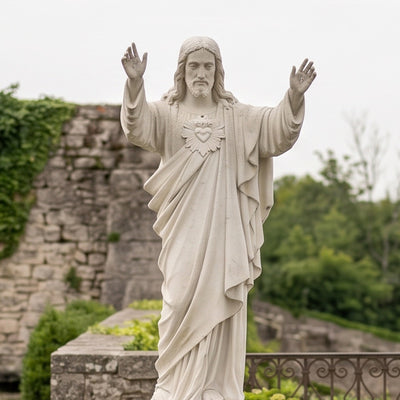
If you have inherited a chalkware St. Anthony or a painted Sacred Heart, put it somewhere dry and stable, ideally in a room held between about 40 and 55 percent relative humidity, away from a radiator and out of direct afternoon sun. Dust it with a soft brush rather than a damp cloth. If you want that figure in the garden, the honest answer is to commission a copy in a weather-rated material and keep the original inside.

Cast Stone, Bronze and Marble: How Each Handles Frost, Damp and Acid Rain
Bronze is the reference material for outdoor religious statues and has been for centuries. It expands and contracts without cracking, shrugs off frost, and develops a patina that protects the metal underneath. A hot-wax or lacquer coat renewed once every 12 months keeps the color even. Bronze also holds fine modeling, so drapery folds, a rosary, or the texture of a robe survive decades of winters intact. Our bronze work sits in the bronze sculptures collection if you want to see how patina options change the mood of the same figure, from a 90cm church bell up to monumental figures of 300cm and beyond.
Patina protects the metal beneath and keeps fine modeling readable decade after decade.
Marble is beautiful and, outdoors in a polluted or coastal setting, slowly self-destructing. Rain is naturally acidic at around pH 5.0 to 5.6, and that dissolves calcite, which is why old marble angels lose their eyelids and fingertips first. The US Geological Survey has documented the same weathering on carbonate stone. A piece like the 180cm (about 6 ft) praying angel still earns its place in a covered cloister, an atrium, or a sheltered courtyard where rain does not sheet across the surface, and marble is unmatched indoors. Browse marble sculptures with that placement rule in mind.
Cast stone is the practical middle ground for religious lawn statues and cemetery plots. Quality varies enormously. Dense, well-cured cast stone with a water absorption rate at or below about 6 percent by weight, the benchmark used in the ASTM cast stone standard, handles freeze-thaw; cheap garden-center concrete does not, and the aggregate starts showing through within three or four seasons. Ask what the mix is, whether the piece is hollow-cast, and how water drains out of it. Any figure with cupped hands or an upturned face needs a weep hole, or it becomes an ice mold.
Wooden Religious Statues Through a Hard Winter
Wooden religious statues carry a different kind of authority. Limewood carves crisply and took the great late-Gothic altar figures of the 15th century; oak is tougher and more open-grained; teak is the only one of the three you should consider anywhere near real weather, and even then under cover. Wood moves with humidity, splits along the grain, and rots wherever water sits in a joint or a crevice.
Our advice for a client with a lime or oak devotional carving is simple: treat it as interior sculpture, or as porch sculpture at most. Keep it off stone floors that wick damp, oil or wax it on a schedule, and watch the base. If you want the look of carved wood in an open garden, cast the carving in bronze with a wood-grain patina. We have done exactly that for a private chapel commission where the family wanted the original figure preserved indoors.

Paint and Gilding Fade First
Every painted religious garden statue looks perfect on day one. UV is what changes that. Blues and reds shift within two or three summers in strong sun, gilding lifts wherever moisture gets behind it, and touch-up work rarely matches the original tone. If a polychrome finish matters to you, place the figure under a canopy, in a north-facing niche, or in a grotto with an overhang, and accept a repainting cycle as part of ownership. Where that is not realistic, a patinated bronze or a natural stone finish will look better in year ten than paint ever will.
Sightlines: Where Religious Garden Statues Actually Work
Placement failures are more common than material failures. Three settings, three different rules:
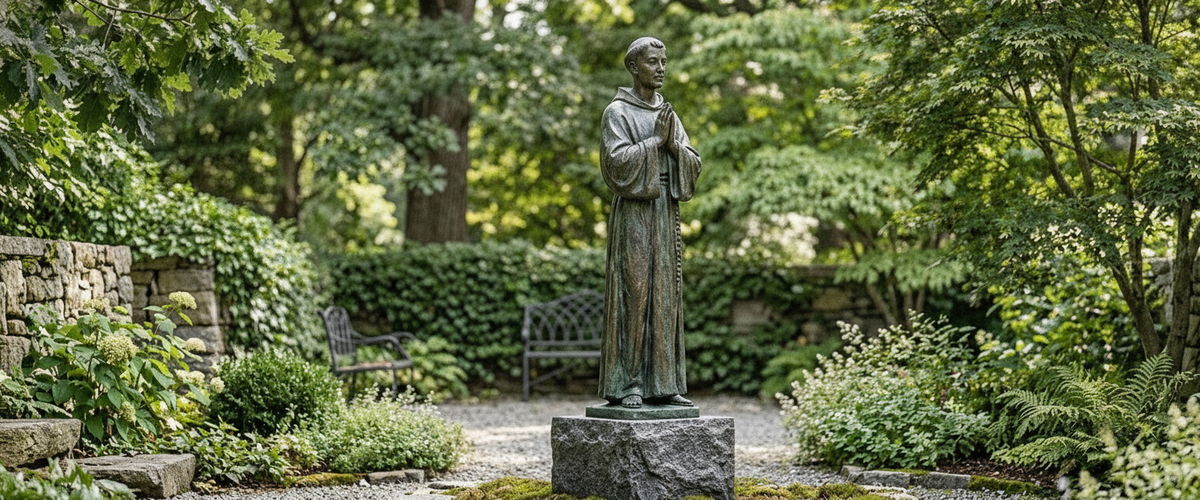
A garden niche or grotto: the figure should read as the end of a view, not a decoration beside a path. Set it back slightly so the recess frames it, and keep planting low enough that the face stays visible from the approach.
A memorial bed: position for the viewer who sits, not the one who walks past. A figure that looks composed at standing height can loom uncomfortably from a bench seat around 18 in (45 cm) off the ground. We check this with a mock-up board on site whenever the client can arrange it.
Open church grounds or a campus lawn: scale up. Big open ground eats sculpture. A figure that feels generous in a suburban yard reads as an ornament on two acres, so plan for something at or above life-size, 5 ft 6 in (170cm) and up, and set it on a plinth of 2 to 3 ft (60 to 90cm) to hold the ground.
A recessed niche and a plinth turn a figure into the end of a view rather than roadside decoration.
Face direction matters too. South-facing figures in California and Texas take punishing UV; north-facing ones in the Northeast hold algae and green film on the shaded side. Neither is a dealbreaker, but they change the cleaning schedule.
Dowels, Plinths and Ballast So the Figure Survives Its First Gale
Tall, narrow devotional figures have a high center of gravity and a small footprint, which is a bad combination in a storm. Get the engineering right and it never becomes an issue.
Pour a footing below the local frost line, which runs from roughly 12 in (30cm) in the mid-Atlantic to 48 in (120cm) in northern Minnesota, so heave does not tilt the base over one winter.
Use stainless steel dowels set in non-shrink grout or epoxy, never mild steel. Rusting steel expands and cracks the stone around it.
Give the plinth a slight drainage fall, around 1 in 50, so water runs off the top rather than pooling at the ankles.
Isolate dissimilar metals with a non-conductive sleeve to avoid galvanic corrosion.
For hollow bronze or fabricated pieces, add internal ballast at the base and specify lifting points before casting, not after.
Photograph the fixing detail before backfilling. It saves an argument years later if the piece is ever moved.

Commissioning Religious Statues That Outlive You
Most of the enquiries we take for religious statues start with an image: a family piece, a photograph of a church figure, a saint with specific attributes that the client cannot find anywhere. That is exactly what a bespoke commission is for. At Giant Sculptures we work from reference material through maquette, scaling and material selection to the finished cast, and the same figure can be delivered in bronze, stone or a fabricated metal, at 90cm on a plinth or 400cm on a church forecourt, depending on where it is going and what has to survive there.
Cost depends on the material, the size, the complexity of the modeling, engineering for wind and anchoring, finishing, and installation access, so the sensible route is a tailored quote rather than a guessed figure. Start with the religious statues collection to fix the subject and the character you want, then tell us the site, the climate and the sightline. The material conversation follows from that, in that order, every time.