





































































































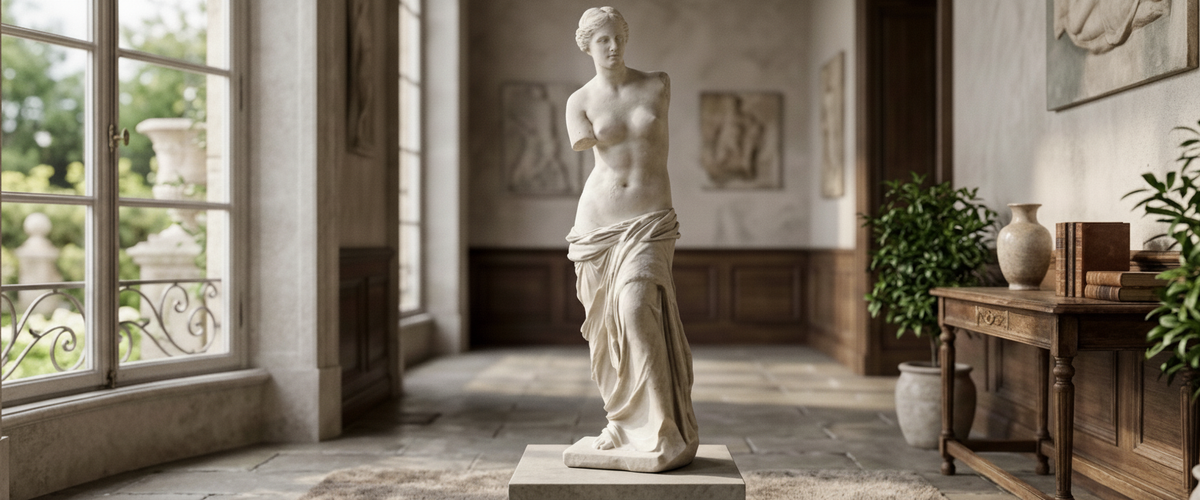

Set a marble Venus in the middle of a lawn and she stops looking like a garden statue. She starts looking like a museum loan that missed its truck. The figure is fine. The setting is wrong. The design behind every Venus garden statue was conceived to be seen against something, such as a wall, a niche or a shadowed gallery. Take that away and the famous twist of her torso reads as awkward rather than graceful.
Giant Sculptures supplies hand-carved marble Venus figures to gardens across the US and UK, and the first question clients ask is almost always about placement. Here is what we tell them about settings, backdrops, plinths and lighting, and about how the spot you choose decides the way she weathers.

At a Glance: Placing a Garden Statue Venus
Enclose her. Hedges, niches and pergola ends frame the spiral of her pose. Open lawn dissolves it.
Put dark green behind pale marble. Backdrop contrast adds more presence than extra height.
Lift her modestly. Bring her face near eye level without building a column.
Choose shade deliberately. Damp, shaded corners bring moss and lichen faster.
Light from the side. Flat front lighting erases the drapery.
Why a Venus Looks Lost on Open Grass
The Venus de Milo was found on the island of Melos in 1820 and has spent most of the time since indoors at the Louvre, lit and walled in. Her design assumes a viewer standing fairly close, reading the counter-twist of hips against shoulders and the heavy fold of drapery slipping from her waist. On open grass the eye has nowhere to rest. Sky behind her washes out the silhouette, and she shrinks, whatever her real height.
More scale rarely fixes this. Buyers often assume a taller figure will hold a big lawn, but even a near life-size carving such as the Venus de Milo Marble Sculpture, 180cm (about 5 ft 11 in) would still read as small parked in the center of a sweeping Westchester lawn. What a garden statue Venus needs is an edge.
Yew Niches, Hedge Rooms and Pergola Ends
The best settings share one quality: they give her a back and sides. A clipped yew niche is the classic answer for good reason. The hedge wraps the figure the way a carved alcove would, and the depth of the niche throws a soft shadow that sharpens her outline.
A yew niche gives the figure a back and sides.
Hedge rooms work the same way at larger scale. In a formal garden in the Hamptons or a walled courtyard in Napa, a Venus at the far end of an axis gives the whole room a destination. Pergola ends are underrated. Set a Venus at the end of a wisteria walk and guests see her framed by the posts long before they reach her. By the time they arrive, the pose has already done its work.
A studio tip we repeat on almost every call: stand her 12 to 18 inches (30 to 45 cm) off the back of the niche so light can slip behind the arms and drapery. Pressed flat against a hedge, she looks pinned.

Dark Green Behind Pale Stone
Backdrop matters more than size. White or pale gray marble against yew, boxwood or holly gives maximum contrast, and the drapery folds read clearly from across the garden. Against a pale limestone wall or a bright sky, the same carving flattens into a vague shape.
This is why a smaller figure can outperform a larger one. In a courtyard with a dark hedge behind it, a 120cm figure such as the Venus Italica Marble Sculpture, 120cm (about 3 ft 11 in) holds attention better than a taller piece floating in front of a white fence. If your garden is mostly pale hardscape, plant the backdrop before you buy the statue. A row of upright yew takes a few seasons to thicken, so start early.
Plinth Height Outdoors
Outdoors, a Venus usually needs lifting. At ground level she sinks into the planting and the eye drops to her feet. The aim is to bring her face roughly to a standing adult's eye line, or a touch above, without a pedestal so tall she becomes a column with a figure on top.
As a rule of thumb, a near life-size garden statue Venus sits well on a plinth between 18 and 30 inches (45 to 75 cm) high; smaller figures can take more. Keep the plinth quieter than the statue: plain dressed stone, slightly wider than her base, with no heavy moldings competing with the drapery. Every outdoor plinth also needs a proper footing and fixing. Marble figures are top-heavy, and gardens bring wind, soil movement and curious dogs. We advise on anchoring for every garden commission.
Shade, Moss and Lichen
The setting decides how fast she ages. Marble in an open, breezy spot dries quickly after rain and stays relatively clean. Tuck her under trees or into a north-facing niche and you invite green algae within a season or two, then moss in the crevices, then slow-growing lichen.
Some owners want exactly that. A lichen-flecked Venus in a shady hedge room looks centuries old, and lichens are slow, sensitive organisms that settle where conditions stay stable, as the British Lichen Society explains. Other owners want crisp white stone. Decide first, because siting for a finish is far easier than fighting the site with cleaning. If you do clean, use soft brushes and plain water. Skip pressure washers and harsh chemicals; acidic cleaners in particular etch marble. In cold climates, ask us about freeze-thaw exposure and winter covers.

Lighting a Garden Venus de Milo After Dark
Flat front lighting kills her. One spotlight aimed straight on fills every fold and turns carved depth into a white cutout. Light a garden statue Venus de Milo from one side and slightly below, at a raking angle, so the folds throw shadow and the twist of the torso reads.
Raking side light keeps the drapery folds legible.
A second, dimmer fitting washing the hedge behind her separates figure from backdrop. Warm white lamps, around 2700K to 3000K, flatter marble far more than cold blue-white. Hide fittings in the planting, and test positions with a flashlight before any cable goes in.
Choosing Your Garden Statue Venus: A Buyer's Checklist
Frame first. Pick the niche, hedge room or axis end before choosing a figure.
Match pose to setting. The upright twist of the Venus de Milo suits narrow niches. For a pool edge or rill, a softer pose such as the Venus Bathing Marble Sculpture, 160cm (about 5 ft 3 in) suits the setting better, since a bathing figure belongs beside water.
Size to viewing distance. Seen from 30 feet (9 m) or more, go larger. In a small courtyard, a 120cm figure is often plenty.
Check backdrop contrast. Dark evergreen behind pale marble, or a plan to plant it.
Choose your weathering. Crisp or softened? Site accordingly.
Plan the plinth and fixing. Treat footing and installation as part of the purchase.
Run lighting early. Lay cable before paving and planting are finished.
Budget depends on material, scale, carving complexity, plinth engineering, shipping and installation, so the honest answer is a tailored quote. Giant Sculptures can also carve a Venus to a bespoke height, in a chosen marble, or with a plinth sized for one particular niche. Send us photos of the spot and we will tell you what will genuinely work there.
For wider placement ideas, Venus De Milo Marble Sculptures and the Quarter-turn Most Homes Get Wrong is useful companion reading before finalising the setting and sightlines.