





































































































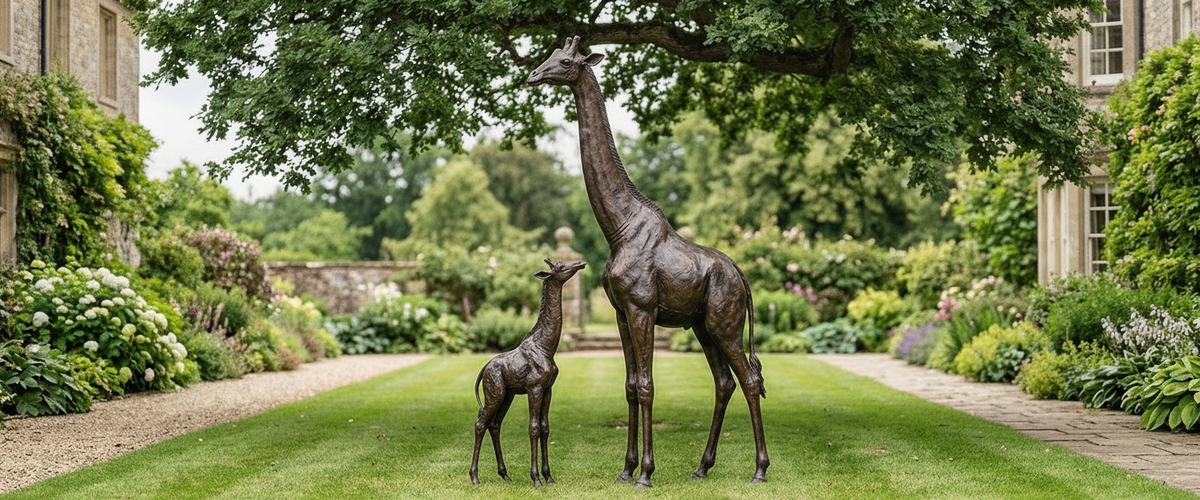

Every giraffe looks enormous in the studio. Stand beside a 13-foot bronze on the workshop floor and the head is up near the roof trusses. Move that same piece onto an open lawn and it can look like a well-made toy. Many large giraffe statue garden plans fail for exactly this reason. The buyer sized the animal against a spec sheet and a living room ceiling, then installed it under a sky with no ceiling at all.
Giraffes are the subject where scale mistakes are hardest to hide. A real adult bull can stand around 18 feet (5.5 m) tall, according to the Smithsonian's National Zoo, and most people carry a rough sense of that height in their heads. Undersize a large giraffe statue in the garden and visitors notice immediately, even if they cannot say why.

At a Glance
Size your large garden giraffe statue against the tallest nearby trees, not the lawn it stands on.
From the window or terrace you use most, the head should clear the hedge or horizon line.
Groups read deeper than singles. A calf beside an adult gives the eye a scale reference.
Set the feet at true ground level, somewhere a real giraffe could plausibly browse.
Choose bronze or marble for permanence, and plan the foundation before the finish.
Why a Giraffe Shrinks Under Open Sky
Indoors, walls and ceilings do the measuring for you. Outdoors, the eye borrows its reference points from whatever is largest in view: mature oaks, a roofline, a ridge of hills. Against a 40-foot sycamore, a large giraffe statue for the garden that measured impressively in a catalog becomes a midsize object. Distance makes it worse. A lawn viewed from a terrace 100 feet away flattens everything, and a slender neck loses visual mass faster than a bulky subject such as a bear or a horse.
We see this pattern in client photos after a large giraffe statue goes into a garden. The pieces that read well were chosen for the view. The ones that disappointed were chosen for the dimensions.
Measure Your Large Giraffe Statue Garden Site Against the Canopy
For wider placement ideas, What Separates Large Garden Fairy Sculptures from Garden-Center Kitsch is useful companion reading before finalizing the setting and sightlines.
Before you look at sizes, walk out and note the height of the lowest branches on the trees nearest your chosen spot. That line matters more than the width of the lawn, and it is where most large garden giraffe statues succeed or fail. A wild giraffe feeds in the band where the canopy begins, so a sculpture whose head sits just below or touching your own canopy line looks at home. Too short and it looks lost under the trees; far taller than everything around it and it starts to feel like signage.
The head sits just at the lowest branch line, so the giraffe reads as part of the planting rather than an object on the lawn.
For gardens with mature trees in the 25 to 40 foot range, the larger end of the scale is usually the safer choice when buying a large giraffe statue for the garden. A single figure at around 450 cm (about 14 ft 9 in), such as the Life-Size Contemporary Giraffe Bronze Sculpture - 450cm, holds its own against established planting in a way a smaller piece cannot. A simple test helps: tape a marker to a pole at the height you are considering, stand it on site, and look at it from the house for a few days.
The Head Should Break the Skyline from Your Main Window
Pick the single view you will see most: the kitchen window, the primary terrace, the drive approach. From there, the head and upper neck should rise above the hedge, wall or horizon behind it, so the silhouette reads against sky rather than foliage. Bronze with a dark patina dissolves into a green backdrop; set against open sky, the same profile becomes graphic and unmistakable. White marble behaves the opposite way, glowing against dark planting and softening against a pale sky. If your site is backed by cypress or yew, that difference should shape the material for your large garden giraffe statue: in front of a dark evergreen screen, a pale stone figure like the Graceful Giraffe White Marble Outdoor Sculpture will still read from the house where a dark bronze would sink into the hedge.

Single, Pair or Mother and Calf?
A lone large giraffe statue in a garden is a statement. Two or more animals start a story, and they also solve a scale problem, because a smaller figure gives the eye a measuring stick. Place a calf a few paces ahead of an adult and the adult suddenly looks taller.
In a formal courtyard or on a terrace, where you want one object rather than a scattered group, a carved composition such as the Giraffe and Calf Pink Marble Statue - 350cm builds that scale cue into a single piece of stone. On a broad lawn, separate bronze figures give you freedom to stagger heights and distances, spreading a family along a planting edge so the group reveals itself gradually as people walk the garden. For estates and resort lawns with real acreage, a full herd of large giraffe statues becomes a bespoke garden commission conversation in its own right.
Setting the Feet: Ground Level, Paths and Browse Height
Plinths kill giraffes. A real animal stands on the ground, and lifting a sculpture onto a visible base turns a presence into a monument. We recommend a concealed concrete footing set flush with, or just below, finished grade, with the hooves fixed by stainless anchors and turf or gravel dressed right up to them. Your structural engineer should size that footing for wind load on a tall, narrow form. It is the most important engineering decision on any large giraffe statue garden project.
Then think about how people approach the large giraffe statue in your garden. Let a path bring visitors in at an angle so they see the full profile first and reach the legs last. Place the head where browsing makes sense: beside a tree, at the edge of a canopy, leaning toward foliage. The San Diego Zoo Wildlife Alliance notes that giraffes feed high in trees other browsers cannot reach, so a head nosing toward a branch looks believable in a way a giraffe marooned on bare lawn never quite does.

Estate and Venue Sites Where We Scaled to the Trees
One client in Napa had chosen a smaller piece from photographs, then sent us a phone video of the site: a gentle slope dropping toward a row of old valley oaks. From the house, the oaks dominated everything. We talked them up a size and moved the position closer to the trees so the head would sit against the canopy line. Now their large giraffe statue looks as if it wandered up through the garden from the vines.
Moving the figure closer to the oaks let the head sit against the canopy when seen from the house.
A Texas event venue raised a different issue. Guests photograph the large giraffe statue in the venue garden from close range, so the legs and belly needed as much finish quality as the head, and the footing had to sit beside a gravel drive with no visible hardware. On commercial sites, we spend as much time on sightlines from the arrival point as on the sculpture itself.
Buyer Checklist Before You Commit
Canopy height: note the lowest branch line of the nearest mature trees before sizing a large giraffe statue for the garden.
Main view: confirm the head clears the hedge or horizon from your most-used window.
Material: bronze for a dark silhouette and long outdoor life; marble for luminous contrast against dark planting.
Grouping: single for drama, pair or family for depth and scale reference.
Access: check crane access, gate widths and ground conditions for delivery.
Foundation: have an engineer specify a flush footing rated for wind.
Budget: cost depends on material, scale, complexity, engineering, installation and finishing, so request a tailored quote.
Giraffe statues for garden settings reward buyers who measure the site before the sculpture. Send Giant Sculptures a few photos from your main window and the rough height of your trees, and our team will recommend a size, pose or bespoke commission for your large giraffe statue garden plan that fits the view you actually live with.