










































































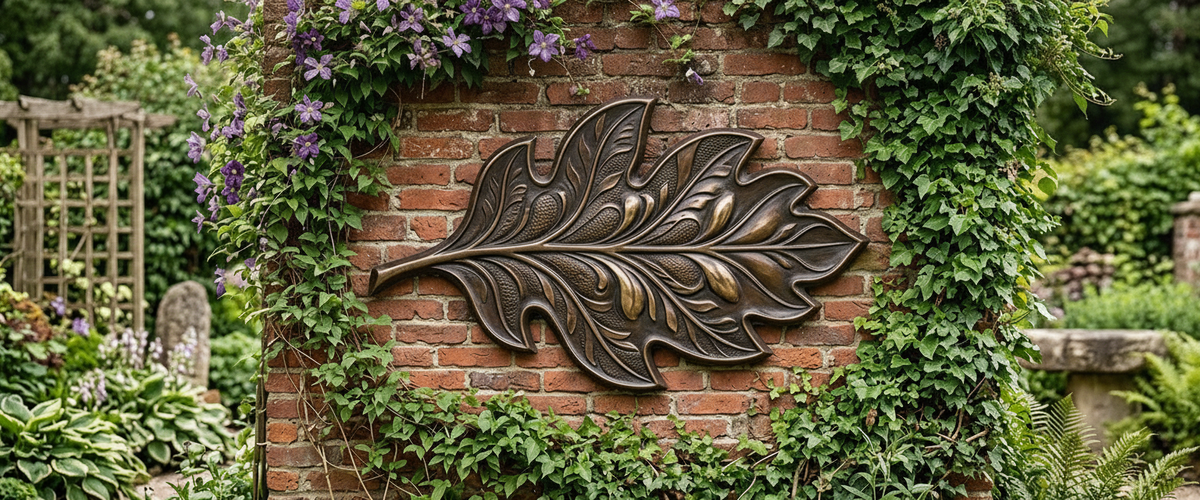

Hang a piece on bare brick in March and it looks perfect. Come back in late June and half of it has gone, swallowed by clematis and shadowed by wisteria, with its best detail lost behind a curtain of leaves. Most garden wall art advice skips this problem. You are choosing for two walls, the winter one and the summer one, and the second is the one you will look at most.
We see it every season at Giant Sculptures. Clients send photos of a wall shot in early spring, and we talk about scale and material. The conversation that saves the commission, though, is the one about what grows there.

At a Glance
Judge the silhouette before the surface detail. Foliage hides texture first.
Mount on stand-off brackets so stems pass behind the piece and the masonry can dry.
Corten blends into summer green. Polished bronze and pale stone stand out against it.
Leave pruning room around the frame so the gardener never has to work against the art.
If the piece may come indoors later, choose stone or metal that suits a conservatory or hallway as well.
Why Garden Wall Art Can Vanish Once the Climbers Wake
Bare brick is a generous backdrop. Every carved hairline reads, and the shadows are crisp. By midsummer the same wall has become a layered, moving surface of green, and your piece is competing with the busiest pattern in the garden. Dappled light breaks up its outline. Leaves overlap its edges. A relief that rewarded close study in spring turns into visual noise.
Silhouette Beats Surface Detail
Judge the outline first. Photograph the piece, then turn the image into a solid black shape. If you can still tell what it is, it will survive ivy, clematis and wisteria crowding its edges. Delicate chasing, shallow carving and fine engraved line are the first things to disappear under shade. Deep relief, generous negative space and a clean outer edge hold up. A bold leaf form or a figure with a clear profile reads from across a lawn in August.
Scale shifts as well. Garden wall art that feels right against clean brick often looks timid once growth surrounds it. For a planted wall, we usually suggest going one size up.
Stand-Off Brackets: Keeping Stems Behind and Damp off the Masonry
Flush-mounting garden wall art against brick traps water behind it and stains the face. It also leaves climbers nowhere to go except over the front. A stand-off bracket holds the piece roughly 1 to 2 inches (25 to 50 mm) proud of the wall. Air moves behind it, rain drains away, and tendrils thread through the gap instead of across the artwork. On older lime-mortar walls, fix into solid brick rather than the joints. Use stainless steel fixings so you don't find rust streaks running down the masonry a year later.
With heavier pieces such as stone relief or cast bronze, the bracket becomes an engineering question. Ask for the weight and the fixing points before you order, and have a builder confirm the wall can carry the load.
Corten Recedes, Polished Bronze Pops
Weathering steel develops a stable, protective rust patina that settles to a warm brown close to the color of old brick. Against summer green it reads as earth. That suits a piece you want to feel as though it grew there. It works less well if you want the piece seen from the terrace.
Polished or gilded bronze does the opposite: its highlights flash through foliage even when the leaves move. Pale stone and marble sit between the two. They glow in shade and stay legible against dark ivy. On a wall that has to hold its own against a full summer of growth, a deeply undercut marble panel such as the Bacchic Group Marble Relief Wall Art - 150cm, at 150 cm (about 59 inches), keeps shadow in its figures even when clematis softens the edges, and its pale ground separates cleanly from the green.
A useful rule is to match contrast to viewing distance. If the wall is seen from 30 feet (about 9 m) away, choose contrast. If you pass it at arm's length on a gravel path, Corten's quieter tone rewards close looking.

The Shears Test: Pruning Room and Trellis Spacing
Before you fix any garden wall art in place, picture the gardener in February with pruning shears. Wisteria wants two cuts a year, in summer and winter. If the artwork sits where those cuts have to happen, someone will either butcher the plant or scrape the piece. Check these points before drilling:
Clearance: keep roughly 12 to 18 inches (30 to 45 cm) of open wall around the frame where no main stems are trained.
Trellis: stop wires or trellis short of the piece rather than running them behind it, unless the stand-offs leave a full hand's gap.
Access: make sure a ladder can reach the piece without standing in a border.
Removal: confirm it can come off for repointing or repair without cutting the plant.
Finish: bronze and stone take a knock from the shears far better than delicate painted finishes do.
Bringing It Under Cover: Garden Wall Art for Indoor and Outdoor Decoration
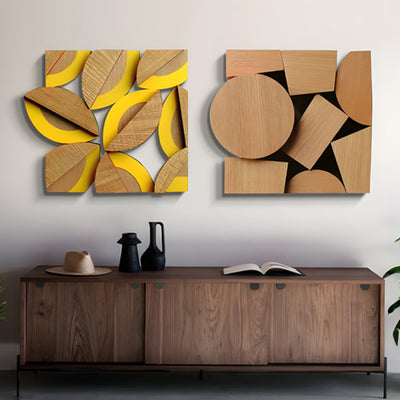
Some of the best garden wall art for indoor and outdoor decoration starts outside and moves in. A buyer redesigns a Napa terrace, or a Hamptons house gains a garden room, and the piece follows. Marble and bronze relief look as natural in a conservatory or a stone-floored hallway as on a courtyard wall. Corten can come indoors too, but seal it first or the patina will mark the floor. Where a garden room has a stud or plasterboard wall that cannot take the weight of carved stone, a lighter wood relief with a pale sandstone texture, such as Selene V White Sandstone Textured 3D Wood Relief Wall Art, gives a similar chalky glow without the structural question.
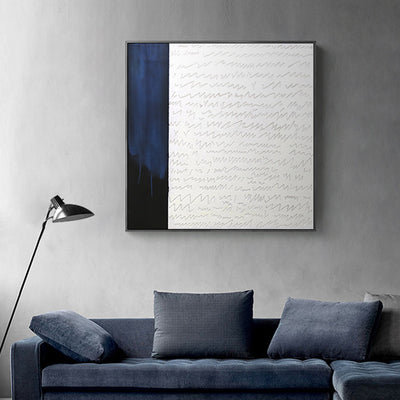
The reverse move is where buyers usually go wrong. Wood, paper and framed textured pieces belong under a roof. If you want the rusted-steel mood of a Corten garden to continue inside, a framed textured panel in that amber range, like Terralume Amber Rust Abstract Textured Framed Wall Art, carries the palette through a hallway that opens onto the garden, with no exposure to rain. For pieces rated to go outside, start with our outdoor wall art collection.
A Walled-Garden Installation We Supplied, and What We'd Hang Differently
We shipped a bronze relief to a walled kitchen garden in the Hudson Valley. The client chose the spot in early March. The wall was bare, and the piece went dead center on the south-facing brick. By July, a climbing rose and an espaliered pear had closed in from both sides. The bronze still read because its outline was bold, but its lower third spent the summer behind leaves.
Given the same wall again, we'd hang it about a foot (30 cm) higher, move the rose wire back to give the shears room, and fit deeper stand-offs so the pear's laterals could pass behind. Each of those changes is cheaper before the drill comes out than after.
Commissioning for a Planted Wall
When nothing in stock fits the wall, bespoke garden wall art lets us shape the outline, depth and finish around what grows there. Send us photos of the wall in winter and in summer, along with the planting plan and the main viewing distance. Budget depends on material, scale, complexity, engineering, installation and finishing, so we quote each piece individually. For depth and relief ideas before you brief us, explore our 3D wall art range.
For wider placement ideas, Large Outdoor Wall Art That Still Reads From the Far End of the Garden is useful companion reading before finalising the setting and sightlines.