














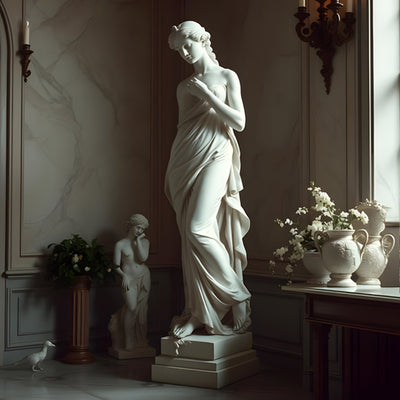
















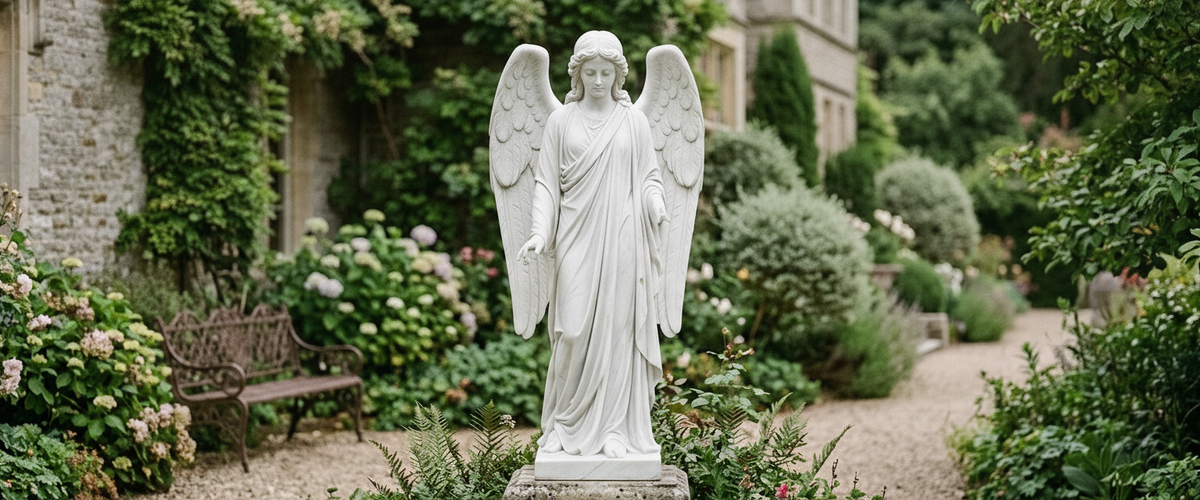

Most garden angel statues fail for one reason: they were bought for the face and placed for the space. A kneeling figure ends up stranded mid-lawn, or a tall guardian disappears against a pale fence, and the owner blames the statue. Choosing angel statues for the garden is mostly a question of eye level. Get the pose right for the spot and even a modest figure looks as though it has always been there.

Quick Answer
Kneeling and seated angels sit low, so place them beside paths and planting where people already look down.
Standing angels over 5 feet (1.5 m) need a dark, solid backdrop such as clipped yew or an old stone wall.
Cherubs and putti work best on architecture: steps, fountain rims and balustrades.
Weathered stone suits shade. Polished marble and bronze want open light.
For a group, plan the sightline from the house before you choose the figures.
Garden Angel Statues Start With Eye Level
The pose decides the eye level, and the eye level decides the spot. Every angel points somewhere with its gaze, its hands and the sweep of its wings. Before we talk about marble grades, we ask where the viewer will actually stand: on a raised terrace, walking a gravel path, or looking out from a kitchen window. That one answer rules out half the catalog.
A useful rule: the figure's face should land roughly where the eye falls naturally from the main viewing point. From a raised terrace, that is lower than most people expect. From a sunken lawn looking up toward a bank, it is higher. Garden angel statues that ignore this tend to look either buried or perched.

Kneeling Angels Belong Low, Beside Paths and Planting
People look down when they walk. A kneeling figure of around 4 feet (120 cm) reads best when you pass within a few steps of it, set into a border of hostas, ferns or lavender so the planting softens the base. For that border-side role, a compact, inward pose such as the Kneeling Prayer Angel in marble makes more sense than a taller standing figure. Put the same piece on a tall pedestal, though, and the bowed head ends up gazing at nothing in particular.
A kneeling angel on a low plinth, where the planting softens the base and passers-by already look down.
Keep plinths low, just high enough to lift the base clear of wet soil and mower blades. Smaller seated figures follow the same logic. A 20-inch (50 cm) sitting angel tucked into the bend of a path rewards the visitor who walks slowly, and that is exactly the point.
Standing Angels Need a Dark Backdrop
A white marble angel against open sky loses its outline. The wings blur into cloud and the carved feathers go flat by midday. A yew hedge gives you a matte, near-black wall that makes every edge read, which is why it beats an open lawn every time. Dark brick, weathered stone, holly or a tall boxwood screen do the same job in a Hamptons or Napa garden.
The most common mistake we see is a 7-foot figure set in the middle of a wide lawn, where it reads as a small pale shape against the sky. Move the same statue twenty feet back against a cypress or yew screen and it finally looks like its studio photographs. At that height, a figure such as the Heavenly Bloom Angel, at 220 cm (about 7 ft 2 in), needs the same kind of backing, plus clear ground in front so it can be seen whole from 15 to 20 feet away.
Against clipped yew, the wings and carved feathers keep their outline even at midday.
Perched Cherubs Do Quiet Architectural Work
Cherubs and putti spent centuries on Renaissance and Baroque fountains, stair rails and garden gateways. They worked as architectural punctuation, marking the end of a wall or the turn of a stair. On a balustrade end post, a fountain rim or the cheek wall beside terrace steps, a cupid of about 31 inches (80 cm), such as the Playing With Butterfly Cupid, is closer to the right scale than a full-size angel, which would overpower the masonry beneath it.
Check the surface first. The top of a pier must be flat, sound and wide enough for the base, and drilling a stainless steel dowel into old masonry is a job for a mason. Against pale limestone, our bronze angel and cherub statues give a warmer, darker accent that deepens as the patina develops.

Match the Material to the Light
Garden angel statues in weathered stone suit a shaded corner. Moss and lichen settle into the folds, the surface softens to gray, and the figure starts to feel like part of the garden's history. Polished marble and bronze need open light. Polish catches the sun, and bronze patina shows its depth when light rakes across it. In deep shade, polished marble simply stays damp and picks up green streaks.
Care is simpler than people fear. A soft brush and plain water handle most of it; pressure washers and acidic cleaners do lasting damage to carved stone, a point made in Historic England's technical conservation advice. In freeze-thaw climates such as Aspen or upstate New York, ask about marble density, base drainage and winter covers. Bronze is the lowest-worry choice there.
Two Angels Make a Gateway, Three Make a Story
A matched pair either side of an opening frames the view beyond it. Mirrored poses facing slightly inward work best, as if the figures are welcoming whoever walks through. Three figures suggest a narrative, so stagger them in depth along one sightline: a kneeling angel in the foreground, a standing figure in the middle distance and a cherub on a terminal fountain. Keep a group of garden angel statues in one material family so the eye reads it as a set.
How to Choose Angel Statues for Your Garden
Main viewpoint: Decide where the statue is seen from most often, then set the face height to suit.
Backdrop: Dark and solid behind white marble; lighter stone or open sky can work behind bronze.
Scale check: Stand bamboo canes cut to the statue's height in the spot and view them from the house before you order.
Climate: Frost, salt air and full sun all affect material choice and finish.
Foundation: Large marble figures are heavy enough that a concrete footing is usually needed. Ask us for the shipping weight in pounds and kilograms so your contractor can plan the base.
Access: Measure gate widths and check whether a forklift or crane can reach the spot.
Budget: Cost depends on material, scale, carving complexity, engineering, installation and finish. Request a tailored quote rather than guessing.

When a Bespoke Angel Makes More Sense
Catalog pieces suit most gardens, but some spaces need a commission: a niche that dictates an exact wingspan, a mirrored pair for a gateway, or a marble design cast in bronze for a coastal site. Giant Sculptures carves and casts bespoke angels to fit the site, and we would rather adjust a pose at the drawing stage than watch a client move a finished piece. Browse the full angel statues collection for reference poses, then send us photos of the spot.
For wider placement ideas, Give Him a Hedge and a Heading: Placing a Male Angel Garden Statue is useful companion reading before finalising the setting and sightlines.