






































































































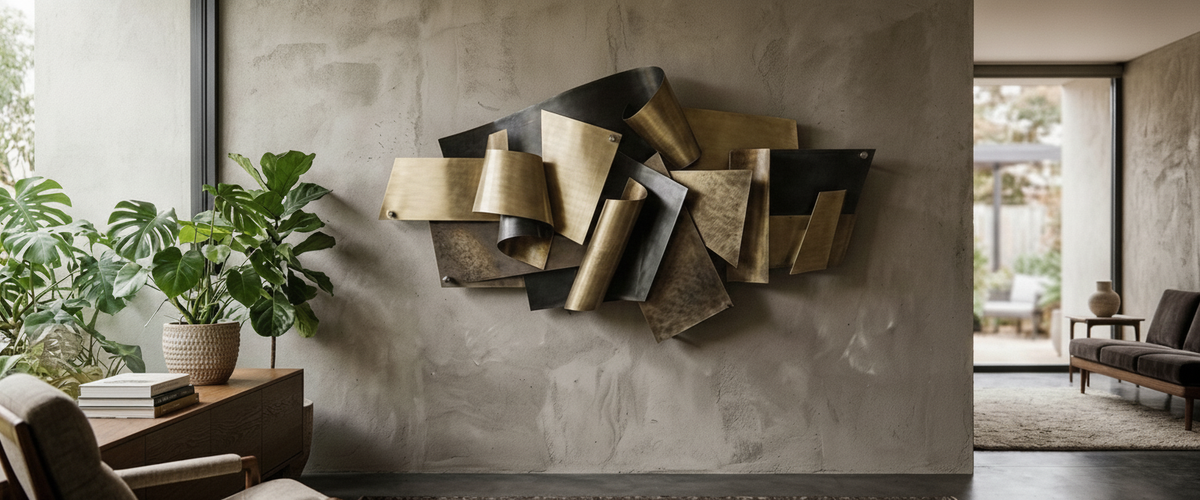

If you own a metal wall decor sculpture, it is almost certainly changing color right now, or at least changing how it reads. It happens slowly enough that nobody notices, until the day a new lamp goes in beside it and the whole piece suddenly looks wrong.
Most buyers choose a metal wall decor sculpture by its color in a product photo. That is the color on the day it left the studio. At Giant Sculptures we ask clients about the room as often as we ask about the piece. Sun, steam, heating and even the depth of the wall fixings decide how a finish looks five years on. What follows comes from commissions we have shipped to homes from Napa to Manhattan, and from a few lessons we learned the hard way.

At a Glance
Indoor metal ages more slowly than outdoor metal, but it still ages.
Lacquered brass stays warm while the lacquer holds. Unlacquered brass drifts toward brown and can spot.
Copper and chemical patinas move fastest in kitchens, bathrooms and south-facing rooms.
Blackened and powder-coated steel are the most stable finishes, but they need decent light.
A deeper standoff adds shadow and changes how the color reads.
Mixed-metal pieces need finishes that age at compatible rates.
An Indoor Metal Wall Decor Sculpture Still Ages
Outdoor pieces get the attention because their exposure is obvious. A garden piece in Aspen faces snow, UV and freeze-thaw cycles, which is why our outdoor wall art is specified with heavier finishes. Indoor pieces face quieter enemies: finger oils, cooking aerosols, radiator heat and the dry air of a winter HVAC cycle. Slower, yes. Static, no.
The practical point is that you are choosing a finish trajectory. The color you see on delivery is only the starting point. Ask any supplier what the surface of a metal wall decor sculpture will look like after a few years in your specific room, and be wary of anyone who says it will not change at all.

Brass Reads Warm on Day One, and the Lacquer Decides the Rest
Fresh brass is the warmest finish a metal wall decor sculpture can carry. Clear lacquer holds that tone by sealing the surface, but lacquer is a thin film. Once a scratch or a worn edge breaches it, tarnish creeps underneath in a visible line that is harder to fix than an evenly aged surface.
A client in the Hamptons once asked us to leave a kitchen panel unlacquered because she wanted it to "live." Within a season, the section nearest the range had gone a deep honey brown while the far edge stayed bright. She loved the gradient. Plenty of buyers would not, so decide before you order. If you like warm tones but want less maintenance, ask whether a warm-toned powder coat or a sealed bronze-effect finish could give you the same color without a brass polishing schedule.
Copper and Patinas Keep Shifting in Kitchens, Bathrooms and Sunny Rooms
Copper moves from salmon pink to russet to chocolate brown as it oxidizes, and sustained moisture can push it toward green. Studio-applied patinas are chemical conversions of the surface, and the Copper Development Association notes that these finishes continue to react with their environment unless sealed and maintained.
That matters room by room. Bathroom steam speeds up darkening. Kitchen grease and acidic splashes leave spots. A south-facing living room in Texas puts the metal through daily heat cycles that slowly break down wax. A copper metal wall decor sculpture in those spaces needs a fresh coat of microcrystalline wax every year or so, or a frank acceptance that it will keep changing.
Blackened and Powder-Coated Steel Holds Steady but Can Go Flat
If you want your metal wall decor sculpture to stay the color you bought, steel is the safer bet. Blackened steel sealed with oil or wax barely moves in a dry room, and a quality powder coat is close to inert. The catch is optical. In a dim hallway, matte black can read as a hole in the wall, with every fold and texture lost. Ask for a satin sheen or a metallic powder if the wall gets little daylight.
Polished stainless steel has the opposite problem: it never looks flat because it borrows color from everything around it. On a wall that catches both midday sun and evening lamplight, a mirror-finished form such as the Silver Polished Oval Disc Stainless Steel Wall Art - 120cm, at 120cm (about 47 inches), will look warmer at sunset and cooler at noon. Check what it will be reflecting before you choose the wall.

A Deeper Standoff Throws the Finish into Shadow
Standoff depth is the most overlooked decision with any metal wall decor sculpture. Mount a piece tight to the wall and the finish reads as one even color. Push it out a couple of inches and you get a shadow line that darkens the edges and makes brushed or textured surfaces look richer, the same effect that gives relief-heavy 3D wall art its presence. Reflective metals also pick up more of the wall paint behind them when they float.
In the studio, we test the standoff on each metal wall decor sculpture with a flashlight held low across the face at dusk, because that is when most rooms are actually lit. At architectural scale, depth stops being purely visual: on a run as long as the Silver Sculptural Metal Wall Panel - 710cm at 710cm (roughly 23 feet), every extra inch of standoff adds strain on the fixings, so wall structure and load need checking before installation.
Pairing Two Metals Means Pairing Two Rates of Change
Mixed-metal sculpture decor looks crisp on delivery because the contrast is at its sharpest. Over time some pairs drift. Brass against blackened steel loses contrast as the brass darkens. Copper beside stainless steel goes the other way, with the copper browning while the steel stays bright. Where dissimilar metals touch on a metal wall decor sculpture hung in a damp room, galvanic corrosion becomes a risk, so ask whether isolation washers or barrier coatings are used at the joints.
Buyer Checklist for a Metal Wall Decor Sculpture
Before you commit to a finish, run through these points with your supplier or designer:
Room conditions: humidity, cooking, direct sun and heating vents near the wall.
Finish trajectory: sealed or unsealed, and what the surface will look like after several years.
Light levels: daytime and evening, especially for matte black or polished steel.
Standoff depth: view a sample or mock-up in low, raking light.
Metal pairings: confirm compatible aging rates and isolated joints.
Maintenance: who rewaxes or cleans it, and how often.
Fixings: wall type, load and access for large panels.

Commissioning Decorative Sculptures That Age on Your Terms
Off-the-shelf sculptures for home decor are usually chosen for how they photograph. A bespoke metal wall decor sculpture can be finished for the room it will hang in, with the lacquer, wax, powder or patina picked to suit the light and the humidity. Budget depends on material, scale, complexity, engineering, installation and finishing, so we prepare a tailored quote for each project rather than quoting a flat figure.
Start by browsing our metal wall art collection to find the forms and finishes that suit your space, then talk to us about adapting one. If you are comparing decorative sculptures across materials, the wider wall art and wall decor range is a useful next stop.
For wider placement ideas, Metal Outdoor Wall Art: Choose the Metal Before the Motif is useful companion reading before finalizing the setting and sightlines for your metal wall decor sculpture.