






































































































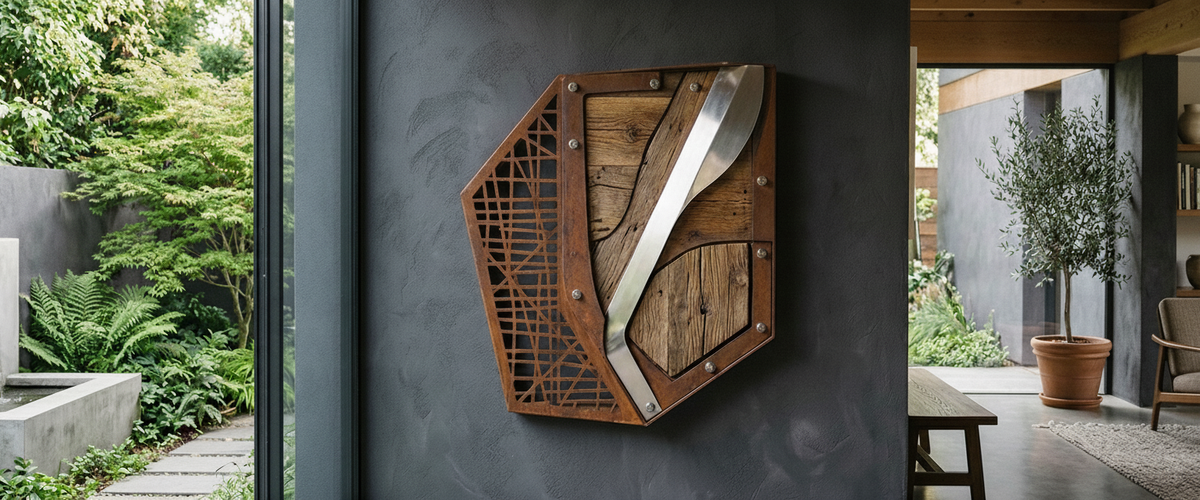

Glue a postage stamp to a gessoed board and you have mixed media art. Bolt a sheet of weathering steel to a slab of reclaimed oak, leave it on a terrace in Austin through August, and you also have mixed media art, along with a problem the first maker never had to think about. The term covers both, which is why it confuses buyers. At sculpture scale, the useful question is less about which materials are used and more about how they are held together, and what happens to that bond after ten summers.

Key Takeaways
Definition: mixed media art is any work that combines two or more distinct materials or techniques in a single piece.
At large scale: the classic pairings are steel with timber, bronze or stainless steel with stone, copper with glass, and resin with stone.
The real risk: materials expand, shrink and corrode at different rates, so the joint usually fails before either material does.
Placement rule: site the piece for whichever material is most vulnerable, not the toughest one.
What Is Mixed Media Art, Beyond the Craft Shelf?
Search "what is mixed media art" and most answers stop at paper, paint and ephemera. That definition is accurate but small. A more useful version: a work becomes mixed media when its meaning or structure depends on the contrast between materials that behave differently. Paint over paint is one medium. Paint over a pressed tin ceiling tile is two, and the tin changes how the piece takes light, carries weight and ages.
That distinction matters to anyone buying for a home or venue. Single-material sculpture has one set of care rules. Mixed media art has as many sets of rules as it has materials, plus another set for the places where they meet.
From Collage to Assemblage: How Mix Media Art Left the Page
Collage gave artists permission to glue the real world onto the picture plane. In 1912 Picasso pasted printed oilcloth into Still Life with Chair Caning, and Braque made his first papier collé the same year. Once a newspaper fragment could sit inside a still life, it was a short step to nailing a crate lid to a canvas, then to building freestanding work from found objects. By 1961 MoMA had staged a full exhibition, The Art of Assemblage, and its explanation of assemblage traces that shift from flat surface into three dimensions. It is the direct ancestor of the large wall reliefs and garden pieces our studio builds today.
What changed along the way was the fixing. Paper collage relies on adhesive. Assemblage brought in screws, wire and welds. Once mix media art moved onto exterior walls and into gardens, those fixings stopped being a craft detail and became engineering.

Mixed Media Art Examples That Work at Scale
The mixed media art examples that hold up outdoors share one trait: each material is chosen for a job, and the contrast is the point of the piece.
Steel with timber. Corten or blackened steel framing oak or cedar. Rust against grain, cool against warm. Timber moves with humidity and steel barely does, so the design needs slotted fixings.
Stainless steel or bronze with stone. A polished metal form rising from a granite or marble base, or set into a carved recess. Stone supplies mass; metal supplies reflection.
Copper with glass. Copper drifts toward verdigris while glass stays constant, so the piece shifts over the years. Suited to courtyards with filtered light.
Resin with stone. Cast resin inlays in a stone slab can carry color that stone cannot. Keep these sheltered, because UV is hard on most resins.
Browse our mixed media art collection and you will see these pairings recur, often in the looser, gestural forms that also run through our abstract art range.
The Joint Is the Weak Point
Every material moves. Steel expands in heat, roughly 0.08 inch (2 mm) over a 10-foot (3 m) run between a cold morning and a 110°F (43°C) afternoon. Oak swells through a damp Pacific Northwest winter and shrinks in a Phoenix summer; a 12-inch (30 cm) wide board can move 1/8 inch (3 mm) or more across its width between seasons. Stone barely moves at all. Bolt two of them rigidly together and something has to give, usually the fixing, sometimes the softer material around it.
We learned this the slow way on an early commission, a Corten and oak wall piece for a client in Napa. The oak boards were fixed through round holes. By the second dry season the timber had shrunk enough to split along two bolt lines. The replacement used slotted holes and stainless sleeves, and it has not shifted since. Every timber-to-metal joint we design now allows for movement on purpose.
Metals have their own quarrel. Put copper or bronze in direct contact with steel or aluminum in a wet climate and galvanic corrosion eats into the less noble metal. Isolating washers and gaskets are a small line item and prevent most of it.

Stamps and Gel Medium Versus Welds and Bolts
Mixed media stamp art is a good place to see how fixings reveal intent. A rubber-stamped layer pressed into gel medium is meant to look layered and handmade, and it is meant to live indoors, framed, away from moisture. Gel medium is flexible and forgiving at that scale. It was never designed to carry load or survive frost.
A weld or a bolt says the opposite: this piece expects weight, wind and weather. When you assess any mixed media work, look closely at how the parts are attached. Adhesive alone on an outdoor piece is a warning sign. Visible, considered mechanical fixings usually mean the maker thought about year five as well as day one.
Place the Piece for Its Weakest Material
For wider placement ideas, Life Size Giraffe Statues: Why the Ankles Matter More Than the Neck is useful companion reading before finalizing the setting and sightlines.
Humidity and sunlight treat each material differently. Stainless steel shrugs off a coastal garden in the Hamptons; untreated timber beside it will gray, check and eventually rot. Stone handles Texas sun, while most resins yellow under it. So the placement question is always the same: which material in this piece is the most fragile, and what does it need?
For timber, that usually means shade from afternoon sun and good drainage at the base. Resin and glass want UV protection or a covered loggia. With copper, either accept the patina or choose a sheltered spot if you want bright metal to last. Pieces from our organic art range are a useful reference here, because their natural forms tend to sit comfortably in planted settings where moisture is constant.

A Buyer's Checklist for Mixed Media Art
Name every material. Ask for the full list, including fixings, sealants and any internal armature.
Ask how the joints move. Slotted holes, isolating washers and expansion gaps are good signs.
Match the piece to the climate. Dry desert, humid coast and freeze-thaw mountain sites such as Aspen stress different materials.
Plan around the weakest material. Provide shade, cover or drainage as that material demands.
Get a care schedule per material. Timber oiling, metal waxing and stone sealing rarely share a calendar.
Know who to call later. For valuable or aging work, the American Institute for Conservation keeps a directory of conservators.
Commissioning Mixed Media Art That Lasts
Most of the mixed media work Giant Sculptures ships starts with a conversation about the site rather than the materials. Tell us where the piece will live, how much sun and rain it gets, and what you want it to feel like, and our studio will propose pairings and fixings to suit. Budget depends on material, scale, complexity, engineering, installation and finishing, so every commission is quoted individually. If you have seen a pairing you like, perhaps a steel-and-stone figure from our animal art range or a wall relief, send it over. We will tell you honestly how it will age where you plan to put it.