























































Most round wood wall art that fails does so quietly. A hairline split opens from the center outward, a disc drifts a few degrees clockwise by spring, or the grain line runs uphill and nobody can say why the piece looks wrong. None of that is the hook's fault. Almost all of it is decided at the bench, long before the piece reaches the wall.
At Giant Sculptures we make and source large wall pieces for homes, hotels and restaurants, and round wood wall art raises more aftercare questions than any other shape we ship. Here is what governs how a wooden roundel behaves once it leaves the studio.

At a Glance
Grain sets the top. Hang a round so its dominant grain runs level or on a deliberate diagonal.
Construction sets the risk. End-grain cookies split most; segmented rounds move least.
Iron rings need clearance. A band forged tight to the wood will eventually crack it.
Size up. A circle reads smaller than a rectangle of the same width.
Two fixings minimum. One nail lets any disc rotate.
Why Grain Orientation, Not the Hook, Decides Which Way a Round Hangs
A circle has no top until the wood gives it one. The eye reads strong grain the way it reads a horizon, so figure that runs left to right feels settled, while vertical figure pulls the gaze downward. Vertical grain also makes any future seasonal check look worse, because checks follow the grain and a vertical split reads like a crack in a plate.
In our studio the top is marked in pencil on the back before any finish goes on, and the hanging hardware is placed to that mark rather than wherever the hanger happens to land. If you buy finished round wood wall art without a marked top, rotate it on the floor and photograph it at each quarter turn (0, 90, 180 and 270 degrees) before drilling anything.

End Grain, Solid Slab or Segmented: Which Round Cracks, and Which One Moves
Wood shrinks roughly twice as much around the growth rings as it does across them; for many common hardwoods that works out to about 8 percent tangentially versus about 4 percent radially from green to oven-dry, a behavior documented in the USDA Forest Products Laboratory's Wood Handbook. That mismatch explains almost every failure we see in round wood wall art.
End-grain cookies (a cross-section sliced from the log) are the most dramatic and the least stable. Uneven shrinkage pulls the rings apart and opens V-shaped radial checks. Some buyers love them; most did not expect them.
Solid slab rounds, cut along the length of the board, rarely split radially but move across their width. Over a dry winter they can turn faintly oval and cup toward the warmer side of the room.
Segmented rounds glue up wedges or staves so movement is spread across many small pieces. They are our default for anything large, painted or carved.
Room conditions matter as much as construction. The Canadian Conservation Institute's guidance on incorrect relative humidity is the clearest explanation we know of why wood above a fireplace or beside an exterior door ages faster. As a working target, keep the room at a steady 40 to 55 percent relative humidity and 65 to 75°F (18 to 24°C). We learned this the hard way with a single-slab white oak disc for a Malibu beach house: after its first season of dry air-conditioning it was measurably narrower across the grain than along it. The replacement was segmented, and it has not moved since.
When a Round Wood Frame and Wrought Iron Wall Art Earns Its Place
For wider placement ideas, Large Wooden Wall Art Is Heavier Than You Think: How to Hang It Right is useful companion reading before finalizing the setting and sightlines.
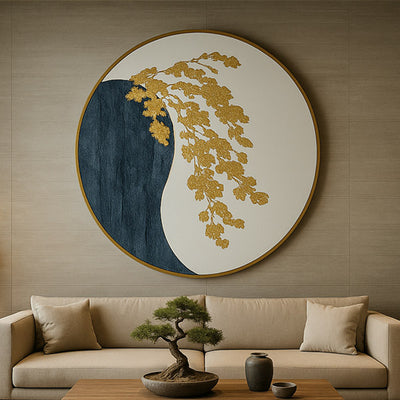
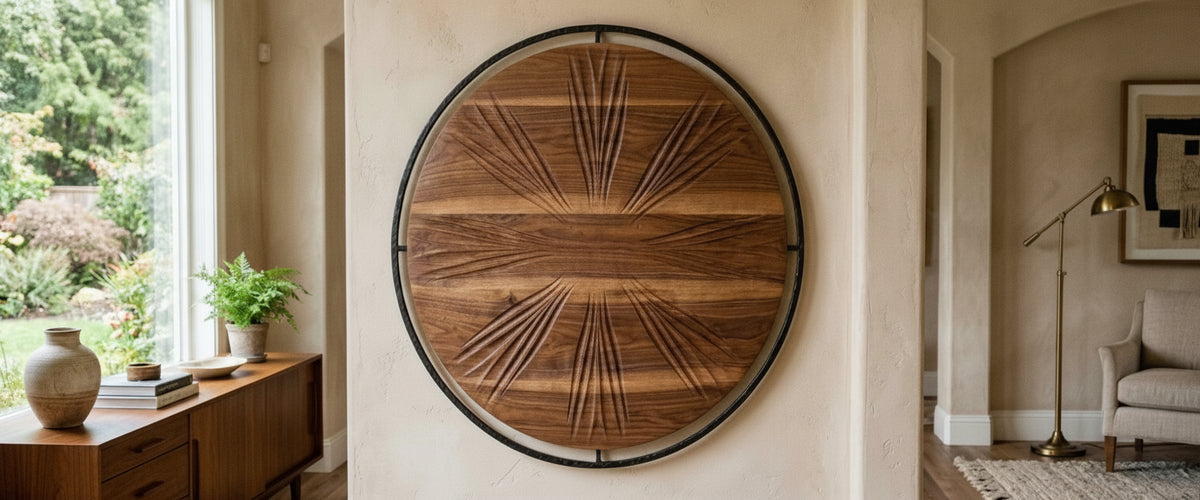
Iron rings around wood centers are popular for good reason. A dark forged rim sharpens the edge of a soft-colored disc and protects the most vulnerable part of the piece, the exposed perimeter. Round wood frame and wrought iron wall art earns its place when the iron does real work: framing a carved center, adding visual weight in a tall room, or carrying the fixings so the wood floats free inside.
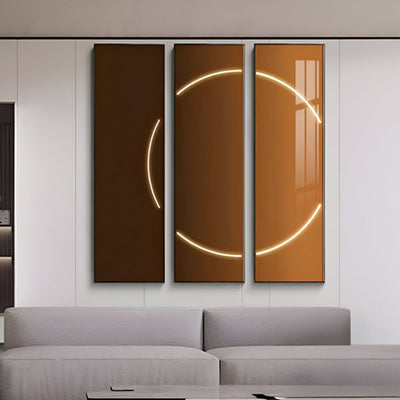
The mistake is forging the band tight. Wood swells in humid months, iron does not, and the wood loses that fight. We leave a small clearance and fix the center through slotted holes so it can move. For coastal homes, ask for a sealed or powder-coated iron finish rather than bare wax. Our iron art and wrought iron wall decor is a useful place to judge how heavy a rim should look against your wall color. Where the room wants a metallic edge but not the mass of forged iron, a lighter brass-accented round such as Luna Forma Mocha Brown Round Brass Accent Wall Art is closer to the right design language.

The Diameter That Holds a Rectangular Wall Without Floating in It
Round wood wall art reads smaller than a rectangle of the same width because the corners are missing. Buyers who size a disc the way they would size a framed print almost always go too small, and the result looks like a clock that wandered off.
Over a sofa, console or bed, start at roughly two-thirds of the furniture width. Over an 84-inch (213 cm) sofa, that points to a disc of about 56 inches (142 cm), hung with its bottom edge 8 to 10 inches (20 to 25 cm) above the furniture. On an open wall with nothing below, center the disc at 57 to 60 inches (145 to 152 cm) from the floor, then cut a paper template, tape it up and live with it for a day. A busier surface can sit a little smaller, because pattern and detail carry visual weight that a plain disc cannot; on a warm-toned wall, a floral round such as Blossom Halo Terracotta Round Floral Decorative Wall Art holds its ground at a more modest diameter than a flat, uniform finish would. Browse our 3D wall art if your wall needs depth more than diameter.
Stopping a Disc From Rotating, Tilting or Creeping off Level
A single central hanger turns any piece of round wood wall art into a pendulum. A client in a Tribeca loft found her disc several degrees off level within a month; the culprit was a heavy front door slamming on the same wall. Our fixes, in order of preference:
A recessed French cleat, which locks rotation and spreads the load.
Two keyhole slots set level with each other, not one.
A spacer bumper at the bottom so the disc hangs plumb instead of tilting forward.
Stud or masonry fixings for heavy hardwood, never drywall anchors alone.

What We Ask Before Carving a Commissioned Roundel
A commissioned piece of round wood wall art starts with questions, not sketches. Before we quote, we want to know:
The full wall width and height, and what sits below it.
Whether the wall faces a fireplace, vent, window or exterior door.
Your preferred species, finish and color, and whether you want visible grain or paint.
Construction: end grain for character, segmented for stability.
Any metal element, and whether it is decorative or structural.
The wall build (drywall, plaster, brick) and access for installation.
The paint-or-grain question is the one clients most often leave open. If you are leaning toward color, living with a bold graphic round such as Solaro Bold Navy & Coral Round Mural Wall Art is a quick way to learn how much saturation your wall can carry before we commit a commissioned palette to wood.
Budget depends on material, scale, complexity, engineering, installation and finishing, so we prepare a tailored quote for each roundel rather than a list price. Start with our wood wall art collection to set a direction, then send us your wall photos. The best rounds we have shipped were the ones where the client told us about the humidity before we told them about the grain.