





































































































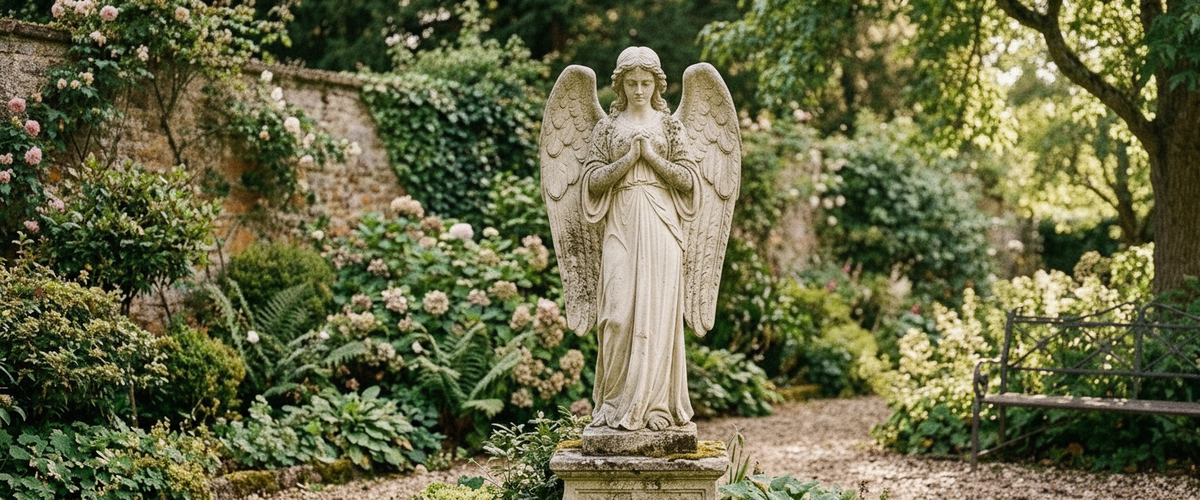

The resin angel that looked razor-sharp in April can feel powdery under your thumb by its third August. That is the honest arc of most resin angel statues garden buyers bring home: excellent first impression, a quiet slide from season three, and a decision to make around year ten. None of that makes resin a bad choice. It makes it a choice with a service life, and buyers who understand what is actually inside the cast get far more out of it.

At a Glance
Resin is a sandwich: a thin pigmented gel coat over a filled polyester or polyurethane body, sometimes with a hollow core.
Sun does the damage, not rain. UV breaks down the surface binder and leaves a chalky bloom, usually on the south or southwest face first.
Light weight is the hidden risk. Garden resin angel statues standing 5 ft (1.5 m) can weigh under 40 lb (18 kg) and will move in a storm.
A re-coat every few seasons takes about two hours and genuinely extends the piece.
For a permanent focal point, marble, granite or bronze earns its cost over decades rather than seasons.
Core, Filler and Gel Coat: What You Are Actually Standing in the Border
Cut through one of the resin angel statues garden centers stock by the pallet and the section reads like a layer cake. Outside sits the gel coat, often less than a millimeter thick, carrying almost all the color and detail you paid for. Behind it is the structural laminate: polyester or polyurethane resin loaded with a mineral filler, commonly marble dust, limestone powder or calcium carbonate, which is why so many listings say "marble resin" or "cold cast stone." Deeper in you may find nothing at all. Larger figures are frequently hollow, with a steel or fiberglass rod running up through the leg and torso.
That build explains how resin angel statues garden displays rely on actually behave. Detail resolution is superb because resin picks up every tool mark in the mold. Cost per foot of height is low because the material is poured, not carved. Durability depends almost entirely on that fragile outer skin. Once the gel coat goes, the filler underneath is exposed, and filler is thirsty.

Season One to Season Three: The Chalking Starts on the South-Facing Wing
Chalking is the first symptom most garden resin angel statues show, and it is predictable. Ultraviolet light cleaves the polymer chains at the surface, the binder gives up its grip on the pigment, and loose pigment powder sits on top like fine dust. Run a finger down the wing and you get a gray or white smear. Conservators have documented this pattern across cast plastics in outdoor settings; the Canadian Conservation Institute notes that light exposure is the dominant deterioration driver for most plastics, ahead of moisture.
Chalking shows first on the upper wing edge, where midday sun lands hardest.
It always shows on the same places first. The upper wing edge. The crown of the head. The forward shoulder. Anything angled toward the midday sun, which is why resin angel statues in the garden so often bleach on one elevation only. A client with a walled garden outside Napa called us about an angel that looked perfect from the patio and badly bleached from the far path, because only one face had ever been in full sun. Freeze-thaw then finishes the job in colder states: water wicks into the exposed filler, expands overnight, and lifts flakes off the fingertips and the trailing edge of the drapery.
Resin Angel Statues for Garden Borders: Where Resin Holds and Where Stone Pulls Ahead
Resin genuinely wins on a few fronts. It carries fine detail at low weight, it travels cheaply, and one person can shift it when a planting scheme changes. For a shaded courtyard in Charleston, a covered loggia, or a seasonal display that gets stored each winter, resin angel statues for garden use make practical sense.
Stone pulls ahead the moment the piece is meant to be permanent. Resin angel statues garden designers treat as a fixture give themselves away in time; carved marble has no coating to lose, so the surface you see is the material all the way through, and weathering softens it rather than destroying it. At border scale the substitution is close to like-for-like, since a seated figure such as Seated Angel With Roses Marble Garden Statue, 170cm (roughly 5 ft 7 in) occupies much the same visual footprint as a large resin angel while aging over generations rather than seasons. Where the setting wants a quieter, more contemporary presence than a full-height classical figure, Contemporary Contemplative Angel Bronze Sculpture, 50cm (about 20 in) is closer to the right design language, and it will hold its patina on a terrace table for decades with nothing more than an annual wax.

A Figure That Weighs Almost Nothing Meets a February Gust
The insurance claims we hear about on garden resin angel statues are rarely cracks. They are falls. A hollow resin angel with outstretched wings is, aerodynamically, a sail on a narrow base. Winter storms along the Hamptons coastline and downslope gusts in Colorado foothill gardens have flattened more than one lightweight figure that was simply set on a paver.
Anchoring at install: a level pad, a pinned base and ballast in the hollow core.
Fix it at install, because anchoring is the one job resin angel statues garden owners most often skip. Bed the statue on a level concrete pad, not on gravel or lawn. Drill the base and pin it with stainless threaded rod set in resin anchor. Fill hollow cavities with dry sand or pea gravel to drop the center of gravity, then seal the drain hole so water cannot collect and freeze. If the figure has open arms or spread wings, orient the narrowest profile into the prevailing wind. In stone, mass solves at source what anchoring has to solve by force: at the scale of Standing Angel With Open Arms Marble Garden Statue, 220cm (about 7 ft 3 in), the same spread-wing pose stops being an uplift problem and becomes a ground-bearing one.
The Two-Hour Re-Coat Routine That Buys Another Five Seasons
Done on a dry, overcast day in spring, this is the single highest-value thing you can do for resin angel statues in the garden.
Wash with warm water and a drop of pH-neutral detergent using a soft brush. No pressure washer; it will strip what is left of the gel coat.
Rinse and let the piece dry fully, ideally four hours in moving air. Trapped moisture under a new coating causes blistering.
Scuff chalked areas lightly with a gray abrasive pad to key the surface, then wipe with a tack cloth.
Spot-fill any flake craters with a two-part exterior epoxy filler and feather the edges.
Apply two thin coats of a UV-stable exterior acrylic or polyurethane clear, matte for a stone look, satin for a cast-bronze look. Thin coats, 20 minutes apart.
Log the date. Most garden resin angel statues need this every three to five years; full-sun southern exposures closer to two.

Repair, Retire or Replace: Judging a Resin Angel at Year Ten
For wider placement ideas, Garden Deer Statues Resin: What Lasts Outdoors and What Quietly Fails is useful companion reading before finalizing the setting and sightlines.
Three tests will tell you where a resin angel statue in the garden actually stands. Press a thumbnail into a hidden area at the base: if it dents, the resin has softened and the piece is near the end. Tap the torso with a knuckle and listen for a dull thud instead of a bright tick, which suggests water has entered the laminate. Look at the fine work, the fingers, feather tips, and the bridge of the nose, because detail loss is irreversible and no coating brings it back.
Pass all three and a re-coat is worth doing. Fail two and you are maintaining something that will not repay the effort. That is the point where most of our clients stop buying replacement resin angel statues garden borders swallow every decade and commission one figure properly, in a material that ends the cycle.
When the Site Deserves Carved Stone Instead, and How to Tell
Ask what the sculpture is doing. If it terminates a sight line from the house, anchors a memorial garden, or is the first thing guests see at an entry court, it is load-bearing in design terms and should be permanent. Anything decorative, seasonal, or likely to move within five years can stay in resin without guilt, and that is exactly where most garden resin angel statues belong.
Scale is the other tell. Past about 6 ft (1.8 m), the biggest resin angel statues garden suppliers offer start to look like what they are: light shells pretending to be mass. Hand-carved marble and granite hold their authority at that height, which is why the memorial and religious pieces in our angel statues collection are cut from stone rather than poured. For patinated metalwork, the bronze angel and cherub statues cover the same subjects with a surface that improves with exposure.
Giant Sculptures works mostly on bespoke commissions at large scale, so the conversation we have with buyers usually starts with the site rather than the catalog: sun path, prevailing wind, foundation, viewing distance, and how long the piece needs to last. Budget follows material, size, carving complexity, engineering and installation, so we quote each project individually rather than guessing from a photograph. Send us the garden plan and a few images, and we will tell you honestly whether resin angel statues in the garden are fine for what you want or whether carved stone is the better investment.