




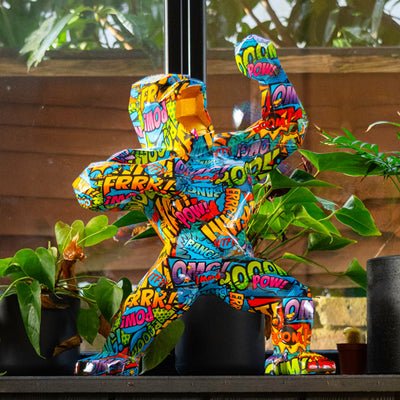




















































































Most fiberglass garden sculptures do not fail because the resin gave up. They fail because a layer of pigmented gel coat, often no thicker than a couple of business cards, was sprayed light in the mold and then asked to hold color through three summers of direct sun in Texas or Southern California. The structure underneath is usually fine. The surface is what goes, and the surface is what you look at.
That single fact should change how you shop. Once you know what to ask about gel coat film build, laminate thickness and internal armature, you can separate fiberglass garden sculptures that will still look sharp in a decade from the ones that chalk out by their third season.

Quick Answer: What Actually Determines Lifespan
Gel coat quality and thickness set the clock. UV-stable, isophthalic or vinyl-ester based gel coats hold color far longer than cheap general-purpose ones.
Laminate thickness and internal armature decide whether the piece stays rigid, especially at ankles, necks, tails and outstretched limbs.
Seams and joins are the usual first failure point, not the open surface.
Anchoring matters more than with metal or stone, because a hollow figure cannot rely on its own mass.
Maintenance rhythm (wash, wax, recoat when needed) is the cheapest way to postpone a full refinish.
Where it wins: roof terraces, balconies, load-limited decks, interior atriums, touring or seasonal installations.
Film build at the tightest details, not the flat panels, is where the lifespan of fiberglass garden sculptures is decided.
What a Gel Coat Really Is, and Why It Sets the Lifespan Before the Resin Does
Gel coat is a pigmented resin sprayed into the mold first, so it becomes the outer skin of the finished shell. Everything behind it is glass fiber and laminating resin doing structural work. The gel coat is doing optical and protective work: color, gloss, and a moisture barrier that keeps water away from the glass reinforcement. The composites industry, represented by bodies such as the American Composites Manufacturers Association, treats that surface layer as its own engineering problem, with its own resin chemistry and cure requirements.
Two things separate good from bad. First, chemistry: UV-stabilized gel coats resist photo-oxidation, while budget general-purpose formulations fade and chalk quickly. Second, film build. A starved spray, especially on complex forms where the gun struggles to reach undercuts, leaves thin spots. Those thin spots are where failure starts, every time. When we specify fiberglass garden sculptures for exterior sites, we ask the finishing team about film build at the tightest details, not the flat panels.

Chalking, Yellowing and Hairline Crazing: The Standard Failure Sequence
Fiberglass garden sculptures tend to age in a predictable order, and on an exposed site the first stage often shows up around year three.
Gloss loss, then chalking. The surface goes matte, then leaves a fine powder on your fingers. That powder is degraded resin and released pigment.
Yellowing or color drift. Whites go cream. Deep reds and blues shift first because those pigments are least stable.
Hairline crazing. Fine spider-web cracks appear over stress points and thick gel coat pools. They are cosmetic at first, then they let water into the laminate.
Conservators looking after modern plastics and composites see the same progression in museum collections; the V&A's guidance on caring for plastics is a useful primer on how UV, heat and moisture combine to break down polymer surfaces. Outdoors, add freeze-thaw and the timeline compresses.
Laminate Thickness and Armature: The Spec Line Almost Nobody Asks About
Ask a supplier how thick the laminate is and you learn a lot about who you are dealing with. A decorative interior shell might be built light. Anything standing in a garden, particularly a tall figure or an animal on slim legs, needs a heavier build in the stress zones, commonly stepped up to around 3/16 inch (roughly 5 mm) at the base, joins and load paths, with additional glass reinforcement locally.
Then there is the armature. Good fiberglass garden sculptures have a steel or stainless internal frame bonded into the shell, carrying load down to a base plate with threaded anchor points. Cheap ones have a bare shell, sometimes with a bag of sand poured in as ballast. Sand is not an armature. It moves, it holds moisture, and it does nothing for a cantilevered arm or a raised tail. Our studio's rule on commissions is simple: if the frame is not drawn, it does not exist.

Thin Shells and Thermal Movement: Why Seams Split Before Surfaces Do
Composite shells expand and contract more than bronze or stone across a temperature swing, and a dark-finished piece in Arizona sun can run far hotter than the air around it. Large fiberglass garden sculptures are usually molded in sections and bonded, so the seam is the weakest line in the whole object. Season after season of movement works that bond until you see a hairline shadow, then a crack, then water ingress and staining from the inside out.
The fix is in fabrication: generous internal seam laminates, chamfered and bonded joins rather than butt joints, and finish sanding that does not thin the gel coat right along the join. On sites with brutal daily swings, such as high-altitude gardens around Aspen or Santa Fe, we usually steer clients toward Corten steel sculptures or bronze, which shrug off thermal cycling without a bonded seam to worry about.
Where Fiberglass Genuinely Wins
Composite is the right answer more often than metal purists admit, and weight is the reason. Roof terraces and balconies come with structural load limits, and one Manhattan penthouse terrace we shipped to had a hard cap set by the building engineer. A marble figure was never going to happen. A hollow composite piece at a fraction of the weight solved it, sat on a load-spreading pad, and looked exactly right against the skyline.
Weight limits are the clearest case for fiberglass garden sculptures over marble or solid bronze.
Other honest wins: temporary or seasonal installations, retail and hospitality set pieces that move between sites, large-scale forms where a solid version would be unhandleable, and interior atriums where UV exposure is minimal so gel coat life is far longer. If long-term permanence outdoors is the priority, compare against bronze sculptures or stainless steel sculptures before you commit, and browse the wider garden sculpture collection for scale reference.
Anchoring a Hollow Figure Against Wind, Not Against Its Own Weight
A 9 ft (2.7 m) hollow figure might weigh a couple of hundred pounds (around 90 to 100 kg). That is nothing against a coastal gust on Long Island or an exposed Cornish garden. Wind loading works on surface area, and tall fiberglass garden sculptures present plenty of it.
Specify a steel base plate with anchor bolt holes bonded into the shell, not surface-screwed.
Fix into a concrete pad or existing structural slab, sized by your installer for the site.
On terraces, use load-spreading plates and non-penetrative ballast where membranes cannot be pierced.
Use stainless fixings and isolate dissimilar metals to avoid galvanic staining.
Check anchors after the first winter, then annually.

Waxing and Recoating: The Maintenance Rhythm That Keeps a Finish Alive
Treat the surface of fiberglass garden sculptures the way boat owners treat a hull, because it is the same chemistry.
Twice a year: wash with mild pH-neutral soap and soft water pressure. No abrasive pads, no pressure washers at close range.
Annually: apply a marine-grade UV wax or polymer sealant. This is the single highest-return job on the list.
Every few years: compound and re-polish to cut back light chalking before it becomes crazing.
When crazing appears: get it filled and refinished promptly. Water inside a laminate is what turns cosmetic into structural.
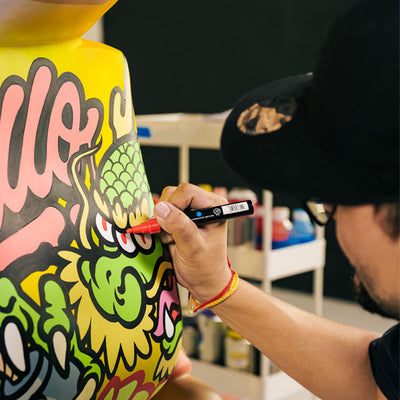
Every decade or so: budget for a full repaint or re-gel with an automotive or marine topcoat system. A well-built shell can be refinished repeatedly.
Commissioning Fiberglass Garden Sculptures: What to Put in Writing
Ask for the gel coat type and film build, laminate thickness at stress zones, a drawing of the internal armature and base plate, seam construction detail, and the recommended anchoring method for your specific site. Budget depends on scale, complexity, engineering, finishing system and installation, so ask for a tailored quote rather than a headline figure. Giant Sculptures builds bespoke work across composite, bronze, stainless, Corten and stone, and part of our job on a commission is telling you honestly when fiberglass is the smart specification and when it is a false economy.
For wider placement ideas, A Giraffe Garden Sculpture Needs Sky Behind It, Not a Hedge is useful companion reading before finalising the setting and sightlines.