

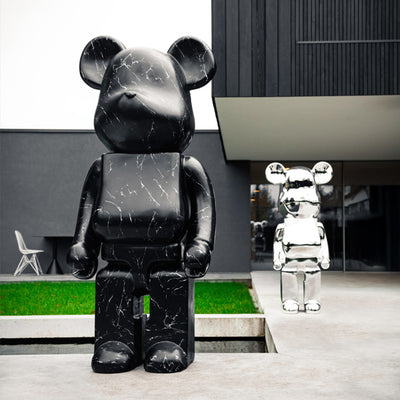

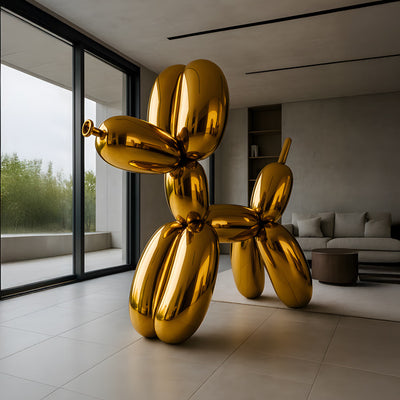


































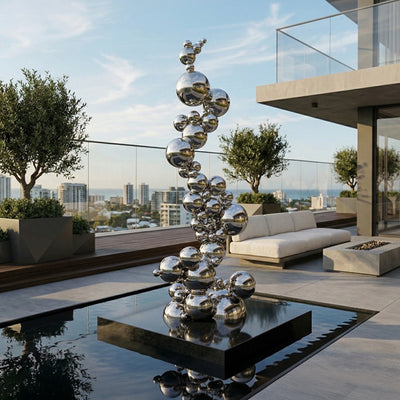








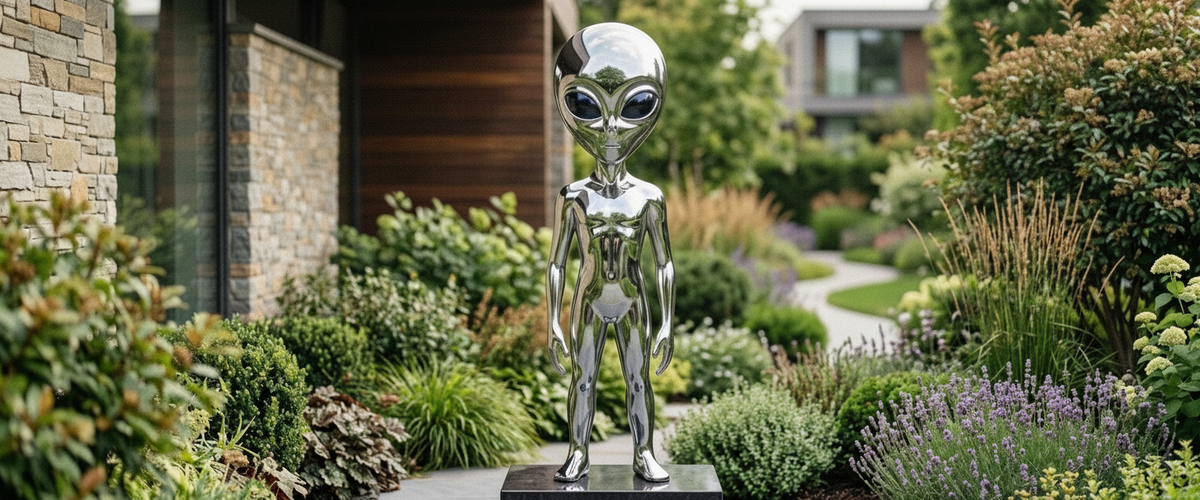

A mirror-polished alien hands the room straight back to you, warts and wallpaper included. That is the part buyers rarely think about until the crate is open: a chrome pop art alien reflects the ceiling vent, the fire alarm, the cheap pendant light over the stairwell and every guest holding a phone up to it. Finish is not a cosmetic afterthought on a figure like this. It decides what the piece says, how hard it works under light, and how much of your week it quietly claims.

Quick Answer: Which Finish Does What
Almost every pop art alien we ship leaves the workshop in one of four surfaces, and each behaves differently once it is in the room:
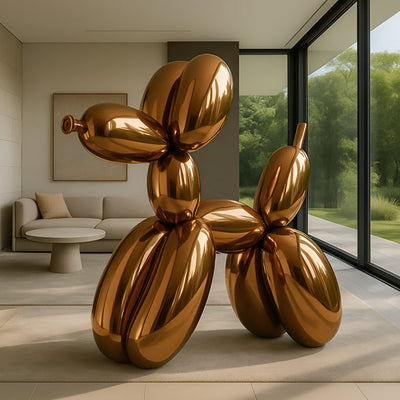
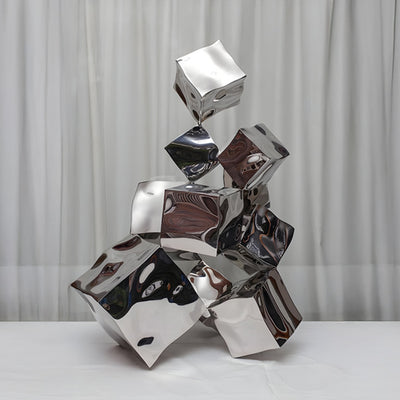
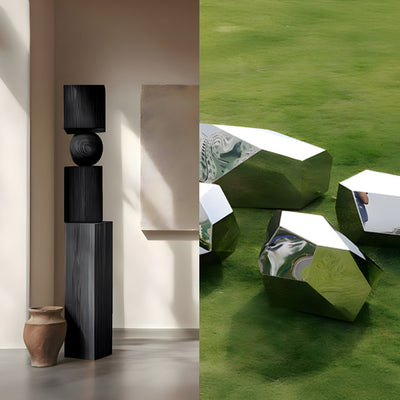
Mirror chrome: maximum drama, maximum reflection. Best in rooms you are proud of, worst in rooms with clutter overhead.
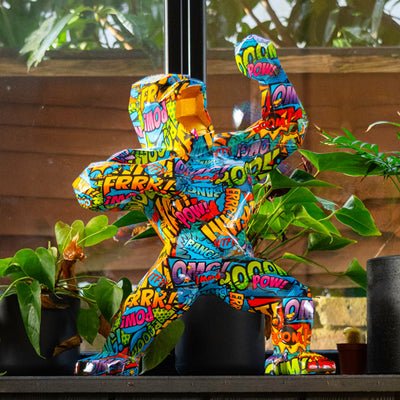
Candy lacquer: deep translucent color over a metallic base. It will set the palette for everything within ten feet (about 3 m) of it.
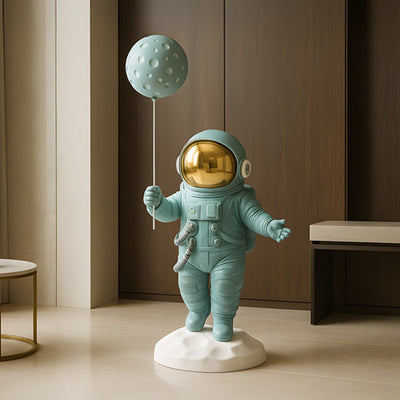
Flat matte: reads as form first. The finish that lets an alien be seen as sculpture rather than merchandise.
Satin or low sheen: the safest all-rounder for daylight-heavy rooms and high-traffic commercial spaces.
Care reality: polished surfaces need weekly attention; matte and satin need far less, but repair work is harder to blend.
Mirror Chrome: The Room Becomes Part of the Sculpture
Chrome is the finish most people picture when they search for a pop art alien, and it is the one that punishes a bad room. A mirror surface doubles whatever surrounds it. Put a polished figure in an atrium with a clean glass ceiling and it collects sky. Put the same figure in a hallway with a sprinkler head and a return-air grille above it, and those become permanent features of the artwork.
A polished pop art alien collects whatever sits above it, so photograph the ceiling first.
On large-scale pop art aliens we usually recommend mirror-polished stainless steel rather than a plated composite when the piece will live outdoors or in a public venue. Stainless holds its reflection, takes knocks better, and can be re-polished decades later. The British Stainless Steel Association's guidance on cleaning exterior stainless is worth reading before you commit: mirror grades reward regular gentle washing and punish abrasive shortcuts.

Candy Lacquer Sets the Palette for Everything Near It
Candy is a translucent color coat sprayed over a metallic or chrome base, then cleared. It has depth that flat paint cannot fake, and it shifts as you walk past. It is also the loudest thing a pop art alien can wear. A candy magenta figure will tint the wall behind it under warm lighting and it will quarrel with any strong accent color in the same sightline. We had a client in Napa who bought a candy-finished piece for a gallery landing, then repainted the landing twice before admitting the sculpture had already chosen the scheme.
If you want that automotive depth on a bigger figure, ask for the color to be sampled on a curved test panel rather than a flat card. Candy behaves differently over a compound curve, which is exactly what an alien head is. Broad, rounded volumes are the friendliest host for a saturated coat: on a form like the Space Alien Labubu Sculpture, 160cm (roughly 5 ft 3 in) the color has somewhere to pool and lift, where a busy, heavily detailed figure would break it into fragments.
Flat Matte Is How a Pop Art Alien Reads as Sculpture
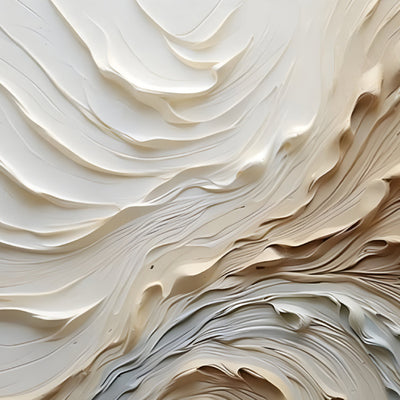
Kill the shine and you get form. Matte removes specular highlights, so the eye follows the silhouette, the shoulder line, the tilt of the skull. This is the finish collectors reach for when they want a pop art alien to sit near serious work without looking like a licensed toy scaled up. Museum interpretation of Pop has always leaned on this tension between mass-produced imagery and considered object-making; the MoMA overview of Pop Art is a useful primer if you want the lineage behind the joke.
Low-angle light and a matte coat let a pop art alien read as form rather than product.
Matte does have a cost. Fingerprint oils sit on the surface rather than wiping away, and a scuff cannot be buffed out; it has to be recoated and blended. On darker matte colors, plan for a professional touch-up every few years in a busy venue.
The Gloss Threshold Where a Collectable Becomes a Gag
There is a point on the sheen scale where a figure stops being funny and starts being a punchline. In our experience it sits somewhere above satin and below full show-car gloss, and it moves depending on subject. A creature with a menacing silhouette can carry high gloss, because the shine reads as armor. A cute, wide-eyed character at high gloss reads as vending machine plastic, whatever it cost you.
Scale changes the threshold too. At desk scale a wet, glossy pop art alien still reads as a collectable, which is why something like the Ocean Blue Alien Beats Figure, 55cm (about 22 in) can take a higher sheen without tipping into novelty. Push the same finish up to 5 ft and it starts to shout. Buyers hunting for a pop art alien sculpture with that glamorous, hyper-finished look should aim for candy over satin clear rather than maximum gloss; you keep the depth and lose the toy read.

Spotlights Versus Daylight
A hard narrow beam is chrome's enemy and matte's best friend. Point a tight spot at a mirror figure and you get a blinding hotspot plus a bright bounce on the nearest wall. Chrome pop art aliens prefer broad, indirect light: a wash from a cove, a skylight, an overcast north-facing window. Matte wants the opposite. Give it directional light at a low angle and the modeling comes alive; give it flat daylight and it can look dusty and inert.
Candy lacquer needs warm, even light to show its depth, and it dulls fast under cool white LEDs. If the sculpture is going into a fixed lighting scheme you cannot change, choose the finish around the lighting rather than the other way around.
Fingerprints and the Honest Weekly Cost of a Polished Figure
Nobody warns you about swirl marks. Wipe a mirror surface with a dry cloth and you drag dust across it, leaving fine circular scratches that show under every downlight. Our finishers use two-bucket wet cleaning and fresh microfiber, and they work in straight passes, not circles.
Weekly for chrome in public spaces: rinse or damp-wipe with clean water and a pH-neutral cleaner, dry immediately with a fresh cloth.
Monthly for candy and gloss: automotive-grade detail spray, no solvents, no household glass cleaner near the clear coat.
Quarterly for matte: soft brush for dust in recesses, damp cloth on marks, never a polish or wax.
Annually for outdoor pieces: check fixings, inspect the base for standing water, look for chalking on the clear coat.
Every few years: professional re-polish or recoat, budgeted in advance rather than as an emergency.
Atriums, Bar Backs and Gallery Landings Disagree
These three settings pull in different directions, which is why one pop art alien finish rarely suits a whole portfolio. An atrium has height, daylight and distance viewing, so chrome earns its keep; visitors see it from three floors and never touch it. A bar back is the opposite: close range, warm spirits lighting, hands everywhere. Satin or matte survives there. We shipped a piece to a Texas hospitality group who insisted on mirror behind the bar, then asked us six weeks later about a matte respray after the glassware polish cloths had done their work.
Gallery landings sit in the middle. They want a finish that holds its own against the art on the walls without stealing the light, which usually means matte or a restrained satin. Where the landing needs presence rather than glare, a strong-silhouette figure such as the Monsterverse Alien Kaiju Labubu Sculpture, 160cm holds the space better than a mirror-finished piece competing with the framed work around it, because the surface stays quiet and the outline does the talking.

Before You Commission, Check These
Photograph the ceiling above the intended spot. If you dislike the photo, do not buy chrome.
Confirm the color temperature of the existing lighting before choosing candy.
Ask who will clean it, how often, and with what. Write it into the handover.
Check floor loading and access routes for anything over 5 ft (1.5 m).
Request a curved sample panel, not a flat swatch.
Decide on indoor or outdoor placement first; it changes the substrate, not just the coating.
Giant Sculptures builds large-scale and bespoke work in mirror-polished stainless, coated metal and engineered composites, and we can take an existing pop art alien into a custom color or sheen for a specific room. Our recommended pieces and bestsellers are a useful way to see how different finishes behave at scale before you talk to us about a commission quote. Cost depends on material, size, complexity, engineering, finishing and installation, so we price each project individually rather than from a list.
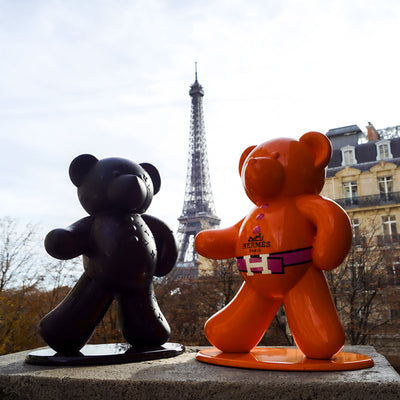
For wider placement ideas, Everyone Touches the Bear: How to Buy a Pop Art Bear Statue That Stays Sharp is useful companion reading before finalising the setting and sightlines.