





















































Pick the wrong material for a pose and you will spend years looking at a support strut or a steel pin that was never part of the idea. Most buyers frame the bronze vs marble sculpture decision as a matter of taste: warm metal against cool white stone. In practice, gravity and the floor underneath decide it. Here is how we talk clients through the choice at Giant Sculptures before a single mold is made or a block is quarried.

Bronze vs Marble Sculpture at a Glance
Extended limbs and open gestures: bronze, almost every time.
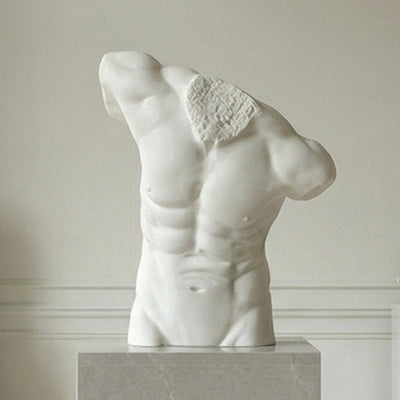
Compact, closed, tactile forms: marble rewards them with depth and glow.
Weight: a hollow-cast bronze is far lighter than a solid marble figure of the same size, so marble may need a structural check.
Outdoors in cold climates: bronze tolerates frost and sun with little fuss. Marble needs more care and a considered site.
Production: marble is carved from one block, so each piece is unique. Bronze is cast from a mold that can support editions.
The Outstretched Arm Test: Bronze Reaches, Marble Needs a Strut
Hold your arm straight out for a minute. Now imagine it is solid stone. Marble is strong in compression but weak in tension, so a horizontal limb carved from it wants to crack at the shoulder. That is why so many classical marbles carry a tree stump beside a leg, a drape falling to the base, or a small bridge of stone between wrist and hip. Many of those figures are Roman marble copies of Greek bronzes, and the carvers had to add supports the originals never needed. In any bronze vs marble sculpture comparison, this is the first test we apply.
Bronze has the tensile strength to carry a gesture into open air. Lost-wax casting produces a hollow shell, which keeps the weight down while the metal does the structural work (the Metropolitan Museum gives a clear account of how ancient Greek foundries developed the technique). When a pose depends on an arm held well clear of the body, as with the raised scales of the Large Classical Lady Justice Bronze Statue - 120cm, cast bronze can carry the gesture with no visible prop. In marble, that same gesture would need a hidden steel armature or a rethink of the pose.

Why a Compact, Closed Pose Is Where Marble Outshines Bronze
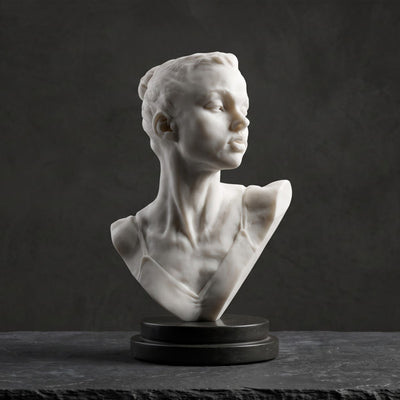
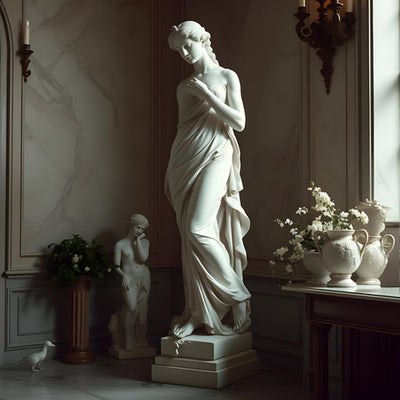
Flip the pose and the argument flips too. A crouching figure, a reclining nude, an embracing pair, a portrait bust: forms that fold in on themselves keep their mass over the base, and marble loves that. Fine statuary marble lets light travel a short way into the surface before it scatters, which softens skin and gives cheeks and shoulders a faint glow that bronze cannot fake. Antonio Canova's Psyche Revived by Cupid's Kiss in the Louvre works because the lovers' arms loop back into each other and most of the stone's mass stays close to the base.
That subject also translates well to metal. Where the embrace has to survive weather rather than sit under gallery light, a cast version such as the Large Classical Cupid and Psyche Bronze Sculpture - 120cm keeps the interlocking arms but trades glow for crisp shadow and outdoor resilience. If the piece will live under a skylight in a Napa tasting room, marble is worth serious thought. If it will face an Aspen winter, bronze earns its place.
Floor Loads: A Marble Figure Can Need a Structural Check That Bronze Rarely Does
Solid marble weighs roughly 170 pounds per cubic foot (about 2,700 kg per cubic meter). A life-size figure plus its base can outweigh a grand piano, and all of that load lands on a small footprint. A hollow bronze of similar height weighs a fraction of that, though its plinth still needs a sound footing.
Raise this early. In apartment buildings, particularly co-ops, the building's engineer may ask for point-load figures before the board approves delivery, and that review can add weeks. For any marble interior piece, we suggest clients bring in a structural engineer at the concept stage, check the route in (elevators, stair turns, door widths), and confirm whether the finished floor sits on a slab or on joists. Rooftop terraces and upper-floor galleries deserve the same scrutiny.

Open-Armed Bronze Under Open Sky, Translucent Marble in a Lit Interior
Setting should settle most bronze vs marble sculpture decisions that the pose leaves open. Outdoors, a dark or verdigris patina reads clearly against sky and planting from across a lawn, and open gestures cast moving shadows through the day. Look across our bronze garden statues and you will notice how many poses reach outward. That is the material doing what it does best in a Hamptons garden or at a Texas ranch entrance.
Indoors, marble wants directed light. A low, raking lamp across a carved surface shows every chisel decision, while flat overhead lighting makes the same figure look chalky. Mixed-material pieces split the difference neatly. For a formal hallway or a sheltered loggia, a bronze animal set on polished stone, such as the Bronze Lion on a Cream Marble Plinth - 120cm, puts metal where detail and durability matter and stone where mass and polish help.
Frost, Sun and Repair: A Chipped Marble Nose Against a Scuffed Bronze Patina
Marble is calcium carbonate, so acidic rain slowly etches polished surfaces, and water that finds a fissure can freeze, expand and open it further. In regions with repeated freeze-thaw cycles, outdoor marble usually needs winter covers or a sheltered spot. Bronze shrugs off frost and UV. Its patina keeps developing, and a periodic wash and wax keeps it even.
Repair is where the bronze vs marble sculpture gap shows most clearly. A scuffed bronze patina can be re-patinated locally by a conservator and, done well, becomes hard to spot as the surface weathers. A chipped marble nose or finger is harder: lost stone cannot be regrown, so repairs rely on adhesive, pinning or a carved insert, and a careful eye will often still find the join. For sites with foot traffic, pets or event crowds, that difference matters.

One Block or an Edition: How the Material Shapes the Commission Timeline
This is the least discussed part of the bronze vs marble sculpture question. A marble commission starts with finding the right block, free of veins or flaws where the face and hands will fall. Carving is subtractive; a mistake cannot be added back, so the pace is deliberate. Bronze starts with a clay or digital model, then moves through mold, wax, ceramic shell and pour, followed by chasing and patination. The mold becomes the asset. Once it exists, a matching pair for twin gateposts or a second piece for another property is straightforward, which is why hotel groups and developers often lean toward bronze.
A Buyer's Checklist for the Bronze vs Marble Sculpture Decision
Pose: any limb reaching away from the body without support points to bronze.
Location: outdoors in a frost zone favors bronze. A controlled, well-lit interior can favor marble.
Structure: for marble, confirm floor capacity and the delivery route before approving a design.
Handling: high-traffic and hospitality spaces suit bronze's tolerance for knocks.
Repeatability: need a pair or an edition? A bronze mold makes that practical.
Budget: cost depends on material, scale, complexity, engineering, installation and finishing, so ask for a tailored quote on both options before deciding.
Still torn? Send us site photos and the pose you have in mind, and our team at Giant Sculptures will tell you honestly which material the design wants. In the meantime, explore our full range of bronze sculptures and bronze figures and statues.
For wider placement ideas, Your Classical Marble Bust Sculpture Deserves a Better Plinth is useful companion reading before finalizing the setting and sightlines.