






























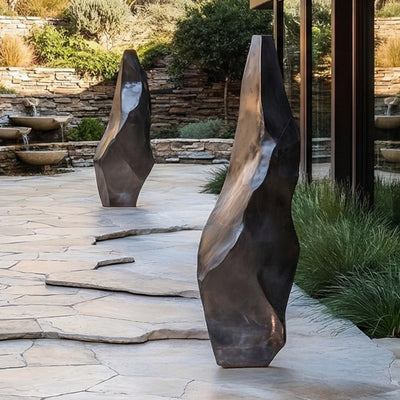
























































Twenty winters will tell you what a product photo never can. A piece that looks superb on delivery day can be chalky, streaked or quietly cracking by its third hard freeze, and the cause is rarely poor craftsmanship. It is a mismatch between material and site. Choosing the best materials for outdoor sculptures starts with an honest read of your weather, your ground and how much upkeep you will genuinely do, not with the form you fell in love with.

Key Takeaways
Here is the short version on the best materials for outdoor sculptures, ranked for durability and weather resistance, plus the upkeep nobody warns you about before we get into the detail.
Bronze is the safest long-term bet almost anywhere, provided someone re-waxes it.
Marble and limestone are calcite-based and vulnerable to freeze-thaw; horizontal surfaces fail first.
Granite is effectively permanent but can read flat under persistent overcast light unless the form is bold.
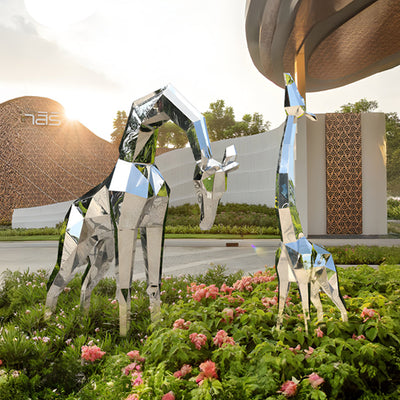
316 stainless beats Corten within a mile of salt water; inland, Corten is superb value for weight and scale.
Fiberglass and resin have a real UV clock, not an indefinite one.
Cast stone and concrete improve as they weather, which is why designers keep coming back to them.
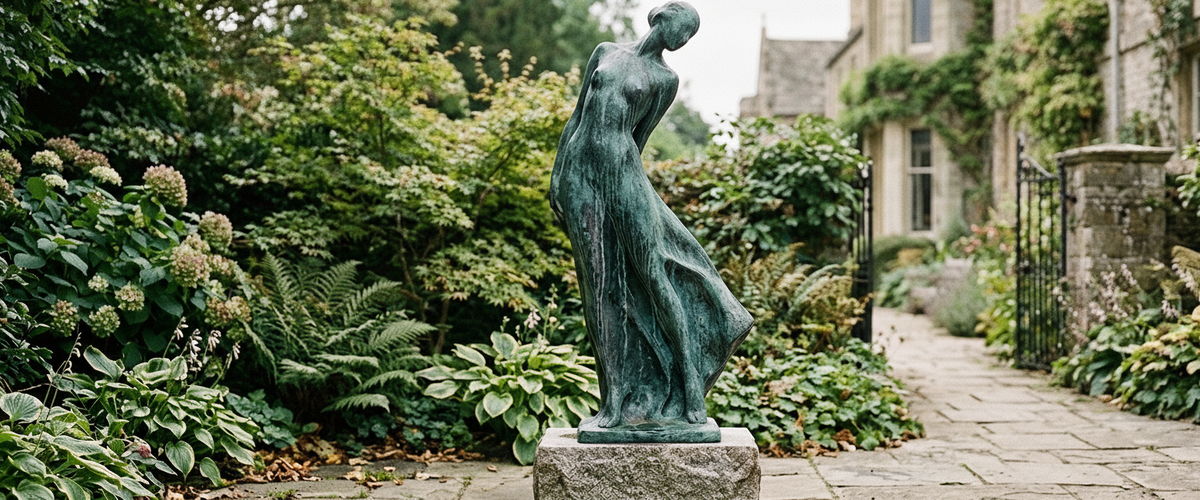
Twenty years of weather on a waxed bronze surface: character, not decay.
Bronze at Year Twenty: What the Patina Is Really Protecting
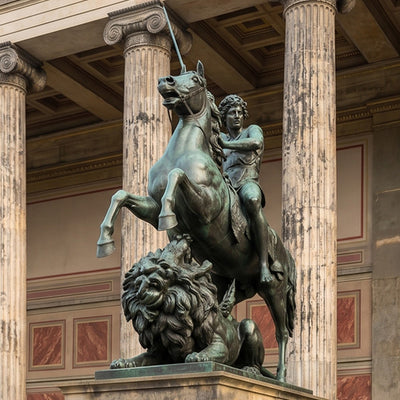
Bronze earns its standing among the best materials for outdoor sculptures because patina is a sacrificial skin. The copper salts that form on the surface slow further attack, which is why a well-cast piece can sit outside for a century and gain nothing worse than character. What people miss is that the applied patina is held in place by wax, and wax is the part that expires. On an exposed lawn in Texas or a coastal deck in Rhode Island, plan on re-waxing annually. In a sheltered courtyard, every two or three years is usually enough.
At year twenty you are looking for three things: green streaking below drip lines, black crusting where rain never rinses, and polished bright spots where hands have found the piece. Form dictates where those problems start. A tall figurative group such as Large Contemporary Dancing Figures Bronze Sculpture, 220cm (about 7 ft 3 in) traps rain in the elbow and shoulder hollows, so those hollows are the first places a maintenance crew should check, ahead of the plinth or the feet. The Smithsonian Museum Conservation Institute's guidance on caring for outdoor bronze is a sensible baseline before you hand the job over. If longevity is the deciding factor rather than subject, the bronze garden statues range is the practical place to keep researching.

Marble and Limestone in Freeze-Thaw
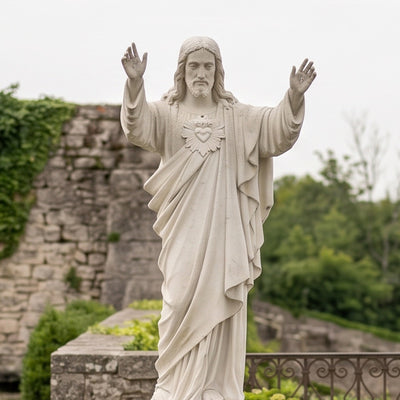
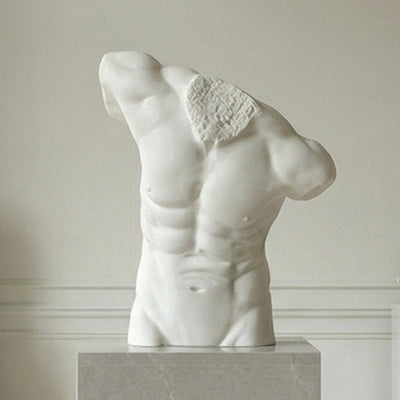
Marble is calcite. It dissolves slowly in acidic rain and it soaks up water into its grain structure. Freeze that water and it expands, and the stone sheds a flake. Spalling almost always begins on horizontal or near-horizontal surfaces: the top of a plinth, an outstretched forearm, the flat of a wing, a drapery fold that holds a teaspoon of water. Vertical faces shed rain and last far longer.
That does not strike marble off the list of best materials for outdoor sculptures. It rules out careless siting. Detail-heavy carving like Weeping Angel and Cross Antiqued Marble Memorial, 200cm (about 6 ft 7 in) will hold its modeling for generations in coastal California or the Carolinas, while the same piece in Aspen or upstate New York needs a winter cover, a well-drained base and an agreed maintenance routine before it ever leaves the workshop. Sandstone and limestone behave similarly: porous, warm in color, happiest where the thermometer rarely swings across freezing.
Granite: Effectively Permanent, Occasionally a Little Inert
Rank the best materials for outdoor sculptures on weather resistance alone and granite wins outright. Near-zero porosity, high compressive strength, no meaningful reaction to acid rain. The trade-off is optical. Under long stretches of flat gray light, a mid-tone granite can lose its modeling and read as a silhouette rather than a sculpture. It is a real issue in the Pacific Northwest and coastal New England, less so in high-sun states.
The fix is form. Pieces with strong, deep-cut geometry carry themselves under dull skies, which is exactly why guardian figures work so well in the material. Where the light is flat for months at a time, an emphatically carved subject such as Chinese Guardian Lion Grey Granite Statue, 180cm (about 5 ft 11 in) still reads at dusk, whereas a softly modeled figure in the same stone would flatten out. Site granite where you want zero maintenance and a piece that will outlive the house.

Stainless Versus Corten, Coast and Inland
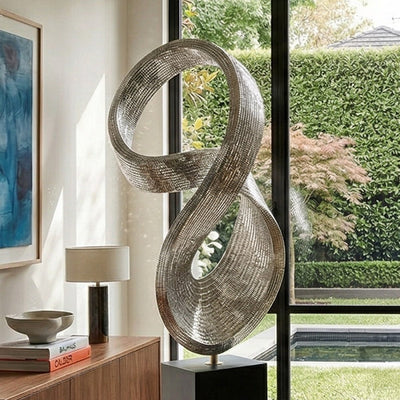
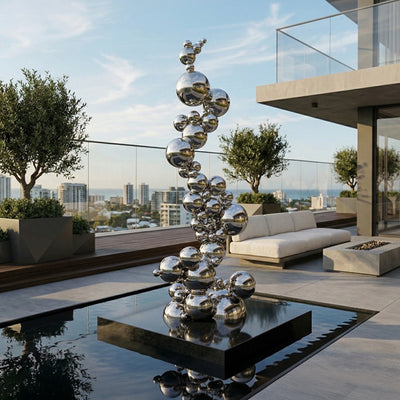
Within a mile of salt water, this is not a close contest. Chlorides pit standard 304 stainless and cause the orange speckling installers call tea-staining. Specify 316 marine grade, mirror or satin, and budget for freshwater rinsing. Corten in the same spot never stabilizes: weathering steel relies on wet-dry cycling to form its protective oxide, and constant salt-laden damp keeps stripping it, so the piece loses section year after year. The US General Services Administration's historic preservation technical resources are blunt about weathering steel in marine exposure.
Corten rewards dry inland air; 316 stainless is the coastal specification.
Move fifteen miles inland and the picture flips. Corten becomes one of the best materials for outdoor sculptures at scale: strong, relatively light for its footprint, and it settles into a color that sits beautifully against prairie planting or Napa vine rows. Watch the run-off. Fresh Corten bleeds rust onto limestone paving for the first couple of years, sometimes longer, so set it on gravel, steel edging or a sacrificial band.
Fiberglass and Resin: The Honest UV Number
Composites rarely top a ranking of the best materials for outdoor sculptures, but they have a place: rooftop terraces with weight limits, touring installations, interior atria. Outside in strong UV, gelcoat chalks and colors shift. Arizona, West Texas and Florida sun will show it faster than a Seattle courtyard. Expect to refinish rather than restore, and plan for that cycle from day one. We steer clients away from resin for permanent exterior commissions unless load limits genuinely force the decision.
Cast Stone and Concrete, the Sleeper Choice
Cast stone and glass-fiber reinforced concrete get better as they stain. Algae in the shadows, a slight darkening in the wet, lichen on the north face: that is the material doing its job. Freeze-thaw performance depends entirely on the mix, so ask about air entrainment and aggregate before you compare quotes. Done well, the durability is genuine: the material takes crisp mold detail and it works hard at scale.
Read Your Own Site Before You Choose the Best Materials for Outdoor Sculptures
For wider placement ideas, Bird Statues for Garden Spaces: Why Height Beats Size Every Time is useful companion reading before finalizing the setting and sightlines.
Walk the ground at 7am in February. Cold air pools at the bottom of slopes and in walled corners, and those frost pockets sit several degrees colder than the rest of the garden. Under tree canopy you get tannin drip, bird activity and permanent damp, which is hard on porous stone and hard on wax. Near a path, hand oils will polish a bronze knee to gold within a season, and some owners love that.
Irrigation catches most people out. One client's new sprinkler zone clipped the base of a marble piece twice a day, and within eighteen months the hard water had left a white mineral collar around the plinth. Check overspray arcs, check where de-icing salt gets shoveled, and check where snow piles.

Pre-Purchase Checklist
How many freeze-thaw cycles per year does the site see?
Distance to salt water or a salted road?
Who will re-wax, rinse or cover, and how often?
Is the base drained, or will the piece stand in a puddle?
Does the form have water-holding horizontal surfaces?
Will the piece be touched, climbed on or leaned against?
Is access adequate for craning and future conservation?
Commissioning to Suit the Climate
On bespoke work, material choice changes the engineering underneath. Internal armatures, drainage weep holes, dowel and anchor specification, plinth design and foundation depth all shift with the material you pick. Budget follows the same logic: scale, complexity, metalwork engineering, finishing and installation, not one headline figure. Ask us for a quote against your actual site conditions. Giant Sculptures builds large-scale bespoke work for gardens, estates and commercial venues worldwide, and we would rather argue with you about durability and weather resistance at the drawing stage than at year five. Start with the range in outdoor sculptures and statues and tell us where the piece is going.