






































































































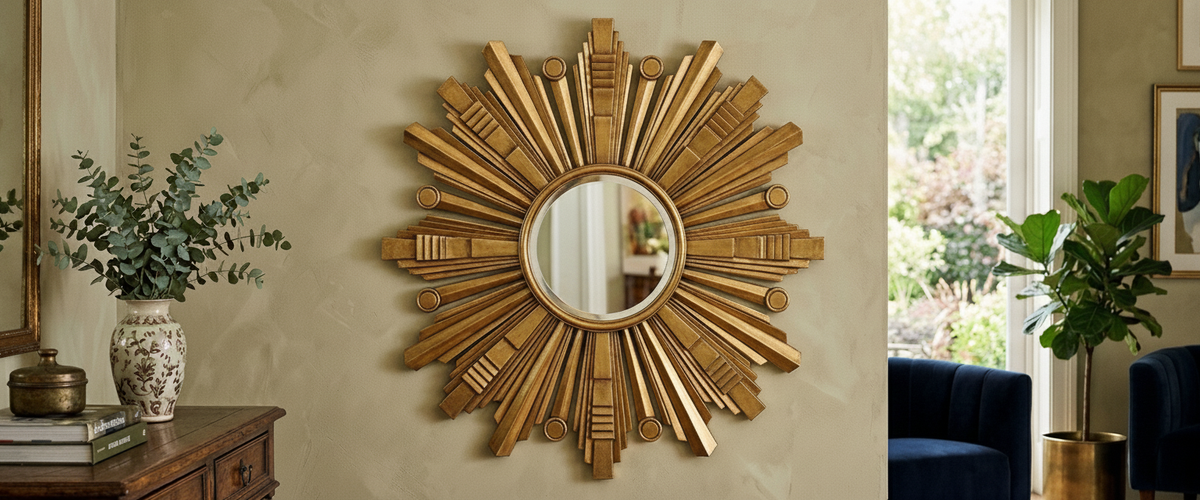

Most people buy an art deco mirror for the frame, then hang it where it does the least good: above a sofa, facing a blank hallway, or staring straight back at the pile of mail by the door. The frame gets the compliments, but the glass does the real work. A Deco mirror controls light, and its geometry decides whether a room feels brighter, deeper, or quietly theatrical after dark.

At a Glance
Shape sets the spread: sunburst frames scatter light, ziggurats stack it, and fans push it upward.
Placement beats size: opposite a window is almost always right. Opposite clutter is always wrong.
Tinted glass is a deliberate choice: smoked glass or antiqued silvering lowers glare and adds mood.
Beveled edges pay off at night under lamps and candles.
Edit the reflection: put a sculpture in it so the room reads as current, not costume.
Sunburst, Ziggurat or Fan: How Each Art Deco Mirror Throws Light
The three classic silhouettes come from the same design vocabulary of the 1920s and 1930s, which the Victoria and Albert Museum traces back to the 1925 Paris exhibition. On a wall, though, each art deco mirror behaves very differently, and the differences matter more than the shared pedigree.
A sunburst has a small central glass and a wide radiating frame. Most of its impact comes from the rays, so it suits a wall with good side light raking across the metal. It reflects less of the room than its overall size suggests. If you want that radiating effect without literal gilded rays, a round metal piece such as the Sculptura warm brown floral mirror works on the same principle, with the petals doing most of the talking and the glass playing a supporting role. A ziggurat, with stepped tiers, usually offers a taller pane and a cleaner vertical bounce, which is why it works in narrow entries and powder rooms. Fan mirrors, the half-circles you see over consoles, spread their reflection up through the arc, drawing the eye toward the ceiling and making a low room feel taller.
A sunburst frame catching side light from the window across the room.
Test any art deco mirror before you drill. Tape a cardboard template of the glass area (not the frame) to the wall and sit where you normally sit. If the cardboard covers nothing you want to see doubled, move it.
Hang It Opposite a Window, Never Opposite the Clutter
For wider placement ideas, 3d Kitchen Wall Art That Survives Grease and Steam is useful companion reading before finalizing the setting and sightlines.
An art deco mirror opposite a window doubles your daylight and borrows the view. A mirror opposite open kitchen shelving doubles the dish rack. That is the whole rule, and people break it constantly. A typical case: a large sunburst hung directly across from a radiator cover stacked with paperbacks. The frame is beautiful and the room still feels cramped. Moving the mirror to the adjacent wall, where it catches the window, changes the room more than any furniture swap could.
Watch for direct sun as well. A mirror catching low western light can bounce glare straight into the seating in the late afternoon. Tilt it slightly, shift it along the wall, or choose tinted glass.

Smoked Glass and Antiqued Silvering Dim the Bounce
Clear silvered glass sends back most of the light that hits it. Smoked bronze or gray glass, and deliberately antiqued silvering, cut that bounce down. Sometimes that is exactly what you want. In a dark-painted study or a dining room lit for evening, a bright mirror can look like a hole punched in the wall. A dimmer art mirror settles into the paint and reads as a surface rather than a window.
Where a dark room needs reflection without the glare of a clear pane, a piece like the Rivarenne black textured steel mirror suits the brief: dark worked steel surrounds the reflective elements, so the wall glows instead of glaring. Antiqued finishes also hide fingerprints and haze that a clear pane shows instantly, which matters in hallways where people touch the wall on the way past.
Why Beveled Edges Earn Their Keep at Night
A flat mirror goes passive after sunset. A beveled edge, ground at an angle around the perimeter, acts like a thin prism and splits lamplight into fine bright lines. Many art deco mirror designs multiply the effect with segmented panels, each with its own bevel, so one table lamp produces dozens of small highlights. In our studio we look at mirrored pieces under a single warm lamp in a darkened room, because that is how most owners actually see them: in the evening, with a drink in hand, not at noon. If a piece only works in daylight, it is half finished.
Segmented, beveled panels turn a single table lamp into dozens of highlights.
When Mirrored Wall Art Becomes the Artwork
At some point mirror wall art stops being about reflection. Layered and colored pieces break the room into shards and tints, so you stop seeing the sofa and start seeing composition.
This kind of mirrored wall art changes the placement rules. Because it no longer works as a functional mirror, it can face a less-than-perfect view, hang above a bed, or brighten a stairwell where a clear pane would only show more stairs. For those spots, a layered arch such as the Arcaluna blue and blush arch mirror makes more sense than traditional framed glass: the arch nods to Deco doorways, while the stacked colored planes keep the reflection secondary to the shape. Treat it like a painting: light it, give it margin, and keep other framed pieces at a distance. Browse the mirror art collection with one question in mind. Do you want to see the room, or a picture made from it?

Put Sculpture in the Reflection, Not Another Period Piece
The fastest way to turn a Deco room into a film set is to match everything: lacquered console, chrome lamp, sunburst mirror, shagreen tray. Decide what the art deco mirror will reflect instead, and put something contemporary there. A bronze or stainless steel sculpture on the opposite plinth gives the mirror a second view of a three-dimensional form, so the room reads as collected rather than themed. Polished stainless picks up the mirror's crispness. Patinated bronze warms it.
Scale catches people out here. Anything you see in a mirror appears farther away than it really is, so a piece that looks generous on its plinth can shrink in the reflection. Size up, not down. This is where a bespoke commission from Giant Sculptures helps, because we can size a piece to the sight line through the glass as well as to the floor plan.
Art Deco Mirror Buyer's Checklist
Before you buy an art deco mirror or commission a mirrored piece, run through these points:
What sits opposite? Stand there and look before you commit.
Glass area versus frame area: sunbursts reflect less than their footprint suggests.
Clear, smoked, or antiqued glass, chosen for the room's evening light rather than its daytime light.
Beveled or segmented edges if the room gets most of its use after dark.
Fixings rated for the weight: heavy metal and glass frames belong on studs or masonry anchors, not drywall plugs. Forged frames from our iron art range need the same care.
Humidity and salt air: bathrooms and coastal homes from the Hamptons to Malibu call for sealed backs and corrosion-resistant metals.
Budget: it depends on material, scale, glass type, finishing and installation, so request a tailored quote for anything bespoke.
Get those right and the frame becomes a bonus. The real payoff is a room that holds light better than it did the day before you hung the mirror.