





































































































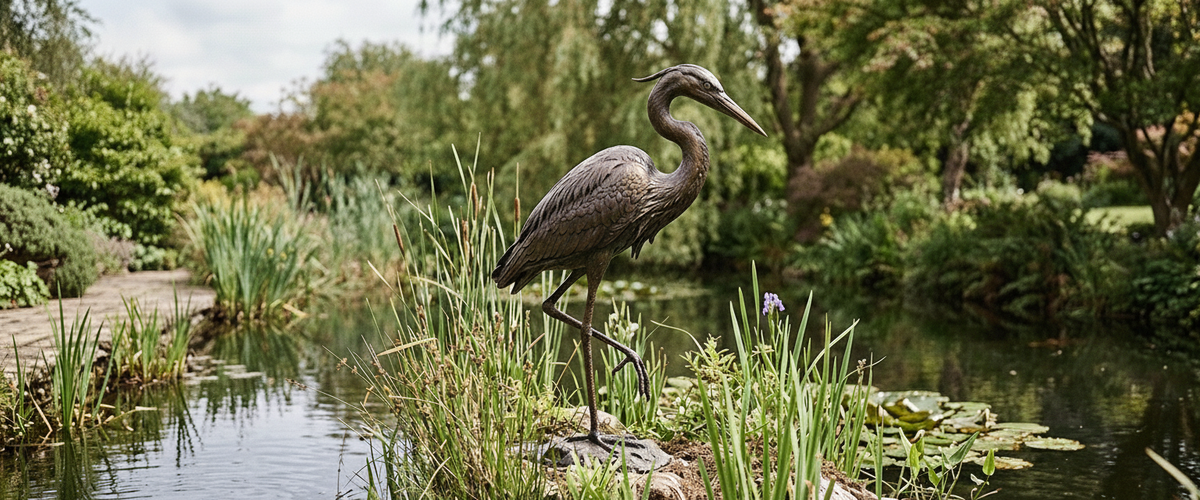

Most wildlife sculpture that looks wrong in a garden was cast perfectly well and then set down in the wrong place. A bronze heron marooned in the middle of a lawn reads as an ornament. Put the same bird at the reed line of a pond and it reads as a heron that happens to have stopped moving. Placement decides whether a wildlife sculpture comes alive or looks stranded, and it is the part of a commission our clients most often underestimate.

Quick Answer: Wildlife Sculpture Placement at a Glance
For wider placement ideas, Bedroom Wall Art That Works From the Pillow, Not the Doorway is useful companion reading before finalising the setting and sightlines.
Start with habitat. Water birds go at edges, predators on high ground, small mammals near cover.
Set plinth height from the animal's eye line, not yours.
Pick a backdrop that contrasts with the patina instead of swallowing it.
Indoors, a large animal needs walk-around space. If the room cannot give it, scale down or go to the wall.
Decide whether you want a portrait or a story, then choose between one figure and a group.
Habitat First: Why a Heron and a Lion Want Different Ground
Every animal carries an idea of where it should be standing. Great blue herons hunt by standing motionless in shallow water, so a heron sculpture belongs at the margin, feet near the waterline, ideally with some rushes breaking up the base. A lion is the opposite. It wants a rise to survey from, and a lion set on flat ground at the bottom of a garden looks oddly captive.
Smaller creatures follow the same logic. Foxes and hares look right tucked against a hedge base or at the edge of a meadow planting, which is where you would glimpse them in life. Garden-scale pieces like our bronze rabbit and fox statues work hardest when they are half-discovered, not centered on a terrace like a trophy.

Set Plinth Height to the Animal's Eye Line
The reflex is to lift a sculpture until it meets the viewer's gaze, roughly 5 feet (1.5 m). For wildlife this is usually a mistake. A fox raised to face height looks taxidermied. Set the animal so its eye sits where it would above the ground it is supposedly standing on: a hare at or near grade, a heron's head landing around 3 to 4 feet (about 1 to 1.2 m) on the strength of its own legs, with little or no plinth.
The exception is the animal that chooses a perch. A leopard or lion on a rough stone plinth that reads as an outcrop feels right, because the plinth becomes terrain. Keep that stone split-faced and matte. Polished granite under a big cat says museum, and the illusion collapses.
Bronze Wildlife Sculptures Against Hedge, Stone and Lawn
Patina is the detail buyers choose indoors under showroom light and then lose outdoors. With bronze wildlife sculptures, a deep brown patina disappears against clipped yew, and a green verdigris fights boxwood. Pale limestone walls, gravel and weathered paving give brown bronze a crisp edge.
Lawn is the tricky one. From a distance an animal on grass reads as silhouette, which suits a stag or a big cat, but only if something lighter sits behind it: sky, water, a pale wall. If a landscape designer is involved, hold patina samples against the actual hedge before the finish is fixed. It saves a lot of regret. For very contemporary settings, mirror-polished stainless steel or Corten can carry the same animal with a different mood: steel throws back the planting around it, while Corten's rust tones sit warmly against green.

African Wildlife Indoors: When a Rhino Earns the Hall
Life-size African wildlife sculptures can make an entrance hall unforgettable, or turn it into an obstacle course. A rhino earns the room when you can see it whole from the doorway and walk fully around it without turning sideways. It crowds the room when guests have to edge past its horn to reach the stairs.
Weight matters as much as footprint. A life-size bronze animal can weigh several hundred kilograms, and the largest run past a tonne, so bring in a structural engineer before you fall in love with the floor plan. If the hall is narrow, reduce the scale, set the animal in a recess, or move the idea to the wall. Where the brief is savanna mood rather than sculptural mass, a framed pairing such as Imperia Wildlife-Inspired Zebra & Leopard Dual Frame Wall Art brings the plains into the hall without claiming a single square foot of floor.
Herd or Lone Animal: Which Says More?
A group tells a story about movement and relationship. Three deer spaced across a Napa hillside suggest a herd drifting through, and odd numbers with uneven gaps read far more naturally than a neat row. Groups need room, though. Clustered tightly, they look like stock on a showroom floor.
A single figure is a portrait. One stag at the end of an allée in the Hamptons holds the view better than five would, because nothing competes with it. Ask yourself whether you want the eye to rest or to wander, and let that answer set the count.

When the Site Should Change the Species
The first animal a client asks for is not always the one the site wants. Picture a bronze bear requested for the edge of a tidal pond: long grass and open water leave a bear looking lost, while a pair of herons, one fishing, one alert, belongs there instantly. On wide, dry grassland with a huge horizon, a stag can shrink to a speck, and a taller silhouette such as a giraffe may be the only animal that still reads from the road.
The lesson is simple. Send us the site before you settle on the species. Giant Sculptures looks at ground, light, sightlines and backdrop first, then proposes the animal and scale that will actually hold the space.
A Buyer's Checklist for Placing a Wildlife Sculpture
Habitat match: would this animal plausibly stand here?
Viewing distance: is it seen close up, or from the house or drive?
Eye line: does the plinth follow the animal, not the viewer?
Backdrop contrast: will the patina read against what sits behind it?
Foundations and floor loading: confirmed by an engineer for heavy pieces.
Care: outdoor bronze benefits from periodic washing and waxing to protect the patina.
Budget: it depends on material, scale, complexity, engineering, installation and finishing, so request a tailored quote.
Our wildlife sculptures are a good place to compare scale and pose. When you are ready, start a bespoke commission with Giant Sculptures by sending a few photos of the spot you have in mind.