





































































































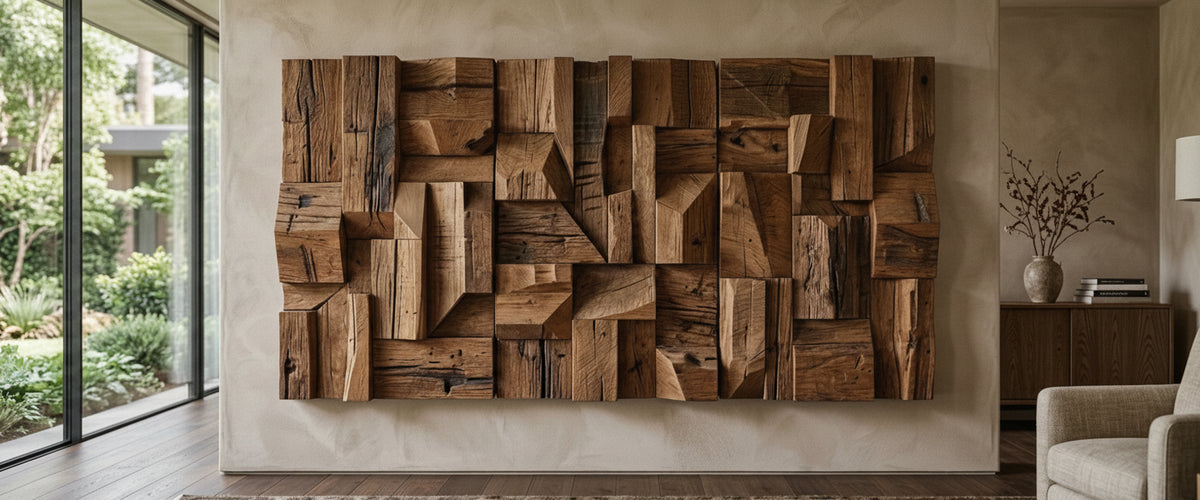

Reclaimed wood wall art fails for one boring reason more than any other: it gets hung too small, too high, and too close to a light source that flattens every mark in the grain. The piece is rarely the problem. The wall around it usually is. Get scale, sightline and light right and even a modest reclaimed wood wall art panel holds a room; get them wrong and a genuinely characterful carving looks like an afterthought bolted above a console.
Looking for the full range in this category? Browse our Wood Art collection for every available finish, size, and configuration.
We work with buyers, interior designers and landscape designers who commission large statement pieces, so most of what follows comes from placements we have actually shipped and, occasionally, from fixing ones that went sideways.

Reclaimed Wood Wall Art at a Glance
- Scale first: aim for a piece that fills roughly two-thirds of the wall or furniture line beneath it. Undersized is the most common regret.
- Height: center the visual mass around 57 to 60 inches (145 to 152 cm) from the floor, adjusted for seated versus standing sightlines.
- Indoors vs outdoors: true salvaged timber belongs in sheltered interiors; for exposed gardens, weather-stable metals like Corten or bronze relief read the same way and last.
- Light: raking side light shows grain and depth; flat frontal light erases it.
- Budget: depends on material, scale, carving complexity, mounting engineering and finishing, so ask for a tailored quote rather than assuming a fixed figure.

What Reclaimed Wood Wall Art Actually Looks Like in a Real Room
The reclaimed wood wall art phrase covers a wide range. At one end you have salvaged barn boards and beam offcuts, knots and nail holes left honest. At the other you have carved and layered panels where the timber is worked into deliberate three-dimensional form. Both count as wood wall art decor, but they behave very differently on a wall.
A flat plank arrangement leans rustic and reads best against pale plaster or a cool gray wall, where the warm tones carry. A carved, sculptural panel behaves more like relief sculpture; it needs room to cast shadow and a viewer standing far enough back to read the rhythm across the panels. Where the wall can take a multi-panel reclaimed wood wall art composition rather than a single board, a piece like the Harmonic Forms 4-Panel Brown Wood Carving becomes the focal element in a double-height living room or a loft, and everything else arranges around it.
Handmade wood wall art also brings variation that machine prints never will. No two salvaged boards weather identically, and a carver's tool marks are part of the surface. That is a selling point, not a flaw, but it means you should choose the specific piece for the specific wall rather than ordering by category and hoping.

Scale, Sightlines and Mounting Height
Most people hang reclaimed wood wall art too high. The instinct is to lift art toward the ceiling; the eye wants it lower. Center the visual mass, not the physical center of the frame, around 57 to 60 inches from the floor for a standing room. In a dining room or a lounge where people are mostly seated, drop that a few inches so the piece meets a seated sightline rather than floating above heads.
Scale is the other lever. A common mistake: a client falls for a 24-inch panel, then hangs it over an eight-foot (2.4 m) sideboard where it looks marooned. As a working rule, a single piece should span roughly two-thirds of the furniture line beneath it. If the wall is bare with no furniture anchor, treat the wall itself as the frame and size up. Wide empty walls swallow small work.
For heavy carved panels, mounting is an engineering question, not a picture-hook one. Weight, wall construction and the depth of the piece all change the fixing. We spec cleats and fixings for the actual weight and the actual wall, and for larger reclaimed wood wall art commissions we supply mounting guidance with the piece so your installer is not guessing.

Indoor Versus Outdoor: When Each Wins
Genuine salvaged timber is an interior material. Even sealed and treated, it moves with humidity swings and will check, cup or gray-off faster than clients expect once it faces frost, direct sun and sprinkler overspray. If your heart is set on a wood-look surface for a covered porch or a shaded courtyard, that can work; a fully exposed garden wall is a different proposition for reclaimed wood wall art.
For exposed outdoor walls we usually steer clients toward metal relief that gives the same graphic, tactile presence and takes the weather without complaint. Where an exterior wall needs a figurative subject that survives frost and sun, a bronze relief such as the Traditional Horse Head Bronze Relief - 80cm holds its form for decades, and bronze develops a patina many owners prefer to the day-one finish. The US National Park Service notes that bronze forms a stable protective patina over time, which is exactly what you want on an exterior wall (nps.gov conservation guidance). If you like the idea but want more options, our metal wall art collection covers the weather-stable end of the spectrum.
Indoors, timber wins on warmth. It softens hard architecture, absorbs a little sound, and pairs with stone and concrete in a way metal sometimes fights. A sheltered indoor wall is where salvaged reclaimed wood wall art earns its keep, and where the surface irregularities read as craft rather than damage.
Light, Backdrop and Contrast
Light decides whether carving reads as depth or mud. Raking light, coming across the surface from the side, throws the grain and the tool marks into relief and gives the piece dimension. A single directional fixture or a picture light angled from above and slightly off-axis does far more for a wood panel than a wash of even downlights.
Backdrop contrast is the second decision. Warm brown wood on a warm beige wall disappears; the tones blur together and the eye slides off. Put the same reclaimed wood wall art against a cool gray, a deep charcoal, or crisp white and the wood steps forward. If the wall is already busy with pattern, choose a simpler, larger piece so the two do not compete.
One studio observation: clients often photograph a piece in showroom light, love it, then install it under 4000K downlights at home and wonder why it looks flat. Ask what light the piece will actually live under before you commit, and light for the wood you own, not the wood in the catalog photo.
Common Placement Mistakes and How to Avoid Them
For wider placement ideas, Abstract Metal Wall Art: A Buyer's Guide to Scale, Finish and Placement is useful companion reading before finalising the setting and sightlines.
- Sizing to the sofa cushion, not the wall. Measure the whole wall and the furniture line, then size up if in doubt.
- Hanging by the ceiling. Anchor to the human sightline, around 57 to 60 inches to the visual center.
- Flat frontal lighting. Use a raking or angled source to bring out the relief in your reclaimed wood wall art.
- Matching wood to a warm wall. Give the piece tonal contrast so it separates from the background.
- Under-speccing the fixing. Heavy carved panels need cleats rated to the real weight and the real wall type.
- Forcing real timber outdoors. For exposed exteriors, choose weather-stable metal relief instead.
Commissioning a Piece That Fits the Wall
Off-the-shelf reclaimed wood wall art works when a piece and a wall happen to suit each other. Often they do not, especially at scale, which is where a bespoke commission earns its cost. Giant Sculptures makes large-scale, made-to-order work, so we can size a panel to your exact wall, tune the depth of the carving for the light you have, and match the finish to the rest of the room.
If you are weighing reclaimed wood wall art against metal or stone for a feature wall, browse the full wood wall art range first to calibrate scale and style, then talk to us about the wall itself: its dimensions, its light, its construction and whether it faces the weather. Those details, more than the reclaimed wood wall art you first fell for, decide what actually works.