





























































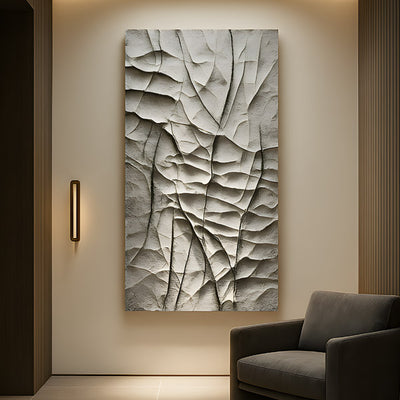
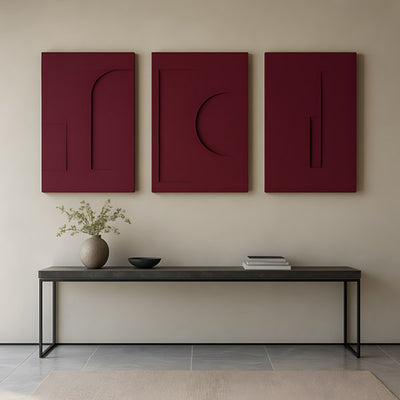

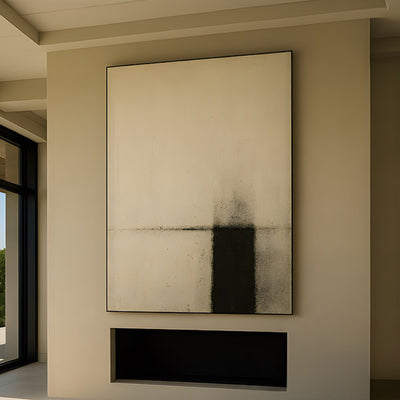



























Most outdoor wall art decor fails at four small holes. The panel itself is usually fine. The fixings, or the wall behind them, are not: a sleeve anchor blown out of soft handmade brick, a plated screw weeping a rust streak down cream render, a flat-mounted relief holding a permanent damp shadow against the masonry. We tend to see those photos six or eight months after installation, from a buyer who chose on looks and never asked what the wall was made of.
So start at the wall. Material, scale and finish for any piece of outdoor wall art decor follow from what you are drilling into.

Key Takeaways
Identify the substrate first. Soft red brick, sand-cement render over block, and rubble stone each hold outdoor wall art decor fixings in completely different ways.
Keep panels above the splash zone. The bottom 3 feet (1 m) of most walls is where failure starts.
Spacer-mount everything. A 3/4 inch (20 mm) air gap dries the wall face and stops rust bloom behind the panel.
Match anchor metal to panel metal. Stainless fixings on stainless and Corten work; zinc-plated screws stain within a season.
Size to viewing distance, not to the tape measure of the wall.
Budget depends on material, scale, engineering and install access. Ask for a tailored quote rather than guessing from a catalog thumbnail.
Read the Substrate Before You Choose the Panel
Soft red brick, especially anything hand-made or pre-1930, crushes under an expanding anchor. The fix is to drill the mortar bed rather than the face and use a resin-set stainless stud, which spreads load along the bond instead of splitting a single brick. Sand-cement render over dense block is the opposite problem: it feels solid, but the render skin can be as little as half an inch thick and will happily shear off in a dinner-plate-sized chunk if you hang weight from the skin alone. Every anchor has to reach the block behind it. The Brick Industry Association's technical notes on anchoring to masonry are worth ten minutes of reading before anyone lifts a hammer drill.
Rubble stone is the wildcard. Voids, lime mortar and irregular bed depths mean you cannot plan a fixing pattern from a drawing. On a Hudson Valley barn wall we worked on, the installer had to move two of four points by several inches on the day. That is exactly why we design outdoor wall art decor with adjustable or oversized mounting plates on commissioned work: the pattern needs to move to suit the stone, not the other way round.
Rain Shadow, Splash-Back and the First Three Feet
Walk your wall in heavy rain once before buying. You will see two things: the rain shadow under an eave or balcony, which stays dry and takes almost any finish, and the splash-back zone where water bounces off paving and hits the wall from below. That lower band, roughly the first 3 feet (1 m) above grade, is where paint blisters, where salt from de-icing works into render, and where cheap outdoor wall art decor rots from the underside first.
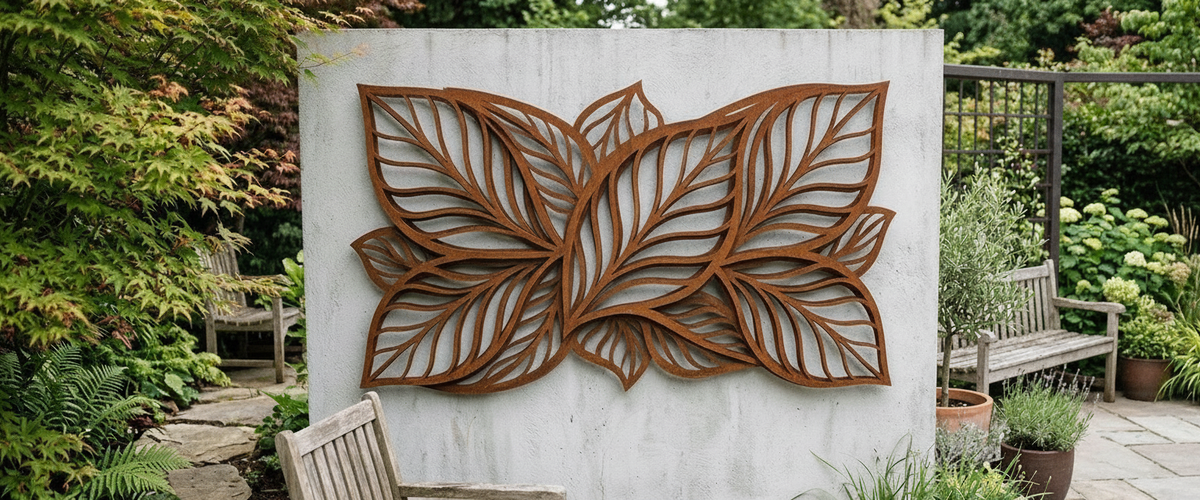
Placement rule we use constantly: put the base of a panel above splash height wherever the composition allows. If a piece has to sit low, specify solid metal or stone rather than a laminated or framed construction with an edge that can wick water. Sheltered courtyards and covered loggias give you far more freedom, and that is where lighter relief work belongs: a protected wall, close viewing, detail that rewards a few feet of distance. A finely worked floral panel such as Blossomkin Owl 3D Floral Wall Art holds up well under an overhang, but the same construction on an exposed gable would be the wrong call.
Panel base lifted clear of the splash-back band, with stainless standoffs holding it off the brick.

Why We Spacer-Mount Everything
A panel fixed flat to masonry traps a film of moisture that never dries. On steel, that reads as rust bloom around each fixing within a year. On render, it shows as a dark ghost outline of the panel that no amount of washing removes.
Our standard for outdoor wall art decor is a 3/4 inch (20 mm) spacer at every fixing point, using stainless standoffs. Air moves behind the work, the wall face dries after rain, and the panel gains a shadow line that makes it read as a sculptural object rather than a sticker. On larger commissions we push the gap further, sometimes 1 1/2 inches (40 mm), because a deeper shadow keeps big flat forms from looking pasted on when the sun is high.
Stainless, Not Zinc: Match the Anchor to the Panel
Mixed metals in a wet wall behave badly. Zinc-plated or galvanized screws against stainless or weathering steel corrode preferentially, and the first sign is a brown tear-drop below each screw head. Use A2 stainless as a minimum inland and A4 (316) stainless within a few miles of salt air, which covers most of the coastal projects we ship to in Florida, the Hamptons and Southern California. Nylon or stainless isolating washers between dissimilar metals cost pennies and save the wall.
The same logic applies to hanging hardware on lighter multi-panel groups. A paired set like Artelis 2-Set Fox & Panda Animal Framed Wall Art only reads correctly when its two elements sit level and evenly spaced, so mark from a laser line and fix both from a shared datum rather than eyeballing the second one.
Runoff, Pale Render and the Corten Drip Detail
Corten is the most requested finish in our outdoor wall art decor commissions and the one that causes the most regret when detailed carelessly. Weathering steel sheds fine rust particles for its first couple of years, and that runoff will stain pale render, limestone and concrete underneath it. Guidance from the American Institute of Steel Construction on weathering steel makes the same point about detailing for controlled drainage.
Two practical answers. First, a folded drip edge along the bottom of the panel so water leaves the metal at a defined point instead of tracking back across the face. Second, pre-weathering the panel in our studio before shipping, plus a gravel or planted strip at the base of the wall to catch what does fall. If the courtyard is finished in pale travertine, we usually steer clients toward stainless or patinated bronze instead and keep Corten for gravel, brick and dark stone settings.
Sizing Outdoor Wall Art Decor to Viewing Distance
Buyers size to the wall. They should size to the spot they actually stand in. A courtyard wall viewed from 10 feet (3 m) away across a dining table can carry fine detail and a piece around a third of the wall width; something on the scale and surface density of Blossomkin Elephant 3D Floral Wall Art rewards that close reading. A gable seen from 40 feet (12 m) down a lawn needs bold silhouette, deep relief and far more surface area than feels right on paper; anything under about 5 feet (1.5 m) wide simply disappears at that range, and fine floral detail vanishes with it.
Scale is set by where you stand, not by the width of the render behind the panel.
Test it before ordering. Cut the footprint from cardboard, tape it up, then walk to your real viewing positions: the kitchen window, the pool steps, the end of the drive. Nine times out of ten the mockup goes up a size. Browse the full outdoor wall art and decor range with those measurements in hand, and compare against the broader wall art and wall decor selection if part of the scheme is moving indoors.

What We Ask About Your Wall Before Quoting
Age and build: solid masonry, cavity wall, timber frame with render board, or freestanding garden wall?
Surface: lime render, sand-cement render, painted brick, stone, or block? Who applied the render and roughly when?
Thickness and backing: can we reach solid substrate behind any skin coat?
Exposure: prevailing wind, coastal salt, overhang, and whether the wall gets full afternoon sun.
Ground condition at the base: hard paving that splashes, or gravel and planting that absorbs.
Access: ladder, tower, or lift, and whether the piece has to pass through a house or side gate.
Viewing points: the two or three positions the piece will be seen from most.
Those answers shape the outdoor wall art decor specification more than any style preference. They decide panel thickness, fixing type, spacer depth, and whether we build in one section or several. For commissioned pieces our studio issues a fixing layout with the artwork so the installer is not improvising on site.
Giant Sculptures works on bespoke outdoor wall art decor as well as ready pieces, from single Corten reliefs to multi-panel stainless installations for hotels and wineries. Pricing follows material, scale, engineering, finishing and install complexity, so send photos of the wall and your viewing distances and we will quote against the real conditions. If you are still shaping the idea, the 3D wall art range is a useful place to test how much relief depth you want before committing to a commission.
For wider placement ideas, Black Metal Wall Art Lives or Dies on the Wall Behind It is useful companion reading before finalising the setting and sightlines.