





































































































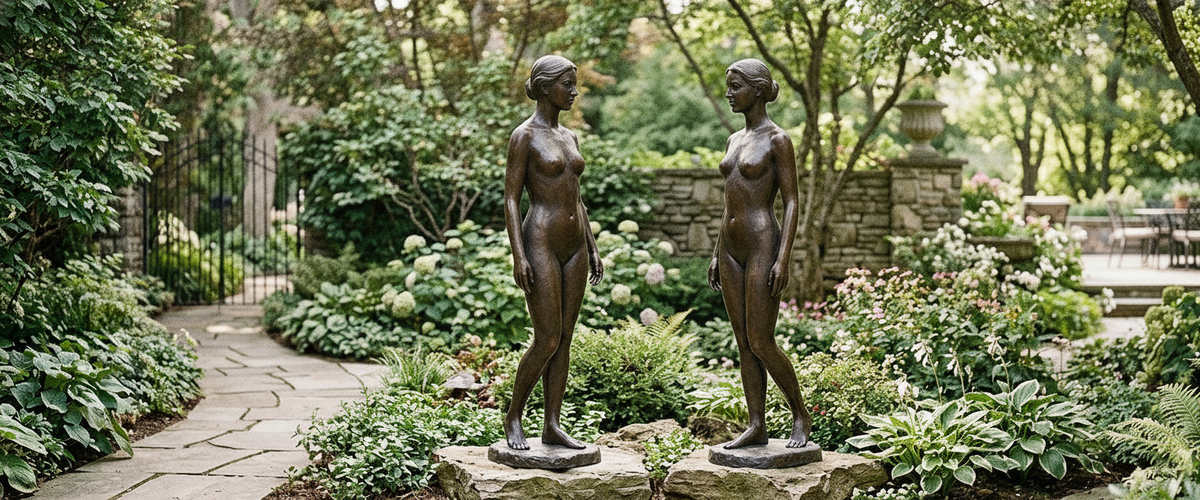

Stand two bronze figures twelve inches apart and everyone who walks past reads a conversation. Pull them nine feet apart and the same two casts read as a breakup. That is the quiet trap with life size figure sculptures: the casting decision is the easy part, and the spacing decision is the one that determines whether your piece lands or looms. We have re-set the anchor pins on more than one commission because the client fell in love with a pair in the studio and then sited them like bookends.
Looking for the full range in this category? Browse our Character Figurines & Collectible Figures collection for every available finish, size, and configuration.
A tight gap reads as conversation. The same pair, pushed apart, reads as distance.

Key Takeaways
A single figure functions as a portrait. Two figures function as a sentence, and sentences can misfire.
The gap between figures is the message. Roughly 12 inches (300 mm) reads intimate; 36 inches (900 mm) starts to read formal or estranged.
Two-figure groups resolve properly from only two viewpoints. Choose those viewpoints before you pour the foundation.
Plinth height sets the eye line, and the eye line decides who the sculpture is looking at when people enter.
Pairs need walk-around clearance that single figures do not, especially on a lawn.
Budgets for life size figure sculptures depend on material, scale, complexity, engineering, installation and finish, so ask for a tailored quote rather than working from a guess.
A Single Figure Is a Portrait, a Pair Is a Sentence
Single life size figure sculptures behave like a strong noun. They hold a spot, anchor a sightline, and ask very little of the space around them. Where the pose itself carries real torsion, one figure can hold a courtyard on its own, because the drama lives inside the body rather than in a relationship to something else. The Life-Size Contemporary Backbend Figure Bronze Sculpture - 200cm at 200 cm (about 6 ft 7 in) is exactly that kind of form.
Add a second figure and you have written a sentence with a subject, a verb and an implied object. Two bodies generate a story whether you intended one or not: pursuit, reunion, indifference, protection. Buyers who choose life size two figure sculptures for the visual weight alone often discover the narrative afterward, when a guest asks why the pair looks like they are arguing.

Negative Space Does the Storytelling
With life size figure sculptures, the air between two bodies is the most active material in the composition. Tight spacing, around 12 to 16 inches (300 to 400 mm), reads as intimacy or tension, depending on the poses. Push out to 30 or 36 inches (760 to 900 mm) and the pair reads as ceremonial, composed, slightly distant. Beyond roughly 6 feet (1.8 m), most viewers stop reading them as a group at all and start reading them as two separate works that happen to share a lawn.
When the relationship is fixed in the cast, as it is in the Life-Size Contemporary Emerging Figures Bronze Sculpture - 210cm at 210 cm (roughly 6 ft 11 in), the spacing question is already settled and the siting job reduces to orientation. Combining two separate studio casts is the harder route: mock the gap up first, with plywood cutouts at true height moved around the site over an afternoon. That will tell you more than any drawing.
Two-Figure Groups Only Resolve From Two Angles
Here is the thing nobody mentions at the point of sale. Paired life size figure sculptures have a front and a reading angle, and from most other positions one figure eclipses the other. Walk a circle around any two-figure group and you will find two viewpoints where the composition clicks: usually the axis where both faces are legible, and an oblique where the overlap creates depth.
Choose those two angles before you site the piece, then build the approach around them. On one courtyard project, we rotated the pair about 20 degrees off the obvious axis so the resolving view landed on the path guests actually used rather than the service door. Small rotation, completely different arrival.
Eye Lines and Plinth Height
Plinth height is how life size figure sculptures set their register. A figure at true human scale placed flat on the ground meets visitors as an equal. Lift it 18 inches (450 mm) and it acquires authority. Lift it 3 feet (900 mm) and it becomes a monument, which is the correct note for a commemorative subject such as the Life-Size Standing Gandhi Figure Bronze Statue - 180cm at 180 cm, and the wrong one for a contemporary domestic piece you want people to stand beside.
Set the base height from the gaze direction, not from a round number.
Track where the cast figure's gaze actually goes before you fix the plinth. A downcast gaze on a tall base sends the eye line into the floor three feet in front of the plinth, which is dead space. A level gaze on a low base can point straight at the reception desk, the dining table, or the neighbor's fence. Model the sight cone, not just the silhouette.

Clearance a Pair Needs That a Single Figure Does Not
Solitary life size figure sculptures tolerate being backed against a wall or hedge. Pairs do not, because half their meaning lives in the view through the gap. Plan for a full walk-around loop with enough distance that a visitor can step back and take in both figures at once, which usually means standing at least one and a half times the piece's height away.
Lobbies: excellent for single full-height figures on a low base. A pair needs a genuinely deep floor plate or it becomes an obstacle.
Stair landings: strong for one figure with an upward or outward gaze. Rarely right for two, since the second figure is seen only in passing.
Open lawn: the natural home for pairs. Mown sightlines from the house and terrace will do the framing for you.
Pool terraces and entry courts: watch reflected glare on polished bronze and any trip hazard around the base.
On open ground, even a 250 cm cast reads as approachable. Drop the same figure into a narrow side return between townhouses and it towers. Scale is relative to the space, always.
Commissioning a Pair Versus Pairing Two Existing Casts
Modeling a pair from life gives you control over every relationship: the gap, the turn of each head, the shared center of gravity, the base plate. It is the right route for memorials, portrait commissions and any installation where the two figures must clearly belong to each other. Expect a longer foundry schedule too, since larger forms are cast in sections, then welded, chased and patinated as a unit. The lost-wax process has barely changed in principle for millennia; the Metropolitan Museum of Art's account of bronze statuary technique in ancient Greece describes the same sequence of indirect molds, wax models and section casting we still use, and it still rewards patience.
Pairing two existing studio casts is faster and often smarter for decorative schemes. Match the patina family, the surface finish and the modeling language first; a smooth contemporary form standing next to a heavily textured traditional one will fight rather than converse. Browse the life size figure sculptures in our life size bronze statues and bronze figures and statues collections with that compatibility test in mind, and speak to us before you commit to two pieces from different series.

Siting Checklist Before You Buy Life Size Figure Sculptures
Mark the footprint on site and live with it for a week.
Mock up full height with plywood or pallets, then photograph from every approach.
Decide your two resolving viewpoints for any pair, then rotate to suit the approach path.
Set plinth height from the figure's gaze, not from a round number.
Confirm foundation, anchor bolts and drainage with an engineer for anything at full height.
Check crane or gantry access, gate widths, and soft ground conditions before delivery day.
Agree the patina and a maintenance rhythm: wash, dry, wax for exterior bronze.
Request a written quote covering casting, base, transport and installation.
Giant Sculptures makes and ships life size figure sculptures worldwide, both from studio casts and as bespoke commissions modeled to your brief. If you are weighing a single figure against a pair, send us the site photos and the arrival path. That one exchange usually settles it. Start with the life size and large statues collection to calibrate scale, then talk to us about the version that fits your space.
For wider placement ideas, Life Size Giraffe Statues and the Ceiling Void Nobody Measures is useful companion reading before finalizing the setting and sightlines.