
























































































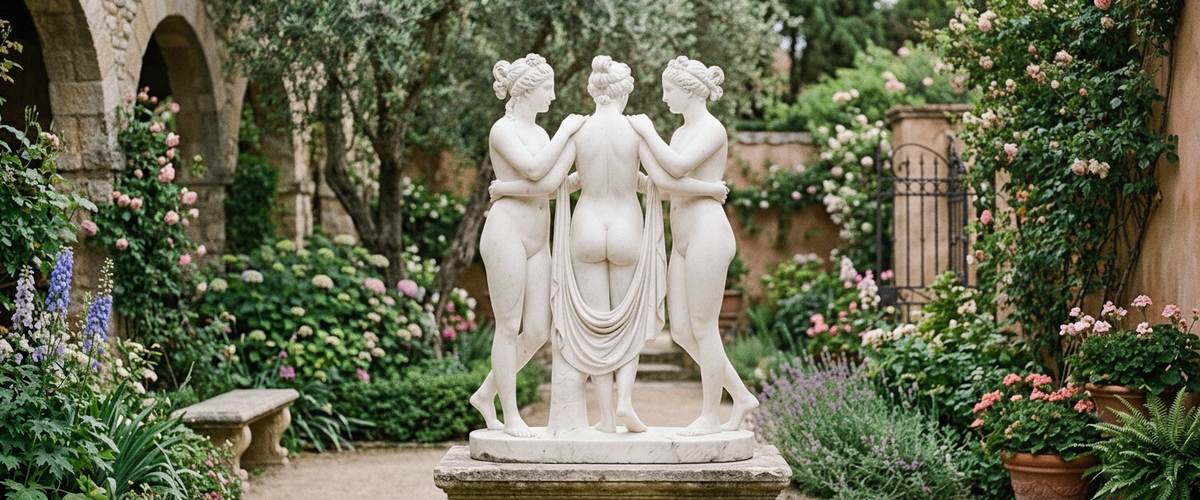

Most buyers pick a three graces marble sculpture from one front-on photograph, then install it hard against a wall. That single decision throws away about two thirds of the carving. The group was designed for orbit, not for frontage; the three figures interlock so that every few steps you take, the silhouette breaks apart and reassembles into something new. Get the setting wrong and you own an expensive relief. Get it right and you own three sculptures in one footprint.

Key Takeaways
The group changes composition roughly every 120 degrees, so it needs a setting you can walk all the way around.
Every version has one weak viewpoint where arms and shoulders read as a single mass. Find it before you install, then aim it at your least-used approach.
Alcoves and niches flatten the group. Stair landings only partly rescue it.
The gaps between the figures carry the composition; keep the backdrop simple so those voids stay legible.
Plinth height decides whether a viewer ten paces away reads hips, shoulders or faces.
Light the gaps from two low angles rather than flooding the front, or the group goes flat after dark.
Three Bodies, Three Silhouettes: The Group Rewrites Itself Every 120 Degrees
The classical trio (Aglaia, Euphrosyne and Thalia in the Greek sources) has been carved, frescoed and cast for well over two thousand years, and the reason it survived is structural rather than sentimental. Two figures face out, one turns away. Arms cross behind shoulders. The result is a composition with no true back, which is exactly why Antonio Canova's version is shown in the round rather than set against a wall by the National Galleries of Scotland, joint owner of the work with the V&A.
Walk 120 degrees around a good carving of the group and the read changes completely: the outward-facing pair gives you symmetry and open chest lines, while the reverse gives you the long S-curve of the turned back and a much quieter, more sculptural mass. Buyers who only ever see the catalogue angle of a three graces marble sculpture are surprised by how different the piece feels in the flesh. That is the point of the subject.
Turntable studies at 30-degree steps reveal how the group reassembles as you walk.
The Dead Angle Nobody Plans For
Every three-figure group has one viewpoint where the arms and shoulders tangle into a single lump of stone. Limbs overlap, the negative space closes, and for a metre or two of walking the sculpture loses its clarity. This is not a carving fault; it is geometry. Three bodies in a circle will always produce one congested sightline.
In the studio we photograph large groups on a turntable at 30-degree steps before sign-off, and the dead angle shows up immediately on the contact sheet. Do the same on site with your phone before the crane leaves. Then rotate the piece so that the congested view faces your service path, the garage run, the boundary hedge, anywhere people pass through rather than pause. Aim the two strongest reads at the approach from the house and the approach from the drive.
Why an Alcove Kills the Group and a Stair Landing Only Half Rescues It
A wall niche does something brutal to this subject: it compresses a fully modelled three graces marble sculpture into a shallow tableau and hides the turned figure entirely. You lose the interlocking arms, the gaps, and the reason the composition exists. Niches suit single standing figures and busts; browse our marble busts and torsos if a recessed wall is genuinely the only spot available.
Stair landings are the halfway house. A landing gives you two elevations, one looking up from the flight below and one at eye level, which is more than a wall ever offers. What it rarely gives you is a full walk-around, so you get perhaps 180 degrees of travel. If a landing is your site, choose a version where the turned figure faces the ascending flight. That way the surprise arrives as the viewer climbs.

Rotunda, Garden Circle or Lawn Island: Settings That Give You the Full Orbit
The settings that flatter this subject all share one trait: continuous circulation. A stair rotunda with a balustrade. A gravel roundel at the crossing of four garden paths. A mown island in a lawn with grass on every side. An entrance court where cars sweep around a central bed.
A gravel roundel gives the full orbit; dark hedging keeps the voids legible.
Scale follows circulation. At full height, The Three Graces Marble Sculpture, 230cm stands roughly 7 ft 6 in (2.3 m) before the plinth, and a group of that size wants a clear walking radius of at least one and a half times its total height, otherwise viewers are craning rather than reading. We shipped a group of this scale to a hillside garden in Napa, where the client set it on a compacted gravel circle at the pivot of three vineyard paths; it now reads as the reason those paths meet where they do.
One material note for exposed sites. Marble is calcareous and reacts to acid rain, de-icing salts and freeze-thaw cycling, which is why Historic England's stone guidance is blunt about surface loss on carved detail. Salt-laden coastal plots and high-altitude mountain gardens punish fine carving. Where the climate is that aggressive, a cast version keeps the same composition without the surface risk, and Large Classical Three Graces Bronze Sculpture, 220cm sits at a comparable height while handling salt spray and hard winters with a patina rather than pitting.
Negative Space Between the Figures Does More Work Than the Figures Themselves
Squint at any strong photograph of the group and what you actually see are the voids: the triangle under the linked arms, the slot between two hips, the gap where the turned figure separates from her companions. Those shapes are the composition. They only work if something clean sits behind them.
Dark evergreen hedging is the reliable choice because it turns the gaps into crisp light shapes. Open sky works beautifully when the plinth lifts the group above the horizon line. Busy mixed borders, pale rendered walls and glazing with reflections all do the opposite; the voids fill with visual noise and the three figures merge. When we survey a site, backdrop is the first thing we assess, before plinth or lighting.
Plinth Height Decides What You Read from Ten Paces
Height is a storytelling tool, not a mounting detail. Put the group low and the eye lands on hips and the sweep of the drapery. Raise it and you read shoulders and the linked arms. Raise it further and you read faces against sky, which is the grandest option and the least intimate.
For garden circles we usually recommend a plinth that brings the figures' shoulder line close to a standing adult's eye level at ten paces. Indoors the calculation tightens considerably: at roughly 3 ft 3 in, The Three Graces Marble Sculpture, 100cm changes character completely depending on whether it sits on a 2 ft or a 4 ft base, so decide the viewing distance first and work backward. Our studio can cut a matching stone plinth as part of the commission, which avoids the common mistake of a fine carving perched on an off-the-shelf base that fights it.

Lighting the Gaps, Not the Fronts
A single floodlight aimed at the front of the group is the fastest way to lose everything you just paid for. Frontal light erases shadow, the voids stop reading, and three figures collapse into one pale shape. Cross-light instead: two low-output fittings set roughly 120 degrees apart, grazing across the stone so the gaps stay dark and the modelling keeps its depth. Warm temperatures around 2700K flatter white marble; cooler light makes it look clinical. Add a third soft source only if the dead angle needs rescuing.
Before You Commission a Three Graces Marble Sculpture
Circulation: can people physically walk 360 degrees around the piece, or are you buying two thirds of it?
Backdrop: is there a clean dark mass or open sky behind the gaps?
Orientation: have you identified the dead angle and pointed it away from the main approach?
Foundation: marble at this scale is heavy, so confirm ground bearing, a reinforced pad and crane or gantry access before delivery day.
Plinth: matched stone, correct height for your viewing distance, with a drainage detail so water does not sit at the base.
Climate: hard winters, coastal salt or heavy pollution may point toward bronze or a sheltered position.
Care: annual soft wash with clean water and pH-neutral cleaner, no acidic products, no pressure washing on carved detail.
Budget: cost depends on stone grade, scale, carving complexity, base work, engineering and installation. Ask for a tailored quote rather than guessing from a comparable piece.
A three graces marble sculpture rewards planning more than almost any other classical subject, because the composition only pays out when the viewer moves. If you are weighing options, start with the wider marble sculptures and statues range and our sculpture placement and care guides, then talk to Giant Sculptures about scale, stone and plinth as one conversation. We carve, engineer and ship large-scale bespoke commissions worldwide, and the siting advice comes as part of the job.
For wider placement ideas, Garden Deer Statues Resin: What Lasts Outdoors and What Quietly Fails is useful companion reading before finalizing the setting and sightlines for a marble statue Three Graces group.