





































































































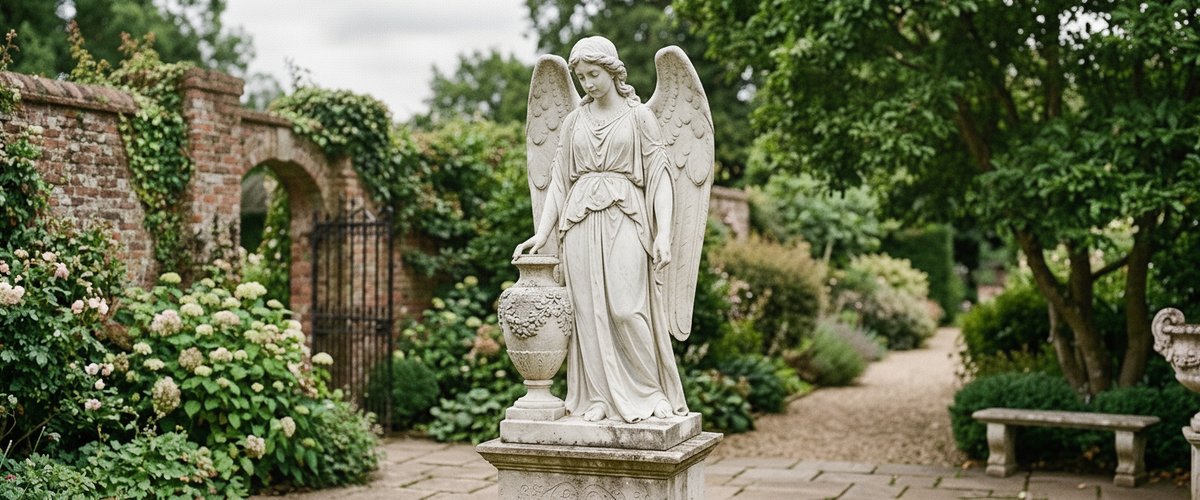

Anyone who has shopped for guardian angel statues and sculptures and memorial figures has seen plenty that disappoint once they reach a garden. Most fail for one reason: nobody decided what the angel was looking at. The carving can be superb and the drapery beautifully cut, yet a figure gazing at a fence post reads as lost rather than protective. This guide is about where that gaze should fall, and how pose, wing position, eye height and backdrop decide whether guardian angel statues and sculptures look watchful or simply misplaced. At Giant Sculptures we ask about the gaze before we ask about material, because the direction of the eyes carries the whole meaning.
At a Glance
Downward gaze: needs a subject close by, such as a bench, a bed of planting or a grave.
Outward gaze: needs distance, ideally the end of a path or a long view.
Folded wings suit open ground; spread wings want a wall or hedge behind them.
Eye height: set the eyes at or just above standing eye level, or the figure looks sullen.
Material: guardian angel sculptures in marble, granite and bronze all last outdoors; climate and finish decide between them.

From Baroque Chapels to Victorian Cemeteries: Why the Guardian Angel Learned to Look Down
Earlier angels in European art tend to announce good news or look heavenward. The Counter-Reformation's growing devotion to the guardian angel gave Baroque sculptors a more personal subject: a protective figure attending to one individual, often a child. That shift from proclamation to attention laid the ground for the downturned head seen on guardian angel statues, sculptures and reliefs ever since.
The Victorian cemetery made it a fixture. As the rural cemetery movement spread through landscaped grounds such as Mount Auburn Cemetery in Cambridge, Massachusetts, marble angels were placed to bow over individual graves, often with a hand resting on a wreath or an urn. Designed for a specific plot, they were meant to be read from a few steps away. That history still shapes how guardian angel sculptures behave in a modern garden.
A Downward Gaze Needs Something to Watch Over
A bowed head is an instruction to the viewer: look where I am looking. If there is nothing there, the pose collapses. Pair a bowed guardian angel statue with a bench, a planted bed, a small water bowl or a memorial stone, and keep that subject within the angel's natural sight line, usually a short distance in front and slightly below.
Smaller guardian angel sculptures make this easier than people expect. At 50cm (about 20 in), a quiet bronze such as the Contemporary Contemplative Angel Bronze Sculpture - 50cm sits comfortably on a low stone wall beside a reading bench, close enough that the person sitting becomes the thing being watched. Put a figure of that size in the middle of a lawn and it simply shrinks.

An Outward Gaze Wants Distance: Guardian Angel Statues and Sculptures at the End of a Path
Guardian angel sculptures with a level or lifted head, arms open or a hand raised, behave like sentinels. They need space in front of them to look into. The classic placement is the terminus of a path or allée, so the figure greets you on approach and seems to keep watch over the whole route. A gravel walk in the Hamptons or a long lawn edged with lavender in Napa suits this well.
The rule of thumb we give clients: the longer the approach, the larger the figure. For guardian angel statues and sculptures seen from 60 feet (about 18 m) away, the silhouette still has to read at that distance, which usually means life-size or above on a proper base. When comparing our angel statues and sculptures, judge each one by the viewing distance rather than the photograph.
Folded Wings for Open Ground, Spread Wings Against a Sheltering Wall
Folded wings give a compact, vertical outline that reads cleanly from every side. That makes them the safer choice for guardian angel statues in freestanding positions on open lawns, in courtyards viewed from several doors, or anywhere exposed to wind.
Spread wings are dramatic, but against open sky or busy planting the feather detail disappears. Give them a backdrop such as a clipped yew hedge or a limestone wall. The same logic applies to any tall winged bronze. Set against a terrace wall, the Classical Winged Angel Candelabra Bronze Sculpture - 190cm, at 190cm (about 6 ft 3 in), has its wing profile framed by the stone, and the bronze catches low evening light against it. On bespoke spread-wing commissions we also plan the internal armature early, since broad wing tips in bronze or stone need proper engineering as well as careful carving.

Eye-Level Mistakes: Why a Watching Angel Set Too Low Looks Like It Is Sulking
The most common installation error we see is height. A downward-gazing guardian angel statue placed straight onto gravel ends up staring at the ground a foot in front of its own toes. The effect is petulant, and any sense of protection drains away.
Clients regularly send us photographs of exactly this: a fine marble figure set directly onto a paved circle, looking faintly embarrassed. Raising it on a plinth so the eyes sit just above a standing adult's eye line, roughly 5 ft 3 in (160 cm) and up, turns the gaze onto visitors rather than the paving. The sculpture does not change. Its relationship to people does.
Memorial Corners That Read as Considered
Memorial guardian angel statues and sculptures need a clear approach and a plinth scaled to the figure, with planting that frames without swallowing. Lay a short path or stepping stones so visitors arrive from the front, where the face and gaze make sense. Choose low evergreens, such as boxwood or germander, that hold their shape in winter, and keep taller shrubs behind the figure.
Larger family plots and estate memorials can carry more than a single figure. A composed group such as the Angel and Mourner Marble Memorial Monument - 300cm, at 300cm (about 9 ft 10 in), tells its own story, so it needs generous clearance on all sides for the pairing to read as one scene rather than two crowded figures. Marble gives the soft, luminous surface people associate with Victorian memorials; granite is harder-wearing in freeze-thaw climates; bronze weathers to a patina and suits anyone who prefers darker tones.

Buyer Checklist Before You Choose or Commission
Name the subject of the gaze before choosing a pose for any guardian angel sculpture.
Measure the viewing distance from the main approach and scale the figure to it.
Check the backdrop: spread wings need a wall or hedge; folded wings can stand free.
Set eye height deliberately and budget for a plinth as part of the piece.
Match material to climate: granite or bronze for hard winters, marble where the finish matters most.
Plan access for delivery and lifting equipment, especially for monument-scale stone.
Ask for a tailored quote: budget depends on material, scale, complexity, engineering, installation and finishing.
If none of our existing bronze angel and cherub statues fits the gaze, height or wing position your site needs, a bespoke commission lets us adjust the head angle, wing spread and base together. Send us photographs of the space and the view you want the angel to hold, and we will advise on scale and material for guardian angel statues and sculptures or memorial pieces that feel as if they were always meant to stand there.
For wider placement ideas, Bronze Angel Statues for Sale: How to Read a Cast Before You Buy is useful companion reading before finalizing the setting and sightlines for your guardian angel sculptures.