














































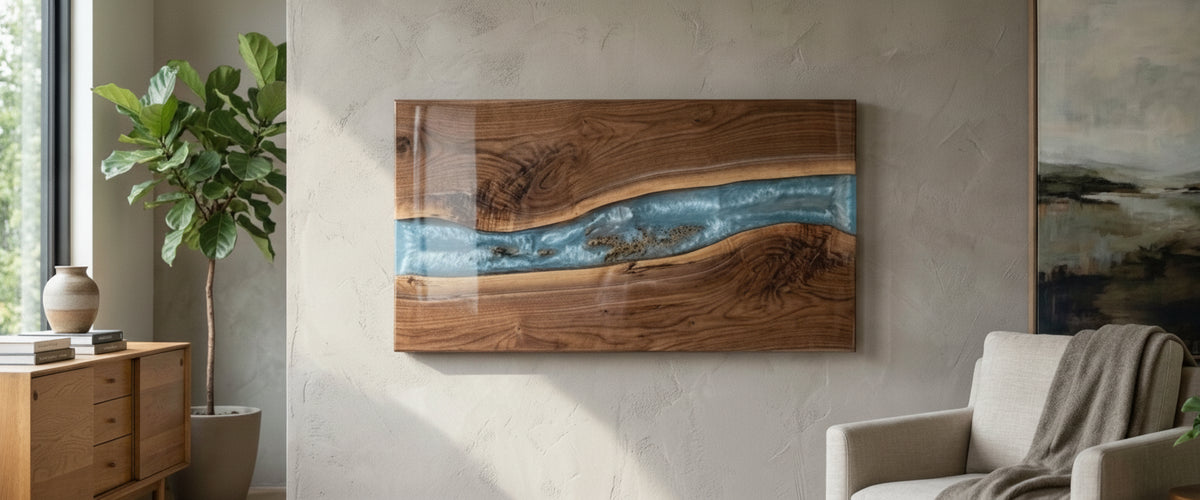

The first thing sunlight damages on a wood and resin piece is the clearest part of the pour. It drifts from water-white to pale straw while the timber beside it still looks freshly oiled. So can wood resin art hang in sunlight? It can, with conditions. Direct sun on a south- or west-facing wall will age it faster than almost anything else in the house, and the damage only adds up. The right resin spec and a smarter choice of wall usually let a bright room keep its piece.
Looking for the full range in this category? Browse our Resin Sculptures & Statues collection for every available finish, size, and configuration.

Quick Answer: Can Wood Resin Art Take Direct Sun?
Resin shows damage first. Standard clear resin yellows under UV well before most timber visibly fades.
Orientation matters more than room brightness. West and south walls carry the highest risk in US homes; north light is the gentlest.
Heat is the hidden problem. Daily warming and cooling stresses the seam where wood meets resin.
UV-stabilized resin slows yellowing. It slows how fast wood resin art can turn amber; it does not stop it.
Placement fixes most of it. Window film, side walls and indirect light do more than any polish.
Sunlight Yellows the Resin Before It Fades the Wood
Ultraviolet light breaks down the polymer chains in epoxy, and the byproducts absorb blue light. The result is that familiar amber cast. Wood fades too, but its natural warmth disguises the change for years. Clear resin has nowhere to hide, which is why wood resin art can look healthy on the timber side long after the pour has turned. The Canadian Conservation Institute's guidance on light as an agent of deterioration makes the point that light damage is cumulative and irreversible, which is exactly how yellowed resin behaves.
The thinnest, clearest passages show it first. On a clear drip wall piece such as the Gold Hand Holding Clear Resin Drip Wall Sculpture - 57cm, at 57 cm (roughly 22 inches), the whole effect depends on that glassy drip reading as liquid, so a beam of afternoon sun would register there before anywhere else. With tinted or pigmented pours, wood resin art can hide yellowing much longer. If your room is bright, a colored pour like the Ocean Blue Resin Splash & Character Wall Relief - 40cm will disguise slow color change far better than a water-white one.
South, West, East or North: How Each Window Changes the Risk
Clients often ask: can a wood and resin art sculpture hang in sunlight without changing? Our first question back is always which way the window faces, because the same piece ages at very different rates depending on orientation. For homes in the Northern Hemisphere, here is how we rank exposure:
West-facing: the worst case. Low, hot afternoon sun reaches deep into the room just as the house is warmest.
South-facing: long hours of light, though a high summer sun rarely reaches far into the room. Winter's lower sun is when it crosses to the opposite walls.
East-facing: morning sun is cooler and shorter. Manageable for most pieces with a sheer or film.
North-facing: steady, indirect light. The safest home for clear resin, and where wood resin art can hang for years with little visible change.
A side wall keeps the clear pour in bounce light rather than the direct beam.
Can wood resin art survive opposite a west window? Not for long. The pattern is predictable: a client picks that wall because it is the obvious focal point, and within a couple of summers the clear edge has warmed to honey while the walnut looks unchanged. The fix is usually a side wall in the same room, or a move to a north-facing study.

The Bond Line Opens Where Heat Cycles Hit Hardest
Wood and resin expand at different rates. Wood also swells and shrinks with humidity, which resin ignores. A sunlit wall heats the piece through the afternoon, then the room cools overnight, and the seam between the two materials takes that strain every day. Over enough seasons, wood resin art can separate at that seam even when both surfaces look fine.
When a sun-exposed piece comes back to the studio for inspection, the bond line is the first place we look. The early sign is a fine white hairline along the joint, sometimes with dust caught inside. Thick pours suffer more than thin inlays. That matters most for blocky castings, where a large mass of clear resin meets a natural surface such as timber or stone. Keep pieces like this away from hot glass and heating vents.
The white hairline along the joint is the earliest sign of sun-driven heat stress.
UV-Stabilized Resin vs Standard Casting Resin: The Spec Line That Matters
Most casting resins carry the phrase "UV resistant" somewhere in their marketing. That tells you very little. The line worth asking about is whether the formula contains UV absorbers or hindered amine light stabilizers (HALS). These slow the chemical breakdown that causes yellowing. Ask your maker how wood resin art can be protected beyond the base pour: a UV-protective topcoat adds another layer and can be renewed later.
So can wood resin art be sun-proofed by spec alone? No. Even with good stabilizers, it can still yellow in direct sun; it simply takes longer. If a supplier promises it never will, treat that as a warning. Kiln-dried, sealed timber matters just as much, because wet or unsealed wood keeps moving and stresses the bond line no matter how good the resin is.
Placements That Let a Sunny Room Keep Its Piece
For wider placement ideas, Large Wooden Wall Art Is Heavier Than You Think: How to Hang It Right is useful companion reading before finalizing the setting and sightlines.
Can wood resin art live happily in a bright room? Usually. You rarely need to banish a piece; you need to move it out of the beam.
Window film: modern films block most UV while barely changing visible light. The US Department of Energy notes in its guide to window attachments that films also cut solar heat gain, which helps the bond line too.
Side walls: a wall perpendicular to the window gets bounce light rather than direct rays.
Indirect bounce: resin glows beautifully in reflected light. You lose very little visual impact.
Sheers on west glass: close them through the late afternoon in summer.
If the only wall you love sits in full sun, wood resin art can be the wrong call, so consider a different material. For that wall, an all-timber composition such as the Aeris Multi-Coloured Wooden Sphere 3D Wall Art is the more forgiving choice: it will still fade gradually, but there is no clear resin to turn amber. For sun-drenched atriums, terraces or pool houses, bronze, stainless steel and Corten are the materials we commission for permanent sun exposure. Shaded walls suit our resin art collection, while brighter ones are better served by wood wall art.

A Buyer's Checklist Before You Hang It
Note which way the wall faces and when direct sun reaches it.
Ask whether the resin contains UV stabilizers or HALS, and whether a UV topcoat was applied.
Confirm the timber was kiln-dried and sealed.
Keep the piece away from heating vents, fireplaces and hot glass.
Check the bond line every few months for white hairlines.
Photograph the clear sections on day one so you can spot slow color change.
For a bespoke wall piece, tell Giant Sculptures where it will hang before we spec it. Wood resin art can hold its looks for a long time in the right spot, and wall orientation changes our choice of resin, finish and sometimes the whole material. Budget depends on scale, complexity and finishing, so request a tailored quote.